115195
论文已发表
注册即可获取德孚的最新动态
IF 收录期刊
- 3.6 Breast Cancer (Dove Med Press)
- 4.3 Clin Epidemiol
- 2.6 Cancer Manag Res
- 3.2 Infect Drug Resist
- 4.1 Clin Interv Aging
- 6.1 Drug Des Dev Ther
- 4.1 Int J Chronic Obstr
- 8.7 Int J Nanomed
- 2.5 Int J Women's Health
- 3.2 Neuropsych Dis Treat
- 2.4 OncoTargets Ther
- 2.6 Patient Prefer Adher
- 2.6 Ther Clin Risk Manag
- 3.1 J Pain Res
- 3.5 Diabet Metab Synd Ob
- 4.5 Psychol Res Behav Ma
- 3.4 Nat Sci Sleep
- 2.4 Pharmgenomics Pers Med
- 2.6 Risk Manag Healthc Policy
- 4.6 J Inflamm Res
- 2.3 Int J Gen Med
- 3.9 J Hepatocell Carcinoma
- 3.3 J Asthma Allergy
- 2.5 Clin Cosmet Investig Dermatol
- 3.0 J Multidiscip Healthc

对中国南方大型转诊眼科中心感染性眼内炎的病原分离和抗生素敏感性的历时九年的分析
Authors Lin L, Mei F, Liao J, Yang Y, Duan F, Lin X
Received 24 October 2019
Accepted for publication 2 February 2020
Published 13 February 2020 Volume 2020:13 Pages 493—500
DOI https://doi.org/10.2147/IDR.S235954
Checked for plagiarism Yes
Review by Single-blind
Peer reviewer comments 3
Editor who approved publication: Dr Eric Nulens
Purpose: To analyze the pathogen spectrum of isolated pathogens and antibiotic susceptibility trends of infectious endophthalmitis over 9 years from a large referral eye center in southern China.
Methods: Data from all inpatients who were clinically diagnosed with infectious endophthalmitis and underwent microbiological evaluation at the Zhongshan Ophthalmic Center from January 2010 to December 2018 were collected retrospectively and analyzed according to different clinical etiologies.
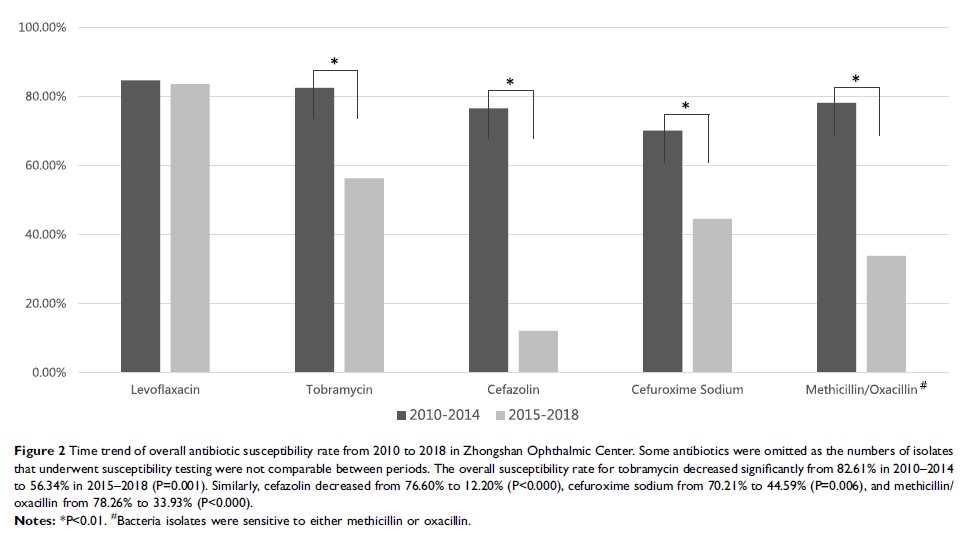
Results: A total of 816 cases were collected in the study. Open-globe injuries had caused 473 (57.97%) cases, 70 (8.58%) cases presented endophthalmitis after infectious keratitis, 156 (19.12%) cases were postoperative, and endogenous causes accounted for 117 (14.34%) cases. Among the 309 culture-positive cases, the predominant pathogen for both postoperative and posttraumatic endophthalmitis was gram-positive cocci (59.52% and 49.72%, respectively). Regarding keratitis-related endophthalmitis, the main pathogens were filamentous fungi (57.58%) and gram-negative bacilli (30.30%). The pathogens of endogenous endophthalmitis were almost evenly distributed among gram-positive cocci, gram-negative bacilli, and fungi. Eighty-five (10.42%) cases underwent evisceration/enucleation, including 42 cases secondary to keratitis-related endophthalmitis. The incidence of evisceration/enucleation was much higher in keratitis-related endophthalmitis than the total endophthalmitis population (χ 2 =123.61, P< 0.001). Overall bacteria showed high susceptibility to fluoroquinolones (75.36– 100.00%). Gram-positive cocci showed much higher sensitivity to cephalosporins compared to gram-negative bacilli (85.11– 92.59% vs 25.42– 35.72%). For the five first-line antibiotics analyzed for time trend of susceptibility, four exhibited a significant decrease of susceptibility from 2010– 2014 to 2015– 2018.
Conclusion: Between 2010 and 2018, posttraumatic endophthalmitis was the most common form of the treated endophthalmitis in Zhongshan Ophthalmic Center. The causative pathogens varied according to different clinical settings. Even though the overall antibiotic susceptibilities were fairly high, we observed a substantial decrease of susceptibility for most first-line antibiotics.
Keywords: infectious endophthalmitis, pathogen spectrum, antibiotic resistance, time trend, evisceration/enucleation