115195
论文已发表
注册即可获取德孚的最新动态
IF 收录期刊
- 3.6 Breast Cancer (Dove Med Press)
- 4.3 Clin Epidemiol
- 2.6 Cancer Manag Res
- 3.2 Infect Drug Resist
- 4.1 Clin Interv Aging
- 6.1 Drug Des Dev Ther
- 4.1 Int J Chronic Obstr
- 8.7 Int J Nanomed
- 2.5 Int J Women's Health
- 3.2 Neuropsych Dis Treat
- 2.4 OncoTargets Ther
- 2.6 Patient Prefer Adher
- 2.6 Ther Clin Risk Manag
- 3.1 J Pain Res
- 3.5 Diabet Metab Synd Ob
- 4.5 Psychol Res Behav Ma
- 3.4 Nat Sci Sleep
- 2.4 Pharmgenomics Pers Med
- 2.6 Risk Manag Healthc Policy
- 4.6 J Inflamm Res
- 2.3 Int J Gen Med
- 3.9 J Hepatocell Carcinoma
- 3.3 J Asthma Allergy
- 2.5 Clin Cosmet Investig Dermatol
- 3.0 J Multidiscip Healthc

KLF16 可影响前列腺癌的 MYC 标签和肿瘤生长
Authors Zhang J, Yu W, Wang X, Hu B, Wu D, Shi G
Received 5 October 2019
Accepted for publication 18 January 2020
Published 13 February 2020 Volume 2020:13 Pages 1303—1310
DOI https://doi.org/10.2147/OTT.S233495
Checked for plagiarism Yes
Review by Single-blind
Peer reviewer comments 2
Editor who approved publication: Dr Federico Perche
Background: KLF16, a member of the Kruppel-like factor (KLF) family, functions in the regulation of dopaminergic transmission, metabolism, and endocrinology. However, the role of KLF16 in prostate cancer (PCa) remains unknown.
Methods: We screened the expression of KLFs in PCa based on bioinformatics analysis. The protein levels of KLF16 in PCa specimens were confirmed by immunohistochemistry. Inhibiting KLF16 by RNA interference with shRNA was used to determine the effects of KLF16 on PCa cell growth in vitro and in vivo. RNA sequencing was used to investigate the signaling regulated by KLF16 in PCa. Bioinformatics analysis was also used to determine the possible correlations of KLF16 and signaling in PCa cohorts.
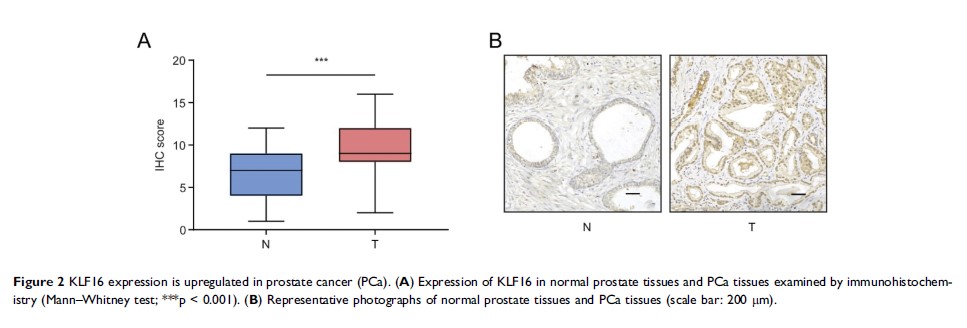
Results: Bioinformatics analysis showed that KLF16 may be required for PCa development. Notably, the expression of KLF16 was elevated in human PCa tissues. In vitro and in vivo experiments both demonstrated that depleting KLF16 significantly inhibited the growth of PCa cells. Downregulation of KLF16 significantly decreased the expression of MYC signaling in PCa cells. Furthermore, KLF16 expression was correlated with MYC signaling activity.
Conclusion: KLF16 was overexpressed in PCa tissues compared to normal tissues. KLF16 knockdown suppressed PCa cell growth in vitro and in vivo, and a deficiency of KLF16 inhibited activation of MYC signaling.
Keywords: Kruppel-like factor, KLF16, prostate cancer, MYC