115195
论文已发表
注册即可获取德孚的最新动态
IF 收录期刊
- 3.6 Breast Cancer (Dove Med Press)
- 4.3 Clin Epidemiol
- 2.6 Cancer Manag Res
- 3.2 Infect Drug Resist
- 4.1 Clin Interv Aging
- 6.1 Drug Des Dev Ther
- 4.1 Int J Chronic Obstr
- 8.7 Int J Nanomed
- 2.5 Int J Women's Health
- 3.2 Neuropsych Dis Treat
- 2.4 OncoTargets Ther
- 2.6 Patient Prefer Adher
- 2.6 Ther Clin Risk Manag
- 3.1 J Pain Res
- 3.5 Diabet Metab Synd Ob
- 4.5 Psychol Res Behav Ma
- 3.4 Nat Sci Sleep
- 2.4 Pharmgenomics Pers Med
- 2.6 Risk Manag Healthc Policy
- 4.6 J Inflamm Res
- 2.3 Int J Gen Med
- 3.9 J Hepatocell Carcinoma
- 3.3 J Asthma Allergy
- 2.5 Clin Cosmet Investig Dermatol
- 3.0 J Multidiscip Healthc

外泌体长非编码 RNA CEBPA-AS1 抑制肿瘤细胞凋亡,并作为诊断胃癌的非侵袭性生物标记物
Authors Piao H, Guo S, Wang Y, Zhang J
Received 15 November 2019
Accepted for publication 25 January 2020
Published 14 February 2020 Volume 2020:13 Pages 1365—1374
DOI https://doi.org/10.2147/OTT.S238706
Checked for plagiarism Yes
Review by Single-blind
Peer reviewer comments 2
Editor who approved publication: Dr Arseniy Yuzhalin
Aim: Traditional non-invasive diagnostic markers for gastric cancer (GC) exhibit insufficient sensitivity and specificity. Circulating exosomes are clinically useful non-invasive biomarkers for tumor diagnosis. In addition to their potential role in cancer biology, circulating long non-coding RNAs (lncRNAs) are a new class of promising cancer biomarkers. In the present study, we aimed to identify lncRNAs in circulating exosomes with potential as biomarkers for GC detection.
Methods: We compared the expression of CEBPA-AS1 between GC cells and gastric epithelial cells. The biological function of exosomal CEBPA-AS1 was determined by cell phenotype experiments and rescue assays. We also compared the expression of CEBPA-AS1 in cancerous tissue from GC patients and corresponding adjacent normal tissues, as well as the expression of CEBPA-AS1 in plasma exosomes of GC patients and healthy controls. Diagnostic accuracy was assessed by the receiver operating characteristic (ROC) curve and area under the curve (AUC).
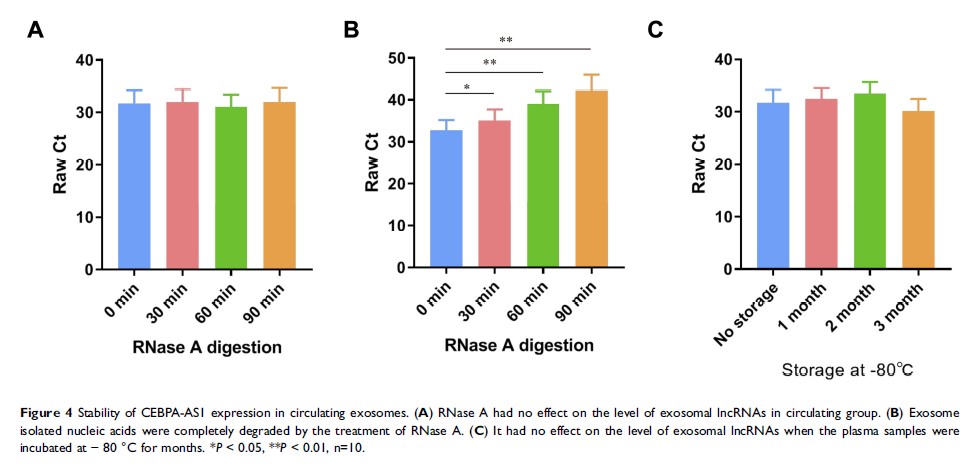
Results: CEBPA-AS1 was highly expressed in both GC cells and in exosomes secreted by GC cells. In addition, CEBPA-AS1-containing exosomes secreted by GC cells could promote cell proliferation and inhibit apoptosis, thereby inducing the malignant behavior of GC cells. The level of CEBPA-AS1 was also significantly increased in tissues and plasma exosomes of GC patients. Stability tests showed that most plasma CEBPA-AS1 was encased in exosomes, thus avoiding degradation by RNases. We evaluated the diagnostic accuracy of exosome-derived CEBPA-AS1. The AUC value of CEBPA-AS1 in discriminating GC patients from healthy controls was 0.824, which was higher than the diagnostic accuracy of other traditional tumor biomarkers.
Conclusion: CEBPA-AS1-containing exosomes secreted from GC cells could promote cell proliferation, inhibit apoptosis, and induce GC progression, indicating that exosomal CEBPA-AS1 is involved in cell-to-cell communication in GC carcinogenesis. Exosomal CEBPA-AS1 is a promising new biomarker for clinical diagnosis of GC.
Keywords: gastric cancer, exosome, lncRNAs, CEBPA-AS1, diagnosis