115195
论文已发表
注册即可获取德孚的最新动态
IF 收录期刊
- 3.6 Breast Cancer (Dove Med Press)
- 4.3 Clin Epidemiol
- 2.6 Cancer Manag Res
- 3.2 Infect Drug Resist
- 4.1 Clin Interv Aging
- 6.1 Drug Des Dev Ther
- 4.1 Int J Chronic Obstr
- 8.7 Int J Nanomed
- 2.5 Int J Women's Health
- 3.2 Neuropsych Dis Treat
- 2.4 OncoTargets Ther
- 2.6 Patient Prefer Adher
- 2.6 Ther Clin Risk Manag
- 3.1 J Pain Res
- 3.5 Diabet Metab Synd Ob
- 4.5 Psychol Res Behav Ma
- 3.4 Nat Sci Sleep
- 2.4 Pharmgenomics Pers Med
- 2.6 Risk Manag Healthc Policy
- 4.6 J Inflamm Res
- 2.3 Int J Gen Med
- 3.9 J Hepatocell Carcinoma
- 3.3 J Asthma Allergy
- 2.5 Clin Cosmet Investig Dermatol
- 3.0 J Multidiscip Healthc

谷氨酰胺和乌司他丁联合治疗可大大改善对败血症的疗效
Authors Wang J, Zhou J, Bai S
Received 10 October 2019
Accepted for publication 10 December 2019
Published 19 February 2020 Volume 2020:13 Pages 109—115
DOI https://doi.org/10.2147/JIR.S234122
Checked for plagiarism Yes
Review by Single-blind
Peer reviewer comments 2
Editor who approved publication: Dr Ning Quan
Background: Sepsis is one of the most dangerous syndromes, has extremely high mortality, and is caused by the body’s extreme responses to an infection. The pathogenesis of sepsis is very complex and remains largely unknown and thus the treatments for sepsis are limited. Here, we evaluated the treatment results of two potential drugs, glutamine and ulinastatin, on sepsis.
Methods: CLP rat model was used to study sepsis. Gastrostomy was performed to deliver the drugs. Flow cytometry was employed to measure CD4 and CD8 levels. May–Grünwald–Giemsa staining was used to count the numbers of monocytes and neutrophils in the blood. ELISA assay was performed to assess the levels of PCT, IL-6, TNFα, and IL-1β.
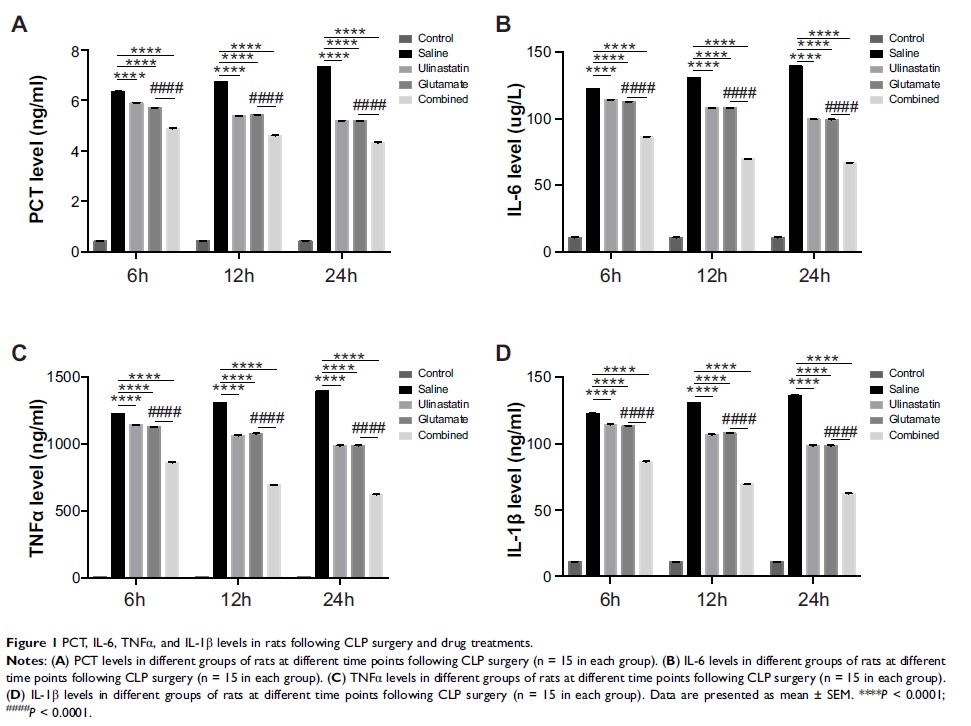
Results: Sepsis was successfully induced with the standard CLP rat model. Both glutamine and ulinastatin treatments greatly improved the outcomes of sepsis, but the combination of both treatments had the maximum therapeutic effect. Mechanistically, PCT, IL-6, TNFα, and IL-1β levels were significantly diminished following glutamine and ulinastatin treatments, suggesting an inhibition of inflammatory responses. Further, CD4 and CD4/CD8 ratio, and the numbers of monocytes and neutrophils were greatly up-regulated by glutamine and ulinastatin, indicating an enhanced immunity.
Conclusion: Glutamine and ulinastatin treatments largely mitigate sepsis shock by suppressing the inflammatory responses of the body and strengthening the immune system. Combination of these two drugs could serve as a potential treatment for sepsis.
Keywords: sepsis, glutamine, ulinastatin, inflammation, immune function