115195
论文已发表
注册即可获取德孚的最新动态
IF 收录期刊
- 3.6 Breast Cancer (Dove Med Press)
- 4.3 Clin Epidemiol
- 2.6 Cancer Manag Res
- 3.2 Infect Drug Resist
- 4.1 Clin Interv Aging
- 6.1 Drug Des Dev Ther
- 4.1 Int J Chronic Obstr
- 8.7 Int J Nanomed
- 2.5 Int J Women's Health
- 3.2 Neuropsych Dis Treat
- 2.4 OncoTargets Ther
- 2.6 Patient Prefer Adher
- 2.6 Ther Clin Risk Manag
- 3.1 J Pain Res
- 3.5 Diabet Metab Synd Ob
- 4.5 Psychol Res Behav Ma
- 3.4 Nat Sci Sleep
- 2.4 Pharmgenomics Pers Med
- 2.6 Risk Manag Healthc Policy
- 4.6 J Inflamm Res
- 2.3 Int J Gen Med
- 3.9 J Hepatocell Carcinoma
- 3.3 J Asthma Allergy
- 2.5 Clin Cosmet Investig Dermatol
- 3.0 J Multidiscip Healthc

蛋白精氨酸甲基转移酶 4 可调节 1 型糖尿病小鼠脂肪组织的脂解
Authors Li Y, Peng M, Zeng T, Zheng J, Liao Y, Zhang H, Yang S, Chen L
Received 25 October 2019
Accepted for publication 10 February 2020
Published 26 February 2020 Volume 2020:13 Pages 535—544
DOI https://doi.org/10.2147/DMSO.S235869
Checked for plagiarism Yes
Review by Single-blind
Peer reviewer comments 2
Editor who approved publication: Dr Antonio Brunetti
Purpose: Hypertriglyceridemia is considered to be driven by increased lipolysis in type 1 diabetes mellitus (T1DM). However, information regarding the transcriptional circuitry that governs lipolysis remains incomplete in T1DM. Protein arginine methyltransferase 4 (PRMT4), a transcriptional coactivation factor, promotes autophagy and may play an important role in lipolysis. We wonder whether activated lipolysis in T1DM is regulated by PRMT4.
Materials and Methods: Recombinant adeno-associated virus was adopted to overexpress PRMT4 in adipose tissue of mice. Streptozotocin (150 mg/kg) was injected intraperitoneally into mice to induce T1DM. Plasma insulin, triglycerides, free fatty acids (FFAs) levels were determined using commercial assay kits. Differentiated adipocytes were applied to verify the regulation of PRMT4 on lipolysis.
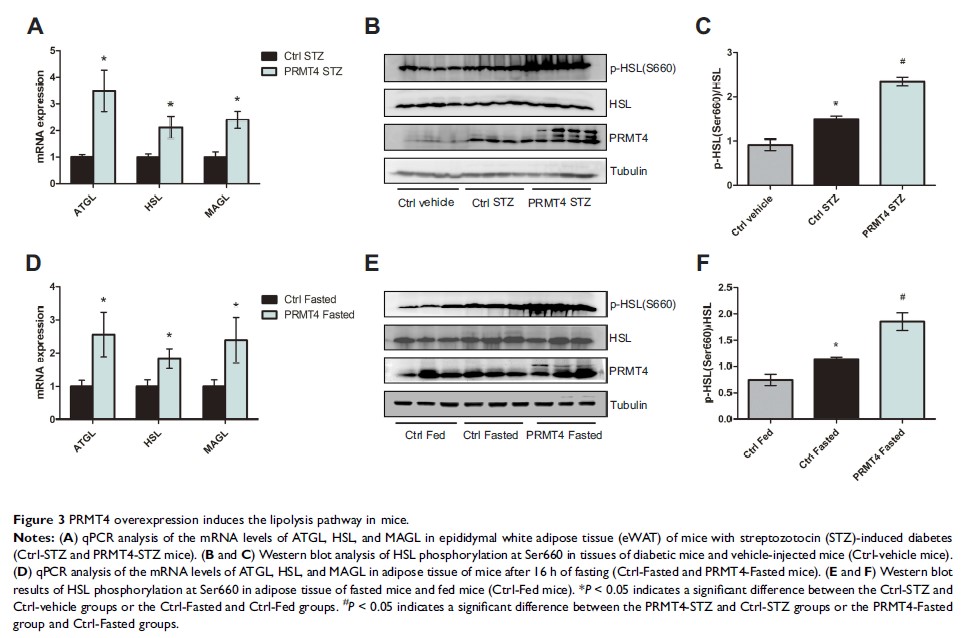
Results: Elevated serum triglycerides and FFAs were observed in PRMT4-overexpressed T1DM mice. We also observed that PRMT4 over-expression induced the decrease of fat pads weights and adipocyte sizes. Moreover, expression levels of lipolysis-related molecules, including ATGL, HSL, and MAGL, and HSL phosphorylation levels were increased in PRMT4-overexpressed mice when compared to those of control mice. In vitro, PRMT4 promoted FFAs release and activated HSL phosphorylation, whereas PRMT4 knockdown inhibited these processes.
Conclusion: PRMT4 promotes lipolysis and increases serum triglyceride in T1DM.
Keywords: type 1 diabetic mice, hypertriglyceridemia, protein arginine methyltransferase 4, lipolysis