115195
论文已发表
注册即可获取德孚的最新动态
IF 收录期刊
- 3.6 Breast Cancer (Dove Med Press)
- 4.3 Clin Epidemiol
- 2.6 Cancer Manag Res
- 3.2 Infect Drug Resist
- 4.1 Clin Interv Aging
- 6.1 Drug Des Dev Ther
- 4.1 Int J Chronic Obstr
- 8.7 Int J Nanomed
- 2.5 Int J Women's Health
- 3.2 Neuropsych Dis Treat
- 2.4 OncoTargets Ther
- 2.6 Patient Prefer Adher
- 2.6 Ther Clin Risk Manag
- 3.1 J Pain Res
- 3.5 Diabet Metab Synd Ob
- 4.5 Psychol Res Behav Ma
- 3.4 Nat Sci Sleep
- 2.4 Pharmgenomics Pers Med
- 2.6 Risk Manag Healthc Policy
- 4.6 J Inflamm Res
- 2.3 Int J Gen Med
- 3.9 J Hepatocell Carcinoma
- 3.3 J Asthma Allergy
- 2.5 Clin Cosmet Investig Dermatol
- 3.0 J Multidiscip Healthc

雾化布地奈德的优化疗法治疗慢性阻塞性肺疾病急性加重
Authors Zhang R, Zhu J, Liu Y, Li Y, Liu W, Zhang M, Chen B, Zhu S
Received 25 October 2019
Accepted for publication 20 December 2019
Published 26 February 2020 Volume 2020:15 Pages 409—415
DOI https://doi.org/10.2147/COPD.S235125
Checked for plagiarism Yes
Review by Single-blind
Peer reviewer comments 2
Editor who approved publication: Prof. Dr. Chunxue Bai
Background: Clinical studies have suggested nebulized budesonide (NB) as an alternative to systemic corticosteroids for patients with acute exacerbation of chronic obstructive pulmonary disease (AECOPD). However, the optimal budesonide dose for AECOPD remains unclear.
Objectives: To compare the efficacy and safety of different doses of NB in the management of AECOPD.
Patients and Methods: A total of 321 AECOPD patients with moderate-to-severe exacerbation were randomly divided into three groups and treated with NB. The low dose group (L) was given 4 mg/day (n=95, 1 mg Q6h), while high-dose group 1 (H1, n=111, 2 mg Q6h) and high-dose group 2 (H2, n=115, 4 mg Q12h) were given 8 mg/day. Patients also received routine treatment including oxygen therapy, expectorant, nebulization bronchodilators, antibiotics, and fluid rehydration. The COPD assessment test (CAT), lung function, and artery blood gas were evaluated before and after 3 hrs and 5 days of treatment. In addition, hospital stay, frequency of acute exacerbations within 3 months of discharge, and adverse events during treatment were compared.
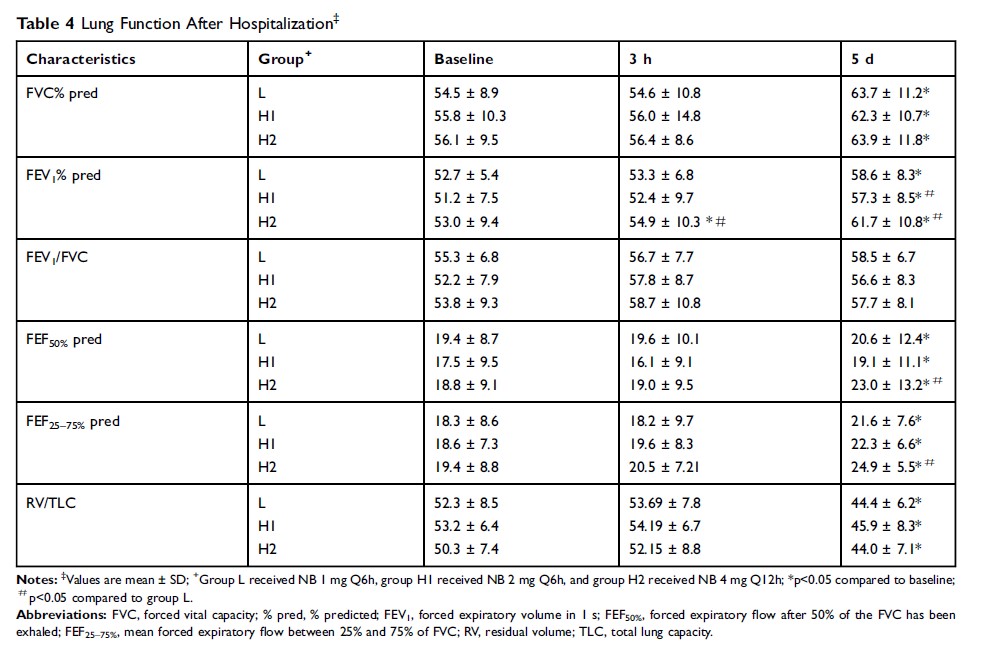
Results: H1 and H2 showed improved spirograms and CAT score faster than L. In H2, forced expiratory volume in 1 s (FEV1%) at 3 hrs and FEV1%, forced expiratory flow after 50% of the forced vital capacity has been exhaled (FEF50%), mean forced expiratory flow between 25% and 75% of forced vital capacity (FEF25– 75%) and CAT score at 5 days were significantly improved compared to L. FEV1% improved most in H2, moderately in H1, and least in L, with significant differences between groups at 5 days. No differences between groups were observed in adverse effects, hospital stay, and frequency of exacerbations within 3 months of discharge.
Conclusion: Compared to the conventional dose (4 mg/day), a high dose (8 mg/day) of NB improved pulmonary function and symptoms more effectively in the early treatment of AECOPD, especially when given as 4 mg twice daily.
Keywords: obstructive pulmonary disease, exacerbation, nebulized budesonide, dose, pulmonary function