115195
论文已发表
注册即可获取德孚的最新动态
IF 收录期刊
- 3.6 Breast Cancer (Dove Med Press)
- 4.3 Clin Epidemiol
- 2.6 Cancer Manag Res
- 3.2 Infect Drug Resist
- 4.1 Clin Interv Aging
- 6.1 Drug Des Dev Ther
- 4.1 Int J Chronic Obstr
- 8.7 Int J Nanomed
- 2.5 Int J Women's Health
- 3.2 Neuropsych Dis Treat
- 2.4 OncoTargets Ther
- 2.6 Patient Prefer Adher
- 2.6 Ther Clin Risk Manag
- 3.1 J Pain Res
- 3.5 Diabet Metab Synd Ob
- 4.5 Psychol Res Behav Ma
- 3.4 Nat Sci Sleep
- 2.4 Pharmgenomics Pers Med
- 2.6 Risk Manag Healthc Policy
- 4.6 J Inflamm Res
- 2.3 Int J Gen Med
- 3.9 J Hepatocell Carcinoma
- 3.3 J Asthma Allergy
- 2.5 Clin Cosmet Investig Dermatol
- 3.0 J Multidiscip Healthc

负载褪黑素的肽功能化磁性纳米平台可有针对性地缓解压力超负荷引起的心肌肥大及纤维化改变
Authors Zhao X, Wang X, Wang J, Yuan J, Zhang J, Zhu X, Lei C, Yang Q, Wang B, Cao F, Liu L
Received 21 October 2019
Accepted for publication 17 February 2020
Published 27 February 2020 Volume 2020:15 Pages 1321—1333
DOI https://doi.org/10.2147/IJN.S235518
Checked for plagiarism Yes
Review by Single-blind
Peer reviewer comments 2
Editor who approved publication: Dr Mian Wang
Introduction: Currently, the unsatisfactory treatment of cardiac hypertrophy is due to the unbridled myocardial fibrosis. Melatonin has been demonstrated to ameliorate cardiac hypertrophy and its accompanied fibrosis in previous studies. But it is not clinically appealing due to its short-lasting time against the hostile microenvironment when administered orally.
Methods: Herein, to address this, poly (lactide) polycarboxybetaine (PLGA-COOH) accompanied by cardiac homing peptide (CHP) and superparamagnetic iron oxide nanoparticles (SPIONs) were used to establish a novel drug delivery and transportation strategy for melatonin via a facile two-step emulsion method. This study characterized these nanoparticles (CHP-mel@SPIONs) and tested their delivery to the hypertrophied heart and their effect on myocardial hypertrophy and fibrosis in an animal model of pressure overload-induced cardiac hypertrophy.
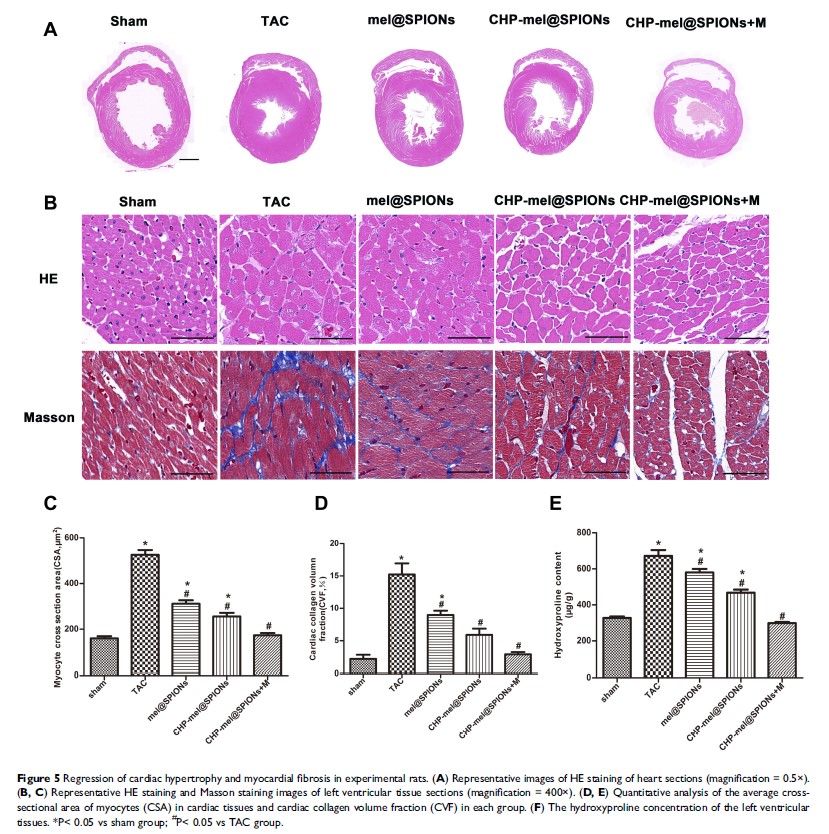
Results: The engineered magnetic nanoparticles of CHP-mel@SPIONs were spherical (diameter = 221 ± 13 nm) and had a negative zeta potential of − 19.18 ± 3.27 mV. The CHP-mel@SPIONs displayed excellent drug encapsulation capacities of SPIONs (75.27 ± 3.1%) and melatonin (77.69 ± 6.04%) separately, and their magnetic properties were characterized by constructing magnetic hysteresis curves and exhibited no remnant magnetization or coercivity. The animal experiments showed that compared with mel@SPIONs, CHP-mel@SPIONs accumulated more in the heart, especially in the presence of an external magnetic field, with in vivo echocardiography and RT-PCR and histological assessments confirming the amelioration of the myocardial hypertrophy and fibrosis with low drug doses.
Conclusion: This simple biocompatible dual-targeting nanoagent may be a potential candidate for the guided clinical therapy of heart disease.
Keywords: magnetic targeting, cardiac homing peptide, cardiac hypertrophy, melatonin, myocardial fibrosis