115195
论文已发表
注册即可获取德孚的最新动态
IF 收录期刊
- 3.6 Breast Cancer (Dove Med Press)
- 4.3 Clin Epidemiol
- 2.6 Cancer Manag Res
- 3.2 Infect Drug Resist
- 4.1 Clin Interv Aging
- 6.1 Drug Des Dev Ther
- 4.1 Int J Chronic Obstr
- 8.7 Int J Nanomed
- 2.5 Int J Women's Health
- 3.2 Neuropsych Dis Treat
- 2.4 OncoTargets Ther
- 2.6 Patient Prefer Adher
- 2.6 Ther Clin Risk Manag
- 3.1 J Pain Res
- 3.5 Diabet Metab Synd Ob
- 4.5 Psychol Res Behav Ma
- 3.4 Nat Sci Sleep
- 2.4 Pharmgenomics Pers Med
- 2.6 Risk Manag Healthc Policy
- 4.6 J Inflamm Res
- 2.3 Int J Gen Med
- 3.9 J Hepatocell Carcinoma
- 3.3 J Asthma Allergy
- 2.5 Clin Cosmet Investig Dermatol
- 3.0 J Multidiscip Healthc

发生 EGFR 扩增的宫颈鳞状细胞癌并肺转移患者从阿法替尼治疗中获益:一份病例报告
Authors Chen Q, Huang Y, Shao L, Han-Zhang H, Yang F, Wang Y, Liu J, Gan J
Received 28 October 2019
Accepted for publication 10 January 2020
Published 28 February 2020 Volume 2020:13 Pages 1845—1849
DOI https://doi.org/10.2147/OTT.S236382
Checked for plagiarism Yes
Review by Single-blind
Peer reviewer comments 2
Editor who approved publication: Dr Carlos E Vigil
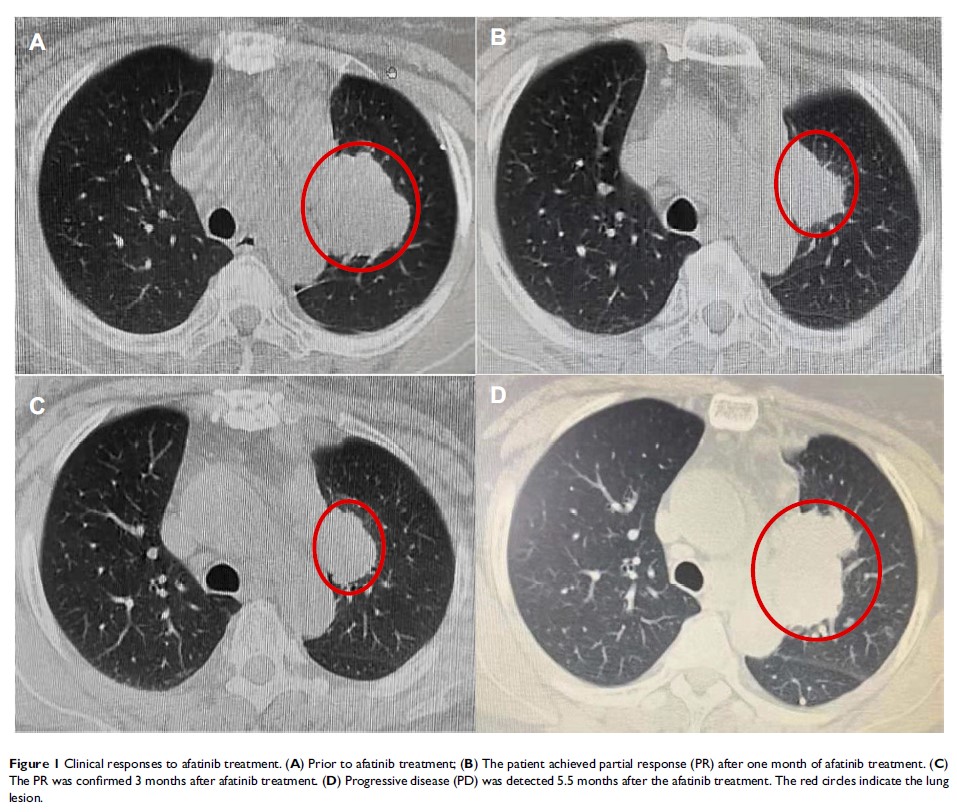
Abstract: Currently, women with metastatic or recurrent cervical cancer still have very limited treatment options. Despite the rapid advancements in targeted therapies, no targeted therapy was approved for cervical cancer, except for bevacizumab. In the present study, we reported a 52-year-old heavily pre-treated EGFR amplified patient with metastatic cervical squamous cancer who benefited from afatinib with a progression-free survival (PFS) of 5.5 months. The patient was administered with a first-line treatment of chemotherapy and bevacizumab with a PFS of 4.3 months. Subsequently the patient was treated with a second-line regimen of angiogenesis inhibitor apatinib plus chemotherapy and a third-line treatment of pembrolizumab. Genomic profiling revealed significant EGFR amplification in both primary (copy number [CN] =15.9) and metastatic lesions (CN =18). Afatinib monotherapy was then administered as the fourth-line regimen. She achieved partial response (PR) with a PFS of 5.5 months. At disease progression, the CN of EGFR was elevated to 39.9 accompanied by the emergence of PIK3CA amplification (CN =4.2). The patient was treated with everolimus and afatinib and achieved stable disease (SD) after 3 months. To the best of our knowledge, this is the first clinical evidence of an EGFR -amplified metastatic cervical cancer patient benefiting from afatinib as a single agent.
Keywords: afatinib, EGFR amplification, cervical squamous carcinoma, EGFR-tyrosine kinase inhibitor, next-generation sequencing