115195
论文已发表
注册即可获取德孚的最新动态
IF 收录期刊
- 3.6 Breast Cancer (Dove Med Press)
- 4.3 Clin Epidemiol
- 2.6 Cancer Manag Res
- 3.2 Infect Drug Resist
- 4.1 Clin Interv Aging
- 6.1 Drug Des Dev Ther
- 4.1 Int J Chronic Obstr
- 8.7 Int J Nanomed
- 2.5 Int J Women's Health
- 3.2 Neuropsych Dis Treat
- 2.4 OncoTargets Ther
- 2.6 Patient Prefer Adher
- 2.6 Ther Clin Risk Manag
- 3.1 J Pain Res
- 3.5 Diabet Metab Synd Ob
- 4.5 Psychol Res Behav Ma
- 3.4 Nat Sci Sleep
- 2.4 Pharmgenomics Pers Med
- 2.6 Risk Manag Healthc Policy
- 4.6 J Inflamm Res
- 2.3 Int J Gen Med
- 3.9 J Hepatocell Carcinoma
- 3.3 J Asthma Allergy
- 2.5 Clin Cosmet Investig Dermatol
- 3.0 J Multidiscip Healthc

Shh 过表达与原发性前列腺癌中 GRP78 和 AR 的表达相关:中国队列研究的临床病理特征和结果
Authors Zhang X, Zhang Y, Lin F, Shi X, Xiang L, Li L
Received 16 September 2019
Accepted for publication 13 February 2020
Published 3 March 2020 Volume 2020:12 Pages 1569—1578
DOI https://doi.org/10.2147/CMAR.S231218
Checked for plagiarism Yes
Review by Single-blind
Peer reviewer comments 2
Editor who approved publication: Dr Beicheng Sun
Introduction: Shh plays an important role in prostate cancer progression, but its correlation with GRP78 and AR is elusive.
Methods: The study included 539 patients in total, of which 443 had primary prostate carcinoma and 96 patients had benign prostatic hyperplasia (BPH). The clinicopathologic features, histologic scores of protein expression, and correlations between protein and disease state were studied in this cohort. Kaplan–Meier and Pearson correlation analyses were used to compare measures between groups. We performed immunohistochemistry to evaluate the expression of the Shh protein in benign prostatic hyperplasia (n=96) and prostate cancer (Gleason scores ≤ 6 [n=399] or ≥ 7 [n=44]). We quantified the expression of Shh, AR, and GRP78 using the weighted histoscore method, studied the correlation between Shh expression and AR and GRP78, and evaluated the impact of Shh protein expression on patient survival.
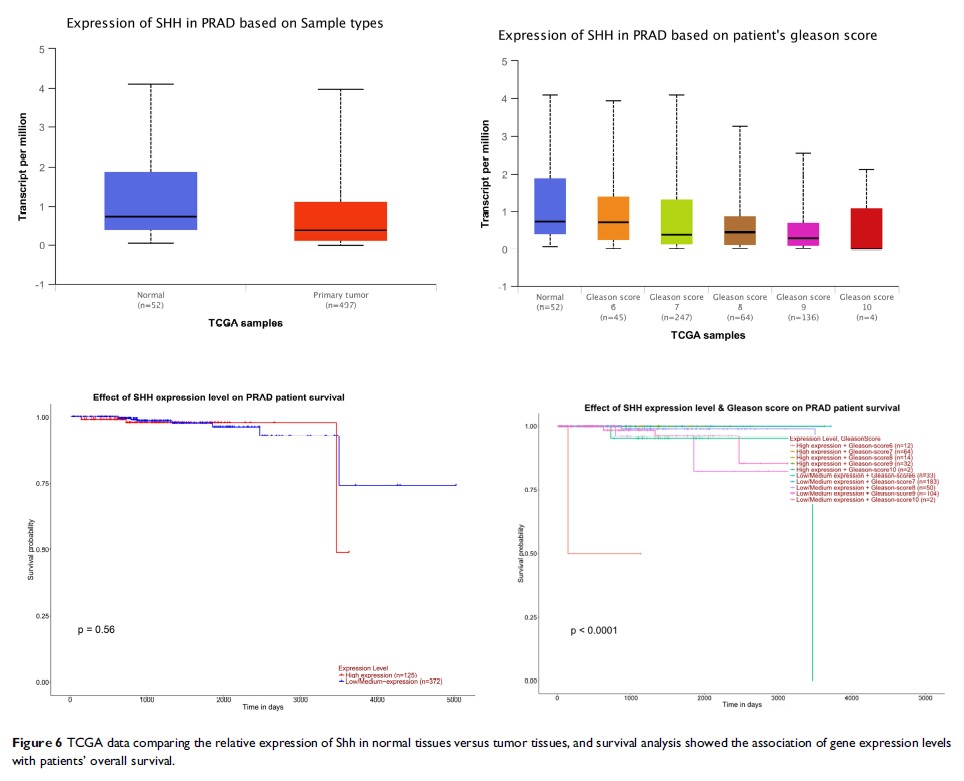
Results: Shh expression was significantly higher in prostate cancer with Gleason scores ≥ 7 than in cancer with lower Gleason scores or benign hyperplasia and was much higher in AR-positive cancer than in AR-negative cancer. Shh is overexpressed in high-grade prostate cancer and is positively correlated with the expression of both GRP78 and AR.
Conclusion: Therefore, Shh may be a useful prognostic marker and therapeutic target for prostate cancer.
Keywords: prostate cancer, GRP78, Shh, AR, survival analysis