115195
论文已发表
注册即可获取德孚的最新动态
IF 收录期刊
- 3.6 Breast Cancer (Dove Med Press)
- 4.3 Clin Epidemiol
- 2.6 Cancer Manag Res
- 3.2 Infect Drug Resist
- 4.1 Clin Interv Aging
- 6.1 Drug Des Dev Ther
- 4.1 Int J Chronic Obstr
- 8.7 Int J Nanomed
- 2.5 Int J Women's Health
- 3.2 Neuropsych Dis Treat
- 2.4 OncoTargets Ther
- 2.6 Patient Prefer Adher
- 2.6 Ther Clin Risk Manag
- 3.1 J Pain Res
- 3.5 Diabet Metab Synd Ob
- 4.5 Psychol Res Behav Ma
- 3.4 Nat Sci Sleep
- 2.4 Pharmgenomics Pers Med
- 2.6 Risk Manag Healthc Policy
- 4.6 J Inflamm Res
- 2.3 Int J Gen Med
- 3.9 J Hepatocell Carcinoma
- 3.3 J Asthma Allergy
- 2.5 Clin Cosmet Investig Dermatol
- 3.0 J Multidiscip Healthc

LncRNA miR503HG 通过调控 miR-155/Caspase-3 来调节宫颈鳞状细胞癌细胞的耐药性
Authors Zhao S, Yu M, Wang L
Received 31 July 2019
Accepted for publication 5 February 2020
Published 3 March 2020 Volume 2020:12 Pages 1579—1585
DOI https://doi.org/10.2147/CMAR.S225489
Checked for plagiarism Yes
Review by Single-blind
Peer reviewer comments 3
Editor who approved publication: Professor Bilikere Dwarakanath
Introduction: The purpose of this study is to investigate the role of long non-coding RNA (lncRNA) miR503 Host Gene (miR503HG) in cervical squamous cell carcinoma (CSCC).
Methods: Analysis of TCGA dataset revealed that expression levels of miR503HG in CSCC tissues were over 12 times lower than those in non-tumor tissues, indicating its involvement in CSCC.
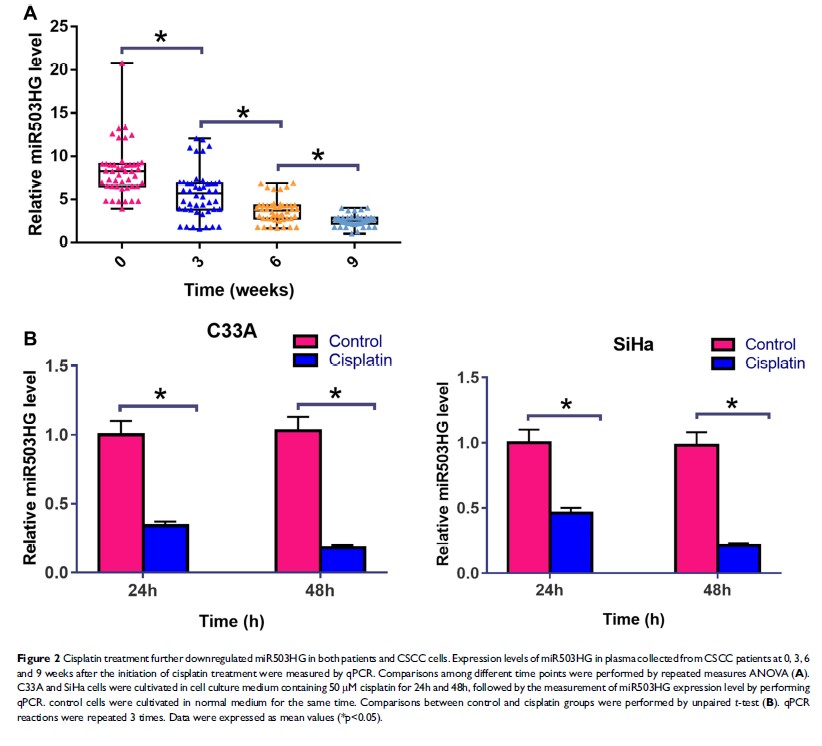
Results: In this study, we observed that levels of miR503HG in plasma were significantly lower in CSCC patients than in healthy participants. The cisplatin-based treatment further downregulated miR503HG in both patients and CSCC cells. MiR503HG overexpression in CSCC cells led to the suppression of miR-155 and elevation of Caspase-3, acting as the downstream target of miR-155. Cell apoptosis analysis showed that miR503HG and Caspase-3 overexpression led to an increased cell apoptosis rate under Cisplatin treatment. MiR-155 played the opposite role and attenuated the functions of Caspase-3 and miR503HG overexpression.
Conclusion: Therefore, miR503HG may regulate the drug resistance of CSCC cells by regulating mir-155/Caspase-3.
Keywords: cervical squamous cell carcinoma, miR503HG, miR-155, Caspase-3, apoptosis