115195
论文已发表
注册即可获取德孚的最新动态
IF 收录期刊
- 3.6 Breast Cancer (Dove Med Press)
- 4.3 Clin Epidemiol
- 2.6 Cancer Manag Res
- 3.2 Infect Drug Resist
- 4.1 Clin Interv Aging
- 6.1 Drug Des Dev Ther
- 4.1 Int J Chronic Obstr
- 8.7 Int J Nanomed
- 2.5 Int J Women's Health
- 3.2 Neuropsych Dis Treat
- 2.4 OncoTargets Ther
- 2.6 Patient Prefer Adher
- 2.6 Ther Clin Risk Manag
- 3.1 J Pain Res
- 3.5 Diabet Metab Synd Ob
- 4.5 Psychol Res Behav Ma
- 3.4 Nat Sci Sleep
- 2.4 Pharmgenomics Pers Med
- 2.6 Risk Manag Healthc Policy
- 4.6 J Inflamm Res
- 2.3 Int J Gen Med
- 3.9 J Hepatocell Carcinoma
- 3.3 J Asthma Allergy
- 2.5 Clin Cosmet Investig Dermatol
- 3.0 J Multidiscip Healthc

小檗碱在乳腺癌中通过 PTEN/Akt/mTOR 信号途径抑制自噬作用,从而逆转阿霉素耐药性
Authors Wang Y, Liu Y, Du X, Ma H, Yao J
Received 9 December 2019
Accepted for publication 20 February 2020
Published 4 March 2020 Volume 2020:13 Pages 1909—1919
DOI https://doi.org/10.2147/OTT.S241632
Checked for plagiarism Yes
Review by Single-blind
Peer reviewer comments 2
Editor who approved publication: Prof. Dr. Takuya Aoki
Purpose: Berberine (BBR), a traditional Chinese medicine, has been shown effects on inhibiting cancer development. Autophagy-mediated resistance plays an important role in cancer progression; therefore, regulation of autophagy is a novel therapeutic strategy for cancer treatment. However, effects of BBR on autophagy-mediated resistance have not been reported.
Methods: MCF-7 breast cancer cells and the doxorubicin (ADR)-resistant MCF-7 cells (MCF-7/ADR) were used for analyses. Western blotting was conducted to evaluate protein expression; MTT, colony formation, and EdU assays were conducted to assess cell proliferation; transmission electron microscopy was used to monitor autophagy levels; and a xenograft tumor model was established to assess the effects of BBR on reversing doxorubicin resistance.
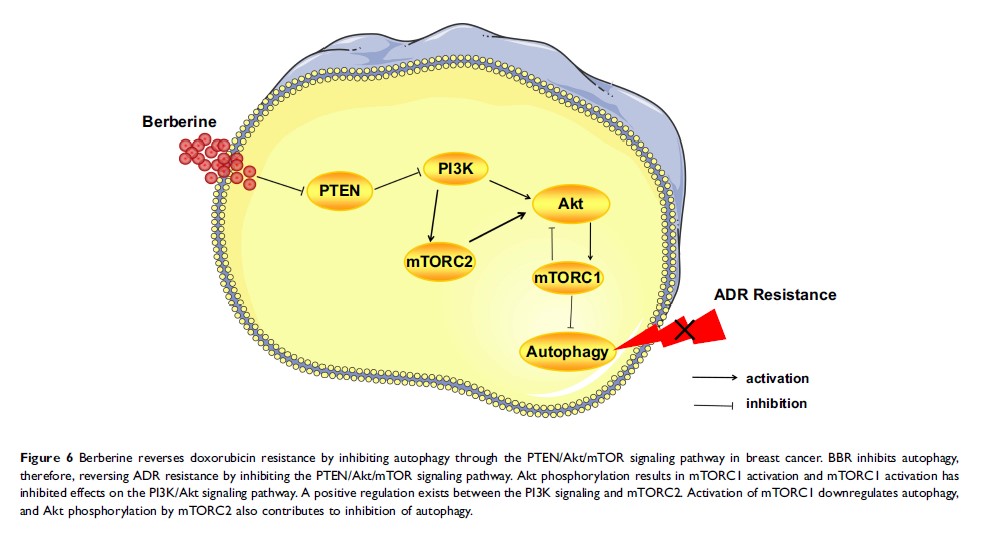
Results: We confirmed that BBR, recently identified as a suppressor of autophagy, inhibits autophagosome formation in MCF-7/ADR cells. Treatment with BBR blocked the accumulation of the autophagy-associated protein LC3II, resulting in cellular accumulation of p62, reduced cell proliferation, and reversal of doxorubicin resistance. Mechanistically, we found that BBR inhibited autophagy by modulating the PTEN/Akt/mTOR signaling pathway. In vivo, our study showed that BBR exerts clear anti-tumor effects.
Conclusion: The results of this study suggest that BBR reverses doxorubicin resistance in breast cancer cells by inhibiting autophagy. This finding highlights the potential clinical application of BBR in the treatment of breast cancer.
Keywords: breast cancer, berberine, chemoresistance, PTEN, autophagy, ADR