115195
论文已发表
注册即可获取德孚的最新动态
IF 收录期刊
- 3.6 Breast Cancer (Dove Med Press)
- 4.3 Clin Epidemiol
- 2.6 Cancer Manag Res
- 3.2 Infect Drug Resist
- 4.1 Clin Interv Aging
- 6.1 Drug Des Dev Ther
- 4.1 Int J Chronic Obstr
- 8.7 Int J Nanomed
- 2.5 Int J Women's Health
- 3.2 Neuropsych Dis Treat
- 2.4 OncoTargets Ther
- 2.6 Patient Prefer Adher
- 2.6 Ther Clin Risk Manag
- 3.1 J Pain Res
- 3.5 Diabet Metab Synd Ob
- 4.5 Psychol Res Behav Ma
- 3.4 Nat Sci Sleep
- 2.4 Pharmgenomics Pers Med
- 2.6 Risk Manag Healthc Policy
- 4.6 J Inflamm Res
- 2.3 Int J Gen Med
- 3.9 J Hepatocell Carcinoma
- 3.3 J Asthma Allergy
- 2.5 Clin Cosmet Investig Dermatol
- 3.0 J Multidiscip Healthc

对结直肠癌进行充分的淋巴结评估和肠道微生物、微生物代谢产物的研究
Authors Han S, Wu W, Da M, Xu J, Zhuang J, Zhang L, Zhang X, Yang X
Received 11 December 2019
Accepted for publication 18 February 2020
Published 4 March 2020 Volume 2020:13 Pages 1893—1906
DOI https://doi.org/10.2147/OTT.S242017
Checked for plagiarism Yes
Review by Single-blind
Peer reviewer comments 2
Editor who approved publication: Prof. Dr. Nicola Silvestris
Purpose: To analyze the lymph node metastasis status and prognosis in CRCs and to investigate the gut microorganisms and microbial metabolites at different lymph node stages.
Methods: The Surveillance, Epidemiology, and End Results (SEER) database and STAT software were used to analyze the clinical features and lymph node metastasis. Bacterial 16S V3-V4 and fungal ITS V3-V4 ribosomal RNA genes were sequenced in 53 stool samples and gas chromatography/mass spectrometry (GS/MS) was performed to detect the microbial metabolites in 48 stool samples from CRC patients.
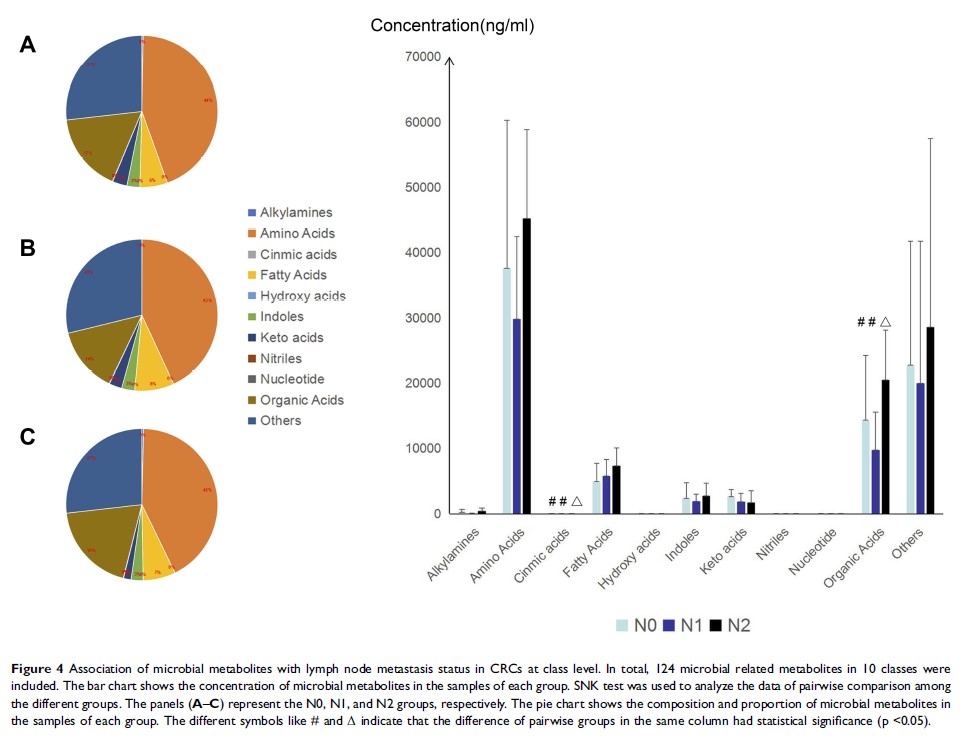
Results: A higher number of lymph node metastases predicted a poor prognosis. Inadequate evaluation of lymph nodes affects the accuracy of prognostic assessments. We constructed a nomogram model for the assessment of prognostic factors. There were multiple characteristic bacteria identified, including Akkermansia, Megamonas, Dialister , etc., and fungi, including Penicillium, Filobasidium, Debaryomyces , etc. A total of 27 characteristic microbial metabolites in different lymph node metastasis status were also identified.
Conclusion: Gut microorganisms and microbial metabolites may provide reference and guidance for the adequate lymph node assessments (ALNA) in CRC.
Keywords: microbiome, metabolites, lymph node, metastasis, colorectal cancer