115195
论文已发表
注册即可获取德孚的最新动态
IF 收录期刊
- 3.6 Breast Cancer (Dove Med Press)
- 4.3 Clin Epidemiol
- 2.6 Cancer Manag Res
- 3.2 Infect Drug Resist
- 4.1 Clin Interv Aging
- 6.1 Drug Des Dev Ther
- 4.1 Int J Chronic Obstr
- 8.7 Int J Nanomed
- 2.5 Int J Women's Health
- 3.2 Neuropsych Dis Treat
- 2.4 OncoTargets Ther
- 2.6 Patient Prefer Adher
- 2.6 Ther Clin Risk Manag
- 3.1 J Pain Res
- 3.5 Diabet Metab Synd Ob
- 4.5 Psychol Res Behav Ma
- 3.4 Nat Sci Sleep
- 2.4 Pharmgenomics Pers Med
- 2.6 Risk Manag Healthc Policy
- 4.6 J Inflamm Res
- 2.3 Int J Gen Med
- 3.9 J Hepatocell Carcinoma
- 3.3 J Asthma Allergy
- 2.5 Clin Cosmet Investig Dermatol
- 3.0 J Multidiscip Healthc

循环肿瘤细胞作为早期非小细胞肺癌的筛选和诊断标志物
Authors Duan GC, Zhang XP, Wang HE, Wang ZK, Zhang H, Yu L, Xue WF, Xin ZF, Hu ZH, Zhao QT
Received 11 December 2019
Accepted for publication 26 February 2020
Published 4 March 2020 Volume 2020:13 Pages 1931—1939
DOI https://doi.org/10.2147/OTT.S241956
Checked for plagiarism Yes
Review by Single-blind
Peer reviewer comments 3
Editor who approved publication: Dr Leo Jen-Liang Su
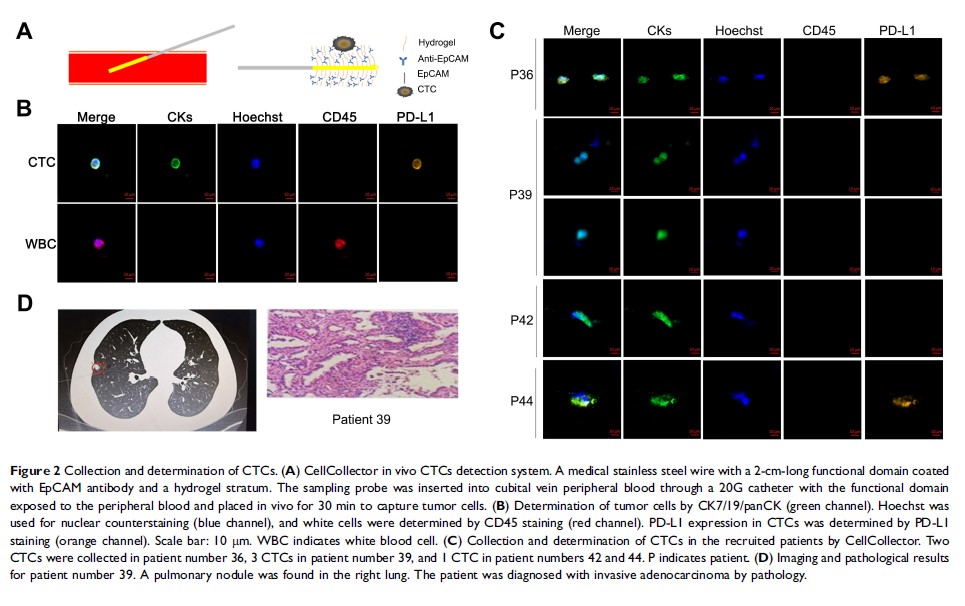
Background: Circulating tumor cells (CTCs) have become potential diagnostic biomarker for several types of cancer, including lung cancer. In this study, we aim to determine whether CTCs detected by CellCollector can be used for early-stage diagnosis of lung cancer.
Methods: In this study, we recruited 64 volunteers, among whom 44 were suspected lung cancer patients requiring surgical treatment and 20 were healthy volunteers. We simultaneously analyzed PD-L1 expression in CTCs isolated using the GILUPI CellCollector and copy number variation by next-generation sequencing (NGS).
Results: We enrolled a total of 44 patients with suspected lung cancer who required surgery and 20 healthy volunteers. The patients were classified into 4 groups based on their pathological results: benign disease, in situ cancer, microinvasive, and invasive. The CTCs detection rate for each group was 10.00% (1/10), 45% (5/11), 50% (7/14), and 67% (6/9), respectively. Among the patients with lung cancer, the CTCs detection rate increased with disease progression. The rate of CTCs positivity was 52.94% (18/34) in patients who were diagnosed with lung cancer by pathology and 10% (1/10) in patients with benign disease. CTCs were not detected in the control group. The area under the receiver operating characteristic (ROC) curve, a measure for distinguishing patients with primary lung cancer, was 0.715 (95% CI 0.549– 0.880, P=0.041). The sensitivity and specificity of the in vivo CTCs detection strategy for the diagnosis of early-stage lung cancer were 52.94% and 90%, respectively. CTCs were associated with clinical pathology but not with the size and location of the nodules.
Conclusion: CTCs isolation using the CellCollector in vivo detection method might be effective for distinguishing between benign and malignant nodules and may be used for early-stage diagnosis of lung cancer.
Keywords: CellCollector, in vivo, circulating tumor cells, early-stage diagnosis, lung cancer