115195
论文已发表
注册即可获取德孚的最新动态
IF 收录期刊
- 3.6 Breast Cancer (Dove Med Press)
- 4.3 Clin Epidemiol
- 2.6 Cancer Manag Res
- 3.2 Infect Drug Resist
- 4.1 Clin Interv Aging
- 6.1 Drug Des Dev Ther
- 4.1 Int J Chronic Obstr
- 8.7 Int J Nanomed
- 2.5 Int J Women's Health
- 3.2 Neuropsych Dis Treat
- 2.4 OncoTargets Ther
- 2.6 Patient Prefer Adher
- 2.6 Ther Clin Risk Manag
- 3.1 J Pain Res
- 3.5 Diabet Metab Synd Ob
- 4.5 Psychol Res Behav Ma
- 3.4 Nat Sci Sleep
- 2.4 Pharmgenomics Pers Med
- 2.6 Risk Manag Healthc Policy
- 4.6 J Inflamm Res
- 2.3 Int J Gen Med
- 3.9 J Hepatocell Carcinoma
- 3.3 J Asthma Allergy
- 2.5 Clin Cosmet Investig Dermatol
- 3.0 J Multidiscip Healthc

II-III 期食管鳞状细胞癌 R0 切除术后放疗中辅助放化疗的作用
Authors Song T, Chen P, Fang M, Zhang X, Du D, Wu S
Received 30 September 2019
Accepted for publication 22 January 2020
Published 5 March 2020 Volume 2020:12 Pages 1631—1639
DOI https://doi.org/10.2147/CMAR.S232930
Checked for plagiarism Yes
Review by Single-blind
Peer reviewer comments 2
Editor who approved publication: Dr Antonella D'Anneo
Purpose: This study compared the effectiveness and safety of postoperative concurrent chemoradiotherapy (POCRT) containing paclitaxel (PTX) and cisplatin (DDP) with postoperative radiotherapy (PORT) after R0 resection for stage II–III thoracic esophageal squamous cell carcinoma (TESCC).
Materials and Methods: After propensity score matching (PSM) analysis, 87 TESCC patients treated with PORT were matched 1:1 to 87 patients who received POCRT between July 2012 and December 2018. Radiotherapy was delivered at a dose of 200 cGy per day to a total dose of 5000 cGy. Concurrent chemotherapy consisted of DDP (25 mg/m2) for 3 days plus PTX (135 mg/m2) on day 1 every 3 weeks.
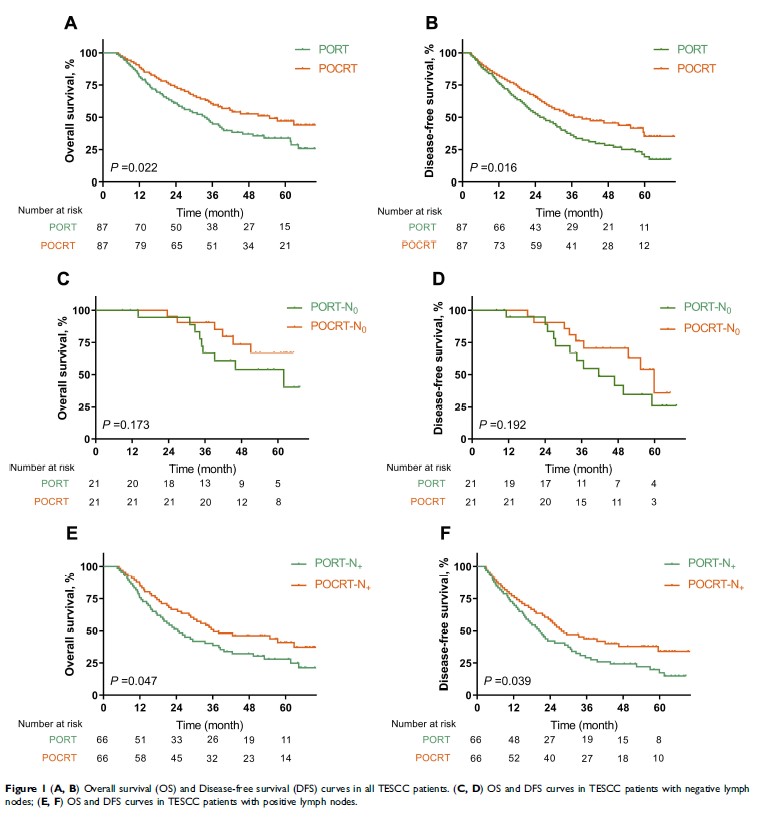
Results: Patient- and disease-related characteristics were well-balanced between the two groups. The median overall survival (OS) and disease-free survival (DFS) times were 39.2 and 31.0 months, respectively. The 5-year OS and DFS rates were 31.9% and 19.1% in the PORT group and 45.1% and 35.1% in the POCRT group, respectively. Statistical significance was demonstrated by comparing OS and DFS (P=0.022 and 0.016, respectively). Additionally, subgroup analysis revealed that in node positive TESCC patients, the POCRT group was significantly different from the PORT group regarding OS and DFS (P=0.049 and 0.039, respectively). POCRT decreased distant metastasis over PORT (P=0.044) with manageable toxicities. Multivariate analysis revealed that aside from factors associated with tumor stages, treatment modality was another strong prognostic factor for both OS and DFS (P=0.015 and 0.010, respectively).
Conclusion: Stage II–III TESCC patients could benefit from POCRT with manageable toxicities. Future well-designed prospective studies are highly warranted to confirm the findings in our report.
Keywords: esophageal squamous cell carcinoma, surgery, chemoradiotherapy, survival