115195
论文已发表
注册即可获取德孚的最新动态
IF 收录期刊
- 3.6 Breast Cancer (Dove Med Press)
- 4.3 Clin Epidemiol
- 2.6 Cancer Manag Res
- 3.2 Infect Drug Resist
- 4.1 Clin Interv Aging
- 6.1 Drug Des Dev Ther
- 4.1 Int J Chronic Obstr
- 8.7 Int J Nanomed
- 2.5 Int J Women's Health
- 3.2 Neuropsych Dis Treat
- 2.4 OncoTargets Ther
- 2.6 Patient Prefer Adher
- 2.6 Ther Clin Risk Manag
- 3.1 J Pain Res
- 3.5 Diabet Metab Synd Ob
- 4.5 Psychol Res Behav Ma
- 3.4 Nat Sci Sleep
- 2.4 Pharmgenomics Pers Med
- 2.6 Risk Manag Healthc Policy
- 4.6 J Inflamm Res
- 2.3 Int J Gen Med
- 3.9 J Hepatocell Carcinoma
- 3.3 J Asthma Allergy
- 2.5 Clin Cosmet Investig Dermatol
- 3.0 J Multidiscip Healthc

双去甲氧基姜黄素通过由 CYLD 介导的去泛素化使 Akt 失活,从而抑制肝细胞癌的增殖
Authors Qiu C, Liu K, Zhang S, Gao S, Chen W, Li D, Huang Y
Received 20 September 2019
Accepted for publication 20 February 2020
Published 5 March 2020 Volume 2020:14 Pages 993—1001
DOI https://doi.org/10.2147/DDDT.S231814
Checked for plagiarism Yes
Review by Single-blind
Peer reviewer comments 2
Editor who approved publication: Dr Qiongyu Guo
Background: Bisdemethoxycurcumin (BDMC), a stable bioactive ingredient in curcuminoids, is associated with various antitumor functions, such as proliferation inhibition, metastasis suppression and apoptosis induction, in many cancer types. However, the mechanism of BDMC in hepatocellular carcinoma (HCC) remains unclear.
Methods: We assessed the toxicity and the inhibitory effect of BDMC in the HepG2 cell line by using CCK-8 and colony formation assays. The regulatory effects of BDMC on Akt and MAPK signaling were investigated by Western blotting and immunoprecipitation.
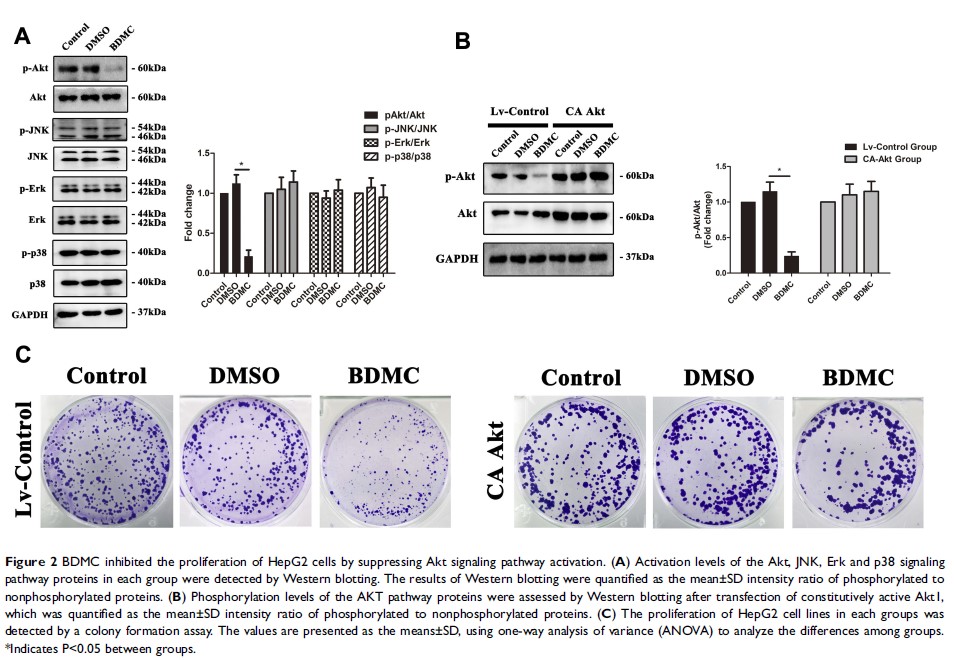
Results: We found that the half-maximum inhibitory concentration (IC50) of BDMC after 48 hrs of treatment was 59.13 μM, and BDMC inhibited proliferation in a time- and dose-dependent manner in HepG2 cells. The inhibitory effect was caused by the inactivation of Akt signaling, but not Erk, Jnk or p38 signaling. In addition, the inactivation of Akt signaling was attributed to the inhibition of ubiquitination mediated by K63-Ub but not K48-Ub. Furthermore, we found that BDMC upregulated the expression of CYLD, leading to Akt deubiquitination and inactivation.
Conclusion: BDMC inhibited HCC cell proliferation, and that this effect was induced by Akt inactivation via CYLD-mediated deubiquitination.
Keywords: bisdemethoxycurcumin, hepatocellular carcinoma, proliferation, deubiquitination