115195
论文已发表
注册即可获取德孚的最新动态
IF 收录期刊
- 3.6 Breast Cancer (Dove Med Press)
- 4.3 Clin Epidemiol
- 2.6 Cancer Manag Res
- 3.2 Infect Drug Resist
- 4.1 Clin Interv Aging
- 6.1 Drug Des Dev Ther
- 4.1 Int J Chronic Obstr
- 8.7 Int J Nanomed
- 2.5 Int J Women's Health
- 3.2 Neuropsych Dis Treat
- 2.4 OncoTargets Ther
- 2.6 Patient Prefer Adher
- 2.6 Ther Clin Risk Manag
- 3.1 J Pain Res
- 3.5 Diabet Metab Synd Ob
- 4.5 Psychol Res Behav Ma
- 3.4 Nat Sci Sleep
- 2.4 Pharmgenomics Pers Med
- 2.6 Risk Manag Healthc Policy
- 4.6 J Inflamm Res
- 2.3 Int J Gen Med
- 3.9 J Hepatocell Carcinoma
- 3.3 J Asthma Allergy
- 2.5 Clin Cosmet Investig Dermatol
- 3.0 J Multidiscip Healthc

TIM-3 通过由 SMAD7/SMAD2/SNAIL1 轴介导的上皮-间质转化参与鼻咽癌的侵袭和转移
Authors Xiao Y, Qing J, Li B, Chen L, Nong S, Yang W, Tang X, Chen Z
Received 4 November 2019
Accepted for publication 17 February 2020
Published 6 March 2020 Volume 2020:13 Pages 1993—2006
DOI https://doi.org/10.2147/OTT.S237222
Checked for plagiarism Yes
Review by Single-blind
Peer reviewer comments 2
Editor who approved publication: Dr Sanjay Singh
Background: T-cell immunoglobulin and mucin domain-containing molecule-3 (TIM-3) was originally found to negatively regulate immune response and mediate immune escape in tumors. Subsequently, an increasing body of evidence has shown that TIM-3 exerts positive functions in the development and progression of several tumors. However, the role of TIM-3 in nasopharyngeal carcinoma (NPC) remains unknown.
Methods: Data from the Cancer Genome Atlas-head and neck squamous cell carcinoma and immunohistochemistry were analyzed to compare the expression of TIM-3 in NPC and non-cancerous nasopharyngitis tissues. Cell proliferation was evaluated using the Cell counting kit-8 in vitro and xenograft experiment in nude mice in vivo. Flow cytometry was used to evaluate the cell cycle. The migration and invasion of NPC cells were assessed through wound healing and Transwell assays. In addition, Western blotting was used to analyze the expression of specific proteins.
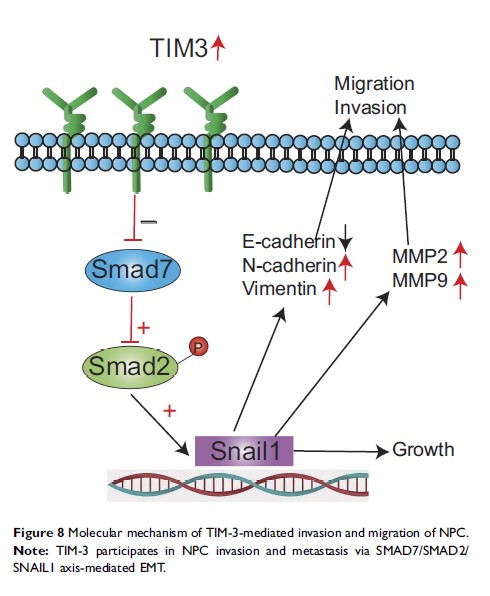
Results: Higher expression of TIM-3 was detected in NPC tissues than normal nasopharyngeal tissues and positively correlated with the clinical stage and T classification; however, it was not correlated with gender, age, and N classification. Furthermore, overexpression of TIM-3 using lentiviral vectors increased the malignancy of 6-10B and CNE-2 cell lines that lowly express TIM-3, by promoting cell proliferation, migration, and invasion in vitro and in vivo. In addition, overexpression of TIM-3 was associated with upregulation of matrix metalloproteinase 9 (MMP9) and MMP2, and led to epithelial-mesenchymal transition (EMT) by increasing the levels of mesenchymal markers (ie, N-cadherin, Vimentin) and decreasing those of the epithelial marker E-cadherin. Further study showed that SMAD7 was downregulated in the TIM-3 overexpression group. Relatively, phosphorylated SMAD2 and downstream molecule SNAIL1 were also upregulated in this group.
Conclusion: TIM-3 exerts a tumor-promoting function in NPC by mediating changes in the SMAD7/SMAD2/SNAIL1 axis. These findings provide a new idea for the study of invasion, metastasis, and treatment of NPC.
Keywords: nasopharyngeal carcinoma, T-cell immunoglobulin and mucin-domain containing molecule-3, invasion, metastasis, epithelial-mesenchymal transition