115195
论文已发表
注册即可获取德孚的最新动态
IF 收录期刊
- 3.6 Breast Cancer (Dove Med Press)
- 4.3 Clin Epidemiol
- 2.6 Cancer Manag Res
- 3.2 Infect Drug Resist
- 4.1 Clin Interv Aging
- 6.1 Drug Des Dev Ther
- 4.1 Int J Chronic Obstr
- 8.7 Int J Nanomed
- 2.5 Int J Women's Health
- 3.2 Neuropsych Dis Treat
- 2.4 OncoTargets Ther
- 2.6 Patient Prefer Adher
- 2.6 Ther Clin Risk Manag
- 3.1 J Pain Res
- 3.5 Diabet Metab Synd Ob
- 4.5 Psychol Res Behav Ma
- 3.4 Nat Sci Sleep
- 2.4 Pharmgenomics Pers Med
- 2.6 Risk Manag Healthc Policy
- 4.6 J Inflamm Res
- 2.3 Int J Gen Med
- 3.9 J Hepatocell Carcinoma
- 3.3 J Asthma Allergy
- 2.5 Clin Cosmet Investig Dermatol
- 3.0 J Multidiscip Healthc

Akt/mTOR 信号通路激活状态对滑膜肉瘤临床表现的影响:对单一机构中 174 例患者的回顾性分析
Authors Li YX, Ding SS, Wen WJ, Han L, Wang HQ, Shi HY
Received 24 August 2019
Accepted for publication 8 February 2020
Published 9 March 2020 Volume 2020:12 Pages 1759—1769
DOI https://doi.org/10.2147/CMAR.S228578
Checked for plagiarism Yes
Review by Single-blind
Peer reviewer comments 4
Editor who approved publication: Dr Eileen O'Reilly
Purpose: Phosphoinositide 3-kinase (PI3K) and the downstream Akt/mammalian target of rapamycin (mTOR) pathway are central to the control of cell proliferation and survival. Although abnormal activation of this pathway has been well established in a variety of tumours, limited studies are available on synovial sarcoma. The aim of this study was to investigate the expression of several key proteins of those pathways in synovial sarcomas and to correlate the expression of these proteins with clinicopathologic features and prognosis.
Patients and Methods: A total of 174 patients with synovial sarcomas were recruited for this study. The phosphorylation status of Akt, mTOR, and eukaryotic translation initiation factor 4E binding protein (4E-BP1) was measured by immunohistochemistry assays in formalin-fixed, paraffin-embedded samples. Correlations between the expression levels of these proteins and clinicopathologic features and prognosis were analysed.
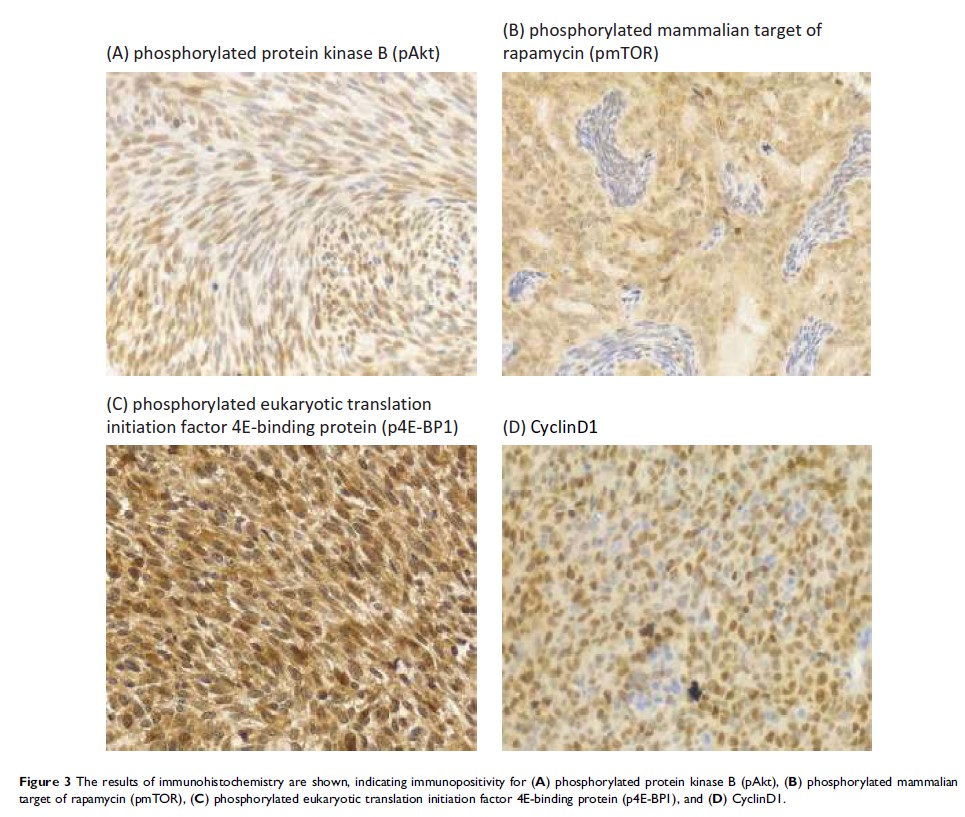
Results: The positive rates of phosphorylated (p)Akt, pmTOR, p4E-BP1, and CyclinD1 were 62.7%, 55.6%, 47.1%, and 52.6%, respectively. The positive results of pmTOR, pAkt, and downstream p4E-BP1 were correlated with each other. The positive pAkt, pmTOR, p4E-BP1, and CyclinD1 results were more highly expressed in head and neck and visceral tumours, and positive p4E-BP1 results were correlated with larger size and larger areas of necrosis. In multivariate analysis of clinicopathologic factors, head and neck and visceral location, large tumour size, larger areas of necrosis and frequent mitosis were confirmed as risk factors for shorter overall survival. Positive pAkt, pmTOR and p4E-BP1 results were correlated significantly with shorter overall survival, and CyclinD1 was not in the univariate analysis. The positive pmTOR, pAkt, p4E-BP1, and CyclinD1 results were significantly poor prognostic factors for overall survival, and only positive p4E-BP1 results were significantly associated with shorter event-free survival in multivariate analysis.
Conclusion: This study demonstrated the high expression of pAkt, pmTOR, and p4E-BP1 associated with aggressive clinical behaviour in synovial sarcomas and provided evidence for prognostic evaluation and targeted therapy.
Keywords: synovial sarcoma, pAkt, pmTOR, p4E-BP1, clinicopathologic features, prognosis