115195
论文已发表
注册即可获取德孚的最新动态
IF 收录期刊
- 3.6 Breast Cancer (Dove Med Press)
- 4.3 Clin Epidemiol
- 2.6 Cancer Manag Res
- 3.2 Infect Drug Resist
- 4.1 Clin Interv Aging
- 6.1 Drug Des Dev Ther
- 4.1 Int J Chronic Obstr
- 8.7 Int J Nanomed
- 2.5 Int J Women's Health
- 3.2 Neuropsych Dis Treat
- 2.4 OncoTargets Ther
- 2.6 Patient Prefer Adher
- 2.6 Ther Clin Risk Manag
- 3.1 J Pain Res
- 3.5 Diabet Metab Synd Ob
- 4.5 Psychol Res Behav Ma
- 3.4 Nat Sci Sleep
- 2.4 Pharmgenomics Pers Med
- 2.6 Risk Manag Healthc Policy
- 4.6 J Inflamm Res
- 2.3 Int J Gen Med
- 3.9 J Hepatocell Carcinoma
- 3.3 J Asthma Allergy
- 2.5 Clin Cosmet Investig Dermatol
- 3.0 J Multidiscip Healthc

对精神病患者进行道德判断的特点:道义论倾向的中介效应
Authors Li S, Ding D, Lai J, Zhang X, Wu Z, Liu C
Received 10 August 2019
Accepted for publication 18 February 2020
Published 9 March 2020 Volume 2020:13 Pages 257—266
DOI https://doi.org/10.2147/PRBM.S226722
Checked for plagiarism Yes
Review by Single-blind
Peer reviewer comments 2
Editor who approved publication: Professor Igor Elman
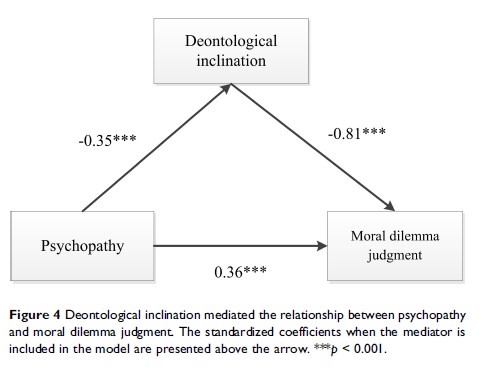
Purpose: Many studies explore the relationship between moral judgment and psychopathy in western culture, but the mechanism underlying this relationship remains unclear. By far, no research about this topic in the background of Chinese culture exists. In the current study, we adopt one of the creative process-dissociation approaches to explore the relationship between the psychopath and moral judgment.
Methods: Adopt the Levenson Self-Report Psychopathic Scale, the Chinese version of Interpersonal Reactivity and Process-dissociation approach to explore the relationship between the psychopath and moral judgment.
Results: Traditional utilitarian moral score of the high psychopathy group are significantly higher than that of low psychopathy group (t = 2.97, p< 0.05), people with high psychopathy utilitarian tendency U factor score and people with low psychopathy have no significant difference (F= 0.85, p = 0.36).
Conclusion: Individuals with high psychopathy tend to make fewer deontological moral judgments because of their decreased deontological tendencies rather than their increased utilitarian tendencies. They may make more acceptance choices not to increase the well-being of the majority of people, but because of their increased acceptance of hurting others in the moral dilemma.
Keywords: psychopathy, moral judgment, deontological inclination, utilitarian inclination