115195
论文已发表
注册即可获取德孚的最新动态
IF 收录期刊
- 3.6 Breast Cancer (Dove Med Press)
- 4.3 Clin Epidemiol
- 2.6 Cancer Manag Res
- 3.2 Infect Drug Resist
- 4.1 Clin Interv Aging
- 6.1 Drug Des Dev Ther
- 4.1 Int J Chronic Obstr
- 8.7 Int J Nanomed
- 2.5 Int J Women's Health
- 3.2 Neuropsych Dis Treat
- 2.4 OncoTargets Ther
- 2.6 Patient Prefer Adher
- 2.6 Ther Clin Risk Manag
- 3.1 J Pain Res
- 3.5 Diabet Metab Synd Ob
- 4.5 Psychol Res Behav Ma
- 3.4 Nat Sci Sleep
- 2.4 Pharmgenomics Pers Med
- 2.6 Risk Manag Healthc Policy
- 4.6 J Inflamm Res
- 2.3 Int J Gen Med
- 3.9 J Hepatocell Carcinoma
- 3.3 J Asthma Allergy
- 2.5 Clin Cosmet Investig Dermatol
- 3.0 J Multidiscip Healthc

5-HT7 受体有助于 NSCLC 细胞的增殖、迁移和侵袭
Authors Du X, Wang T, Wang Z, Wu X, Gu Y, Huang Q, Wang J, Xie J
Received 31 December 2019
Accepted for publication 25 February 2020
Published 9 March 2020 Volume 2020:13 Pages 2139—2151
DOI https://doi.org/10.2147/OTT.S244339
Checked for plagiarism Yes
Review by Single-blind
Peer reviewer comments 2
Editor who approved publication: Dr William Cho
Introduction: Because only a small portion of NSCLC (non-small-cell lung cancer) patients benefit from molecular targeted therapy or immunotherapy and do not develop therapeutic resistance, continued research on new targets is warranted. Serotonin has recently emerged as a growth factor for tumor cells, and its receptors may be potential therapeutic targets. The mechanism related to the behavior of the 5-HT7 receptor in NSCLC remains unknown.
Methods: Both gene expression analysis and immunohistochemical analysis were conducted to evaluate 5-HT7 receptor expression in NSCLC tissues. The correlation between 5-HT7 receptor expression and clinicopathological features was also examined. Cell proliferation was measured using a CCK8 (Cell Counting Kit-8) assay and colony formation, migration and invasion were evaluated by the Transwell assay. siRNA transfection and stimulation with the selective agonist LP211 were used to identify the involvement of molecules in proliferation, migration and invasion. Quantitative real-time chain reaction (qRT-PCR) and Western blotting were used to quantifiy mRNA and protein levels, respectively. Pathway inhibitors facilitated the exploration of possible signaling pathways regulated by the 5-HT7 receptor in migration and invasion.
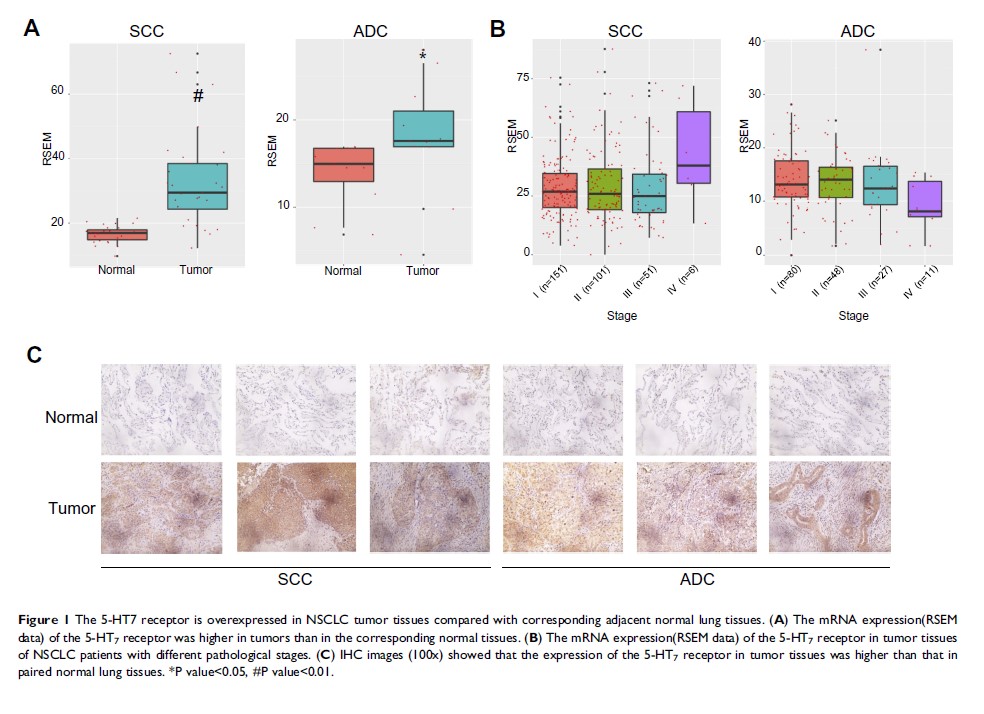
Results: The 5-HT7 receptor was overexpressed in NSCLC tumor tissues compared with adjacent normal lung tissues. High 5-HT7 receptor expression levels were correlated with lymph node metastasis (P=0.007) and advanced TNM stage (P=0.000) in NSCLC patients. The 5-HT7 receptor positively regulated cell proliferation, migration and invasion in NSCLC cells. The stimulatory effect of the 5-HT7 receptor on A549 cell migration and invasion may occur through the P38 pathway. In H1299 cells, the 5-HT7 receptor might positively regulate Src to promote cell migration and invasion.
Conclusion: Our findings suggest that the 5-HT7 receptor, which mediates NSCLC progression, may be a potential therapeutic target.
Keywords: non-small cell lung cancer, progression, 5-HT7 receptor, LP211