115195
论文已发表
注册即可获取德孚的最新动态
IF 收录期刊
- 3.6 Breast Cancer (Dove Med Press)
- 4.3 Clin Epidemiol
- 2.6 Cancer Manag Res
- 3.2 Infect Drug Resist
- 4.1 Clin Interv Aging
- 6.1 Drug Des Dev Ther
- 4.1 Int J Chronic Obstr
- 8.7 Int J Nanomed
- 2.5 Int J Women's Health
- 3.2 Neuropsych Dis Treat
- 2.4 OncoTargets Ther
- 2.6 Patient Prefer Adher
- 2.6 Ther Clin Risk Manag
- 3.1 J Pain Res
- 3.5 Diabet Metab Synd Ob
- 4.5 Psychol Res Behav Ma
- 3.4 Nat Sci Sleep
- 2.4 Pharmgenomics Pers Med
- 2.6 Risk Manag Healthc Policy
- 4.6 J Inflamm Res
- 2.3 Int J Gen Med
- 3.9 J Hepatocell Carcinoma
- 3.3 J Asthma Allergy
- 2.5 Clin Cosmet Investig Dermatol
- 3.0 J Multidiscip Healthc

辛伐他汀同时抑制 YAP 和 β-连环蛋白信号传导,从而遏制胃癌细胞的恶性行为
Authors Liu Q, Xia H, Zhou S, Tang Q, Zhou J, Ren M, Bi F
Received 7 November 2019
Accepted for publication 25 February 2020
Published 9 March 2020 Volume 2020:13 Pages 2057—2066
DOI https://doi.org/10.2147/OTT.S237693
Checked for plagiarism Yes
Review by Single-blind
Peer reviewer comments 2
Editor who approved publication: Dr Yao Dai
Background: Statins, which are used to lower blood cholesterol levels by inhibiting HMG-CoA reductase, have shown anticancer effects in many cancer cells. However, the role of statins in gastric cancer remains unclear. This study aims to investigate whether the statins could antagonize progression of gastric cancer cells and tried to find the molecule mechanism.
Methods: Effects of simvastatin on the morphology, proliferation, migration, apoptosis, and invasion of gastric cancer cells were detected and compared. Western blotting, cell viability assay, fluorescence, and transfection were employed to study the molecule mechanism of the effects and the interaction between YAP and β-catenin signaling.
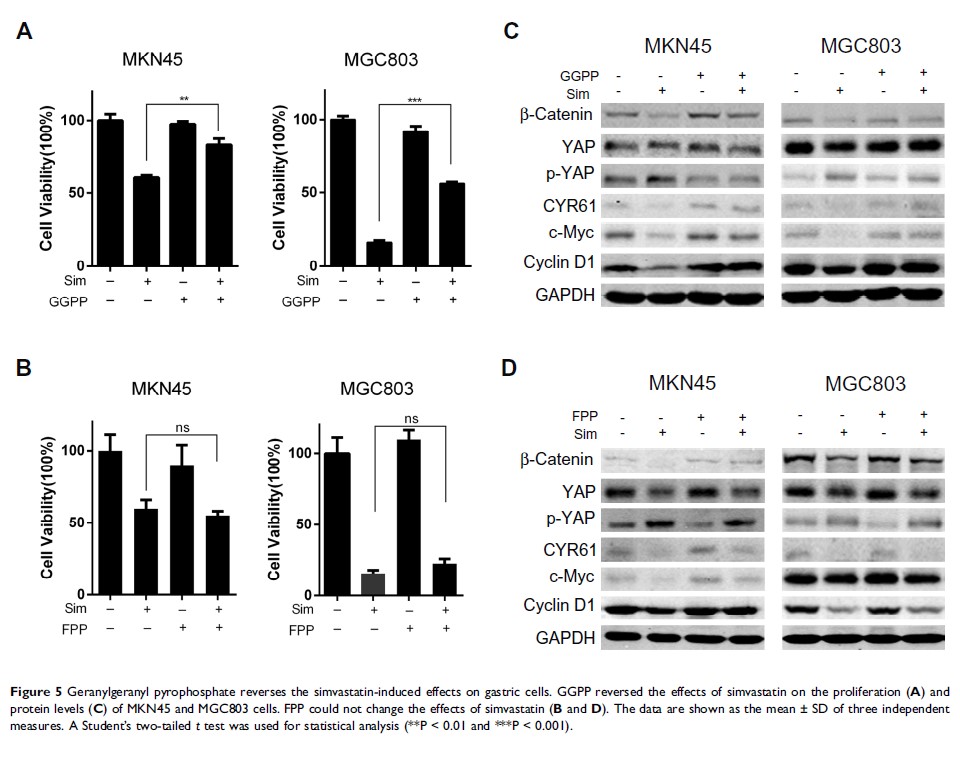
Results: Simvastatin could inhibit proliferation, migration and invasion, and promote the apoptosis in gastric cancer cells. Mechanistic studies showed that simvastatin treatment could inhibit the expression of β-catenin and the activity of YAP and the downstream targets of YAP and β-catenin in gastric cancer cells. Moreover, we found that YAP and β-catenin could form a positive feedback loop in gastric cancer cells. Further investigation revealed that simvastatin mainly acted through by inhibiting the activity of RhoA to inhibit YAP and β-catenin, and the geranylgeranyl pyrophosphate pathway mediated this regulation.
Conclusion: Statins represent a promising therapeutic option for gastric cancer by simultaneously targeting YAP and β-catenin signaling.
Keywords: gastric cancer, simvastatin, YAP, β-catenin, RhoA