115195
论文已发表
注册即可获取德孚的最新动态
IF 收录期刊
- 3.6 Breast Cancer (Dove Med Press)
- 4.3 Clin Epidemiol
- 2.6 Cancer Manag Res
- 3.2 Infect Drug Resist
- 4.1 Clin Interv Aging
- 6.1 Drug Des Dev Ther
- 4.1 Int J Chronic Obstr
- 8.7 Int J Nanomed
- 2.5 Int J Women's Health
- 3.2 Neuropsych Dis Treat
- 2.4 OncoTargets Ther
- 2.6 Patient Prefer Adher
- 2.6 Ther Clin Risk Manag
- 3.1 J Pain Res
- 3.5 Diabet Metab Synd Ob
- 4.5 Psychol Res Behav Ma
- 3.4 Nat Sci Sleep
- 2.4 Pharmgenomics Pers Med
- 2.6 Risk Manag Healthc Policy
- 4.6 J Inflamm Res
- 2.3 Int J Gen Med
- 3.9 J Hepatocell Carcinoma
- 3.3 J Asthma Allergy
- 2.5 Clin Cosmet Investig Dermatol
- 3.0 J Multidiscip Healthc

通过 miRNA 和超声相结合鉴别与肝结石相关的胆管癌
Authors Jiang W, Deng X, Zhu T, Wei Y, Lei Z, Guo M, Yang J
Received 11 December 2019
Accepted for publication 2 March 2020
Published 12 March 2020 Volume 2020:12 Pages 1845—1853
DOI https://doi.org/10.2147/CMAR.S241870
Checked for plagiarism Yes
Review by Single-blind
Peer reviewer comments 2
Editor who approved publication: Dr Eileen O'Reilly
Background: Identification of cholangiocarcinoma (CCA) associated with hepatolithiasis (HL) is difficult. There is no effective method to discriminate CCA associated with HL (HL-CCA) from HL currently.
Objective: To explore the value of clinical data, ultrasonic characteristics and miRNA expression level in the identification of HL-CCA.
Methods: Thirty-one patients with HL-CCA in Huazhong University of Science and Technology Union Shenzhen Hospital were enrolled in the observation group, while 40 patients with HL alone were included in the control group. The clinical data, ultrasonic characteristics, and miRNA expression level of the two groups were recorded and analyzed to explore the potential indicators for the identification of HL-CCA.
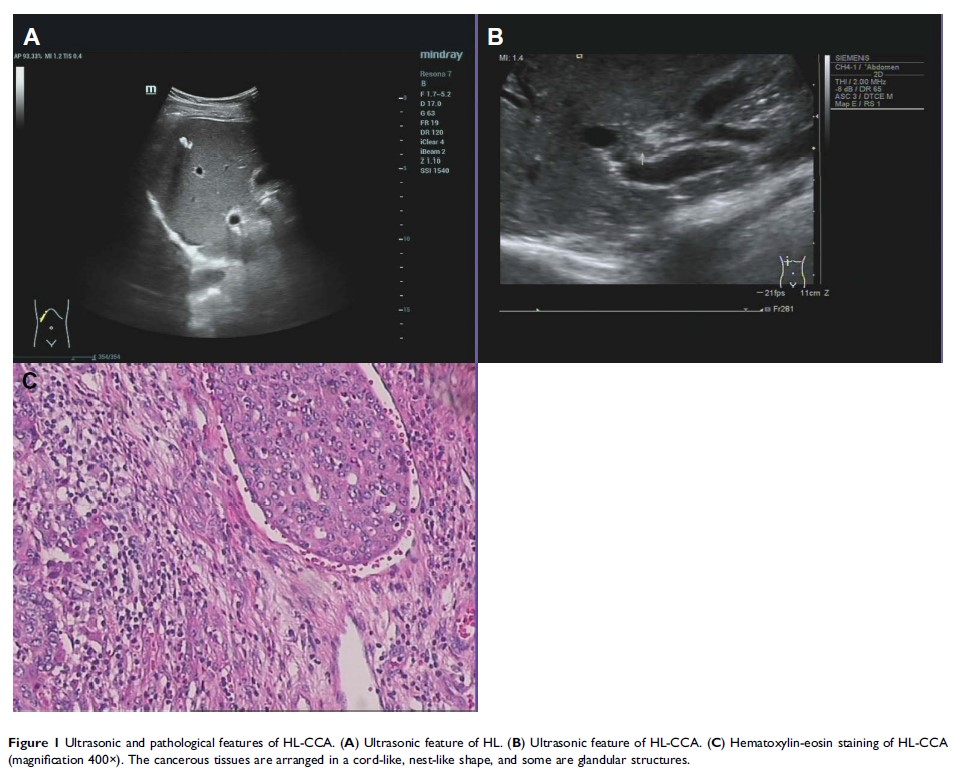
Results: The accuracy of ultrasound in the diagnosis of HL-CCA was low (54.84%). Multivariate logistic regression analysis showed that liver abscess (P=0.021), indistinct border demarcation (P=0.015), non-homogenous echotexture (P=0.019), missed portal vein around lesion (P=0.032), miRNA-21 (P=0.018) and miRNA-221 (P=0.009) were the potential indicators for the identification of HL-CCA. The combined diagnosis based on logistic regression contained liver abscess, border demarcation, echotexture, portal vein around lesion, miRNA-21 and miRNA-221. The results showed that the accuracy of combined diagnosis identifying HL-CCA was the most accurate (AUC=0.911), which was significantly greater than the AUC of miRNA-21 or miRNA-221 individually (P< 0.05), with a sensitivity and specificity of 77.42% and 97.50%, respectively.
Conclusion: Patients with HL-CCA show high incidence of hepatic abscess and elevated miRNA-21 and miRNA-221 expression level. The ultrasonic features are more likely to show indistinct border demarcation, non-homogenous echotexture, and missed portal vein around lesion. The combined diagnosis is more accurate in the identification of HL-CCA.
Keywords: cholangiocarcinoma, hepatolithiasis, microRNA, differential diagnosis, combined diagnosis, ultrasound