115195
论文已发表
注册即可获取德孚的最新动态
IF 收录期刊
- 3.6 Breast Cancer (Dove Med Press)
- 4.3 Clin Epidemiol
- 2.6 Cancer Manag Res
- 3.2 Infect Drug Resist
- 4.1 Clin Interv Aging
- 6.1 Drug Des Dev Ther
- 4.1 Int J Chronic Obstr
- 8.7 Int J Nanomed
- 2.5 Int J Women's Health
- 3.2 Neuropsych Dis Treat
- 2.4 OncoTargets Ther
- 2.6 Patient Prefer Adher
- 2.6 Ther Clin Risk Manag
- 3.1 J Pain Res
- 3.5 Diabet Metab Synd Ob
- 4.5 Psychol Res Behav Ma
- 3.4 Nat Sci Sleep
- 2.4 Pharmgenomics Pers Med
- 2.6 Risk Manag Healthc Policy
- 4.6 J Inflamm Res
- 2.3 Int J Gen Med
- 3.9 J Hepatocell Carcinoma
- 3.3 J Asthma Allergy
- 2.5 Clin Cosmet Investig Dermatol
- 3.0 J Multidiscip Healthc

褪黑素通过肝癌细胞中的 Hippo 传导调节顺铂耐药性和葡萄糖代谢
Authors Mi L, Kuang H
Received 10 September 2019
Accepted for publication 11 January 2020
Published 12 March 2020 Volume 2020:12 Pages 1863—1874
DOI https://doi.org/10.2147/CMAR.S230466
Checked for plagiarism Yes
Review by Single-blind
Peer reviewer comments 2
Editor who approved publication: Dr Yong Teng
Introduction and Aim: Hepatocellular carcinoma (HCC) is a primary malignancy that occurs in the liver. Clinical cases have been recorded worldwide, particularly in the Saharan area and Asia. In the present work, we aimed to probe the characteristics of melatonin involved in human HCC development, especially in cisplatin resistance and glucose metabolism.
Methods: Two HCC cells, HepG2 and Hep3B cells, were treated with melatonin. Cell cycle test was then used to define the role of melatonin in cell progression while Western blotting and qPCR assay were applied to determine the associated proteins in the treatment. Annexin V/PI staining and MTT assay was used to probe the involvement of melatonin in cisplatin-induced cell apoptosis process. Successively, we assessed glucose consumption in melatonin treated cells along with Western blotting for detection of GLUT-3 expression level. Yes-associated protein (YAP), a key regulator of Hippo signaling pathway, was further examined to characterize the function of melatonin on adjusting GLUT3 and Bcl-2 expression.
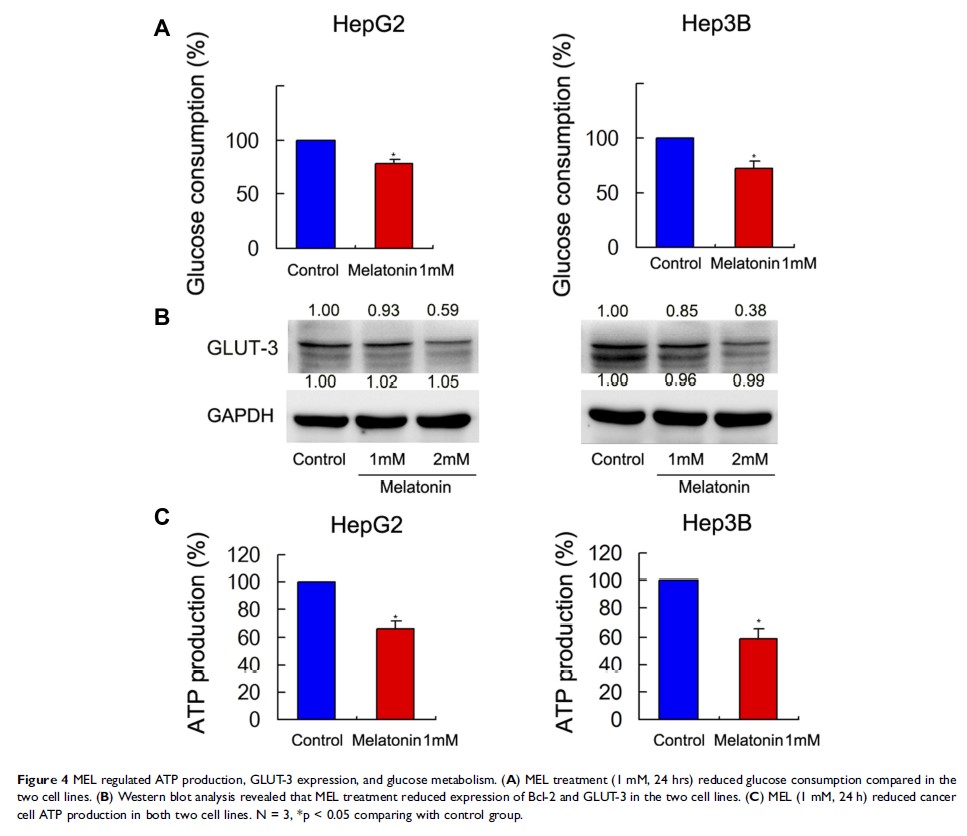
Results: Melatonin enabled inhibition of HepG2 and Hep3B proliferation and cell cycle progression via affecting the cell cycle-associated proteins. Annexin V/PI staining and MTT assay results demonstrated that melatonin assisted cisplatin-induced apoptosis accompanied with upregulated caspase-3 and poly ADP-ribose polymerase (PARP) cleavage, as well as Bcl-2 expression. It revealed that melatonin inhibits glucose uptake and ATP production via downregulation of Glucose transporter 3 (GLUT3). In addition, YAP was downregulated by melatonin treatment. The YAP depletion in HepG2 and Hep3B cells suppressed mRNA and protein expression of Bcl-2 and GLUT3, whereas overexpression of YAP in melatonin treated cells partly reversed the melatonin-induced inhibition on proliferation, cisplatin-induced apoptosis, and GLUT3 and Bcl-2 expression.
Conclusion: Melatonin hindered HCC proliferation and aided cisplatin resistance via regulating the Hippo signaling pathway.
Keywords: melatonin, hepatocellular carcinoma, proliferation, glucose metabolism, YAP, apoptosis