115195
论文已发表
注册即可获取德孚的最新动态
IF 收录期刊
- 3.6 Breast Cancer (Dove Med Press)
- 4.3 Clin Epidemiol
- 2.6 Cancer Manag Res
- 3.2 Infect Drug Resist
- 4.1 Clin Interv Aging
- 6.1 Drug Des Dev Ther
- 4.1 Int J Chronic Obstr
- 8.7 Int J Nanomed
- 2.5 Int J Women's Health
- 3.2 Neuropsych Dis Treat
- 2.4 OncoTargets Ther
- 2.6 Patient Prefer Adher
- 2.6 Ther Clin Risk Manag
- 3.1 J Pain Res
- 3.5 Diabet Metab Synd Ob
- 4.5 Psychol Res Behav Ma
- 3.4 Nat Sci Sleep
- 2.4 Pharmgenomics Pers Med
- 2.6 Risk Manag Healthc Policy
- 4.6 J Inflamm Res
- 2.3 Int J Gen Med
- 3.9 J Hepatocell Carcinoma
- 3.3 J Asthma Allergy
- 2.5 Clin Cosmet Investig Dermatol
- 3.0 J Multidiscip Healthc

TAP 表达增加可预测非小细胞肺癌患者的预后不良
Authors Cheng Y, Chen Y, Zang G, Chen B, Yao J, Zhang W, Wang H, Yu L, He P, Zhang Y, Wu H
Received 21 November 2019
Accepted for publication 20 February 2020
Published 13 March 2020 Volume 2020:12 Pages 1941—1946
DOI https://doi.org/10.2147/CMAR.S239593
Checked for plagiarism Yes
Review by Single-blind
Peer reviewer comments 2
Editor who approved publication: Professor Rudolph Navari
Background: The most common cancer among humans is lung cancer. Non-small cell lung cancer (NSCLC) comprises the majority of these cases. In the development and progression of cancers across the spectrum, tumor abnormal protein (TAP) plays crucial roles. Additionally, in the advancement of the bladder and colorectal cancers, the involvement of glycoproteins like TAP is present. However, it is worth noting that current literature has yet to clarify the clinical significance of the TAP in NSCLC.
Methods: In the present study, to evaluate the relative level of TAP, we utilized a TAP detection agent in 154 cases of NSCLC and normal patients who underwent surgical resection anytime from March 2013 to January 2019 at the People’s Hospital of Chizhou.
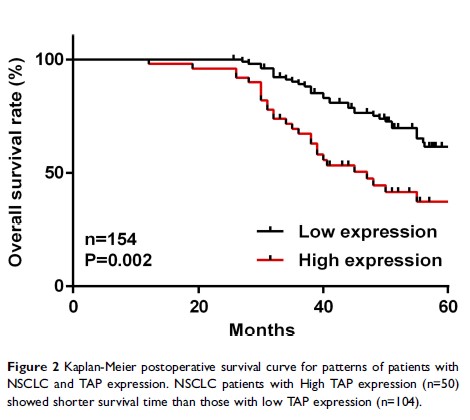
Results: Our results demonstrated that in NSCLC patients, the expression level of TAP was significantly higher than in normal patients. Moreover, after surgery, TAP expression was significantly downregulated in NSCLC patients. TAP expression is associated with an array of factors, which include the patient’s sex, history of smoking use, tumor size, pTNM, distant cancer, metastasis of lymph nodes, invasive and aggressive indicator pleural invasion, and differentiation degree of NSCLC. Additionally, TAP has no association with the patient’s age, history of drinking, location of the tumor, hypertension, and diabetes. In NSCLC patients, a poor overall survival rate within 5 years is significantly correlated with the increased TAP expression. For NSCLC patients, an independent prognostic factor is the TAP, which is confirmed using the multivariate survival analysis.
Conclusion: In the malignant progression of NSCLC, our results demonstrate how the promoting role of the upregulated TAP expression takes place. Hence, a therapeutic aim for NSCLC and a potential biomarker for NSCLC progress is a TAP.
Keywords: tumor abnormal protein, TAP, lung, cancer, prognosis, predictive