115195
论文已发表
注册即可获取德孚的最新动态
IF 收录期刊
- 3.6 Breast Cancer (Dove Med Press)
- 4.3 Clin Epidemiol
- 2.6 Cancer Manag Res
- 3.2 Infect Drug Resist
- 4.1 Clin Interv Aging
- 6.1 Drug Des Dev Ther
- 4.1 Int J Chronic Obstr
- 8.7 Int J Nanomed
- 2.5 Int J Women's Health
- 3.2 Neuropsych Dis Treat
- 2.4 OncoTargets Ther
- 2.6 Patient Prefer Adher
- 2.6 Ther Clin Risk Manag
- 3.1 J Pain Res
- 3.5 Diabet Metab Synd Ob
- 4.5 Psychol Res Behav Ma
- 3.4 Nat Sci Sleep
- 2.4 Pharmgenomics Pers Med
- 2.6 Risk Manag Healthc Policy
- 4.6 J Inflamm Res
- 2.3 Int J Gen Med
- 3.9 J Hepatocell Carcinoma
- 3.3 J Asthma Allergy
- 2.5 Clin Cosmet Investig Dermatol
- 3.0 J Multidiscip Healthc

转移性淋巴结比率(MLNR)与蛋白酪氨酸磷酸酶 H1(PTPH1)表达相结合对可手术治疗的乳腺浸润性导管癌预后的意义
Authors Ma S, Lv Y, Ma R
Received 27 November 2019
Accepted for publication 12 February 2020
Published 13 March 2020 Volume 2020:12 Pages 1895—1901
DOI https://doi.org/10.2147/CMAR.S239085
Checked for plagiarism Yes
Review by Single-blind
Peer reviewer comments 2
Editor who approved publication: Dr Sanjeev Srivastava
Purpose: The metastatic lymph node ratio (MLNR) is one of the most important factors in prognostic analysis of breast cancer. The objective of this study was to determine if MLNR combined with protein-tyrosine phosphatase H1 (PTPH1) pathological expression can be used to predict the prognosis of patients with breast invasive ductal carcinoma (IDC) better than one factor only.
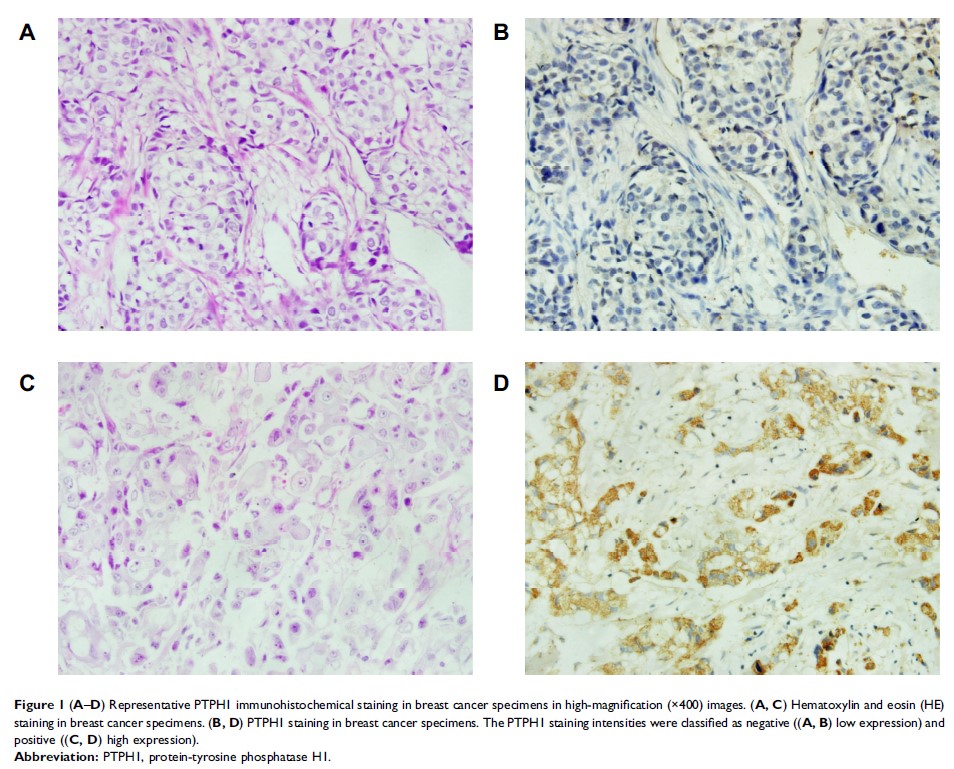
Patients and Methods: A total of 136 patients with invasive ductal carcinoma (IDC) of breast who underwent modified radical mastectomy and were treated with chemotherapy after operation at Qilu Hospital of Shandong University from December 2008 to October 2011 were included. PTPH1 expression was evaluated by immunohistochemistry in surgical specimens retrospectively collected from patients with histologically proven invasive ductal breast cancer. Kaplan–Meier survival analysis and Cox regression analysis were performed to assess the prognostic significance of PTPH1 expression. A prognostic factor for disease-free survival (DFS) was identified by univariate and multivariate analyses. ROC analysis was used to evaluate the performance of single factors and combined feature.
Results: One hundred and thirty-six patients were included in the analysis. By cut-point survival analysis, MLNR cut-off was designed as 0.2. On multivariate analysis, a MLNR> 0.2 was associated with a worse DFS (HR=2.581, 95% CI=1.303– 5.113, P =0.007). PTPH1 overexpression is correlated with a better DFS (HR=0.391, 95% CI=0.162– 0.945, P =0.037). In addition, MLNR and PTPH1 combined feature had better performance in predicting clinical outcomes after surgery long before recurrence had occurred (Area under the curve=0.795 [95% CI=0.694– 0.896], P < 0.001).
Conclusion: These findings indicate that both PTPH1 and MLNR are accurate independent prognostic parameters in patients with IDC of the breast. Better information on IDC prognosis could be obtained from the combined feature.
Keywords: breast invasive ductal carcinoma, protein-tyrosine phosphatase H1, metastatic lymph node ratio, prognosis