115195
论文已发表
注册即可获取德孚的最新动态
IF 收录期刊
- 3.6 Breast Cancer (Dove Med Press)
- 4.3 Clin Epidemiol
- 2.6 Cancer Manag Res
- 3.2 Infect Drug Resist
- 4.1 Clin Interv Aging
- 6.1 Drug Des Dev Ther
- 4.1 Int J Chronic Obstr
- 8.7 Int J Nanomed
- 2.5 Int J Women's Health
- 3.2 Neuropsych Dis Treat
- 2.4 OncoTargets Ther
- 2.6 Patient Prefer Adher
- 2.6 Ther Clin Risk Manag
- 3.1 J Pain Res
- 3.5 Diabet Metab Synd Ob
- 4.5 Psychol Res Behav Ma
- 3.4 Nat Sci Sleep
- 2.4 Pharmgenomics Pers Med
- 2.6 Risk Manag Healthc Policy
- 4.6 J Inflamm Res
- 2.3 Int J Gen Med
- 3.9 J Hepatocell Carcinoma
- 3.3 J Asthma Allergy
- 2.5 Clin Cosmet Investig Dermatol
- 3.0 J Multidiscip Healthc

1,25(OH)2D3 通过调节 PI3K/AKT 信号通路增强大鼠骨髓多能性间充质基质细胞的血管生成
Authors Ye B, Weng Y, Lin S, Lin J, Huang Z, Huang W, Cai X
Received 7 July 2019
Accepted for publication 3 March 2020
Published 16 March 2020 Volume 2020:14 Pages 1157—1167
DOI https://doi.org/10.2147/DDDT.S222244
Checked for plagiarism Yes
Review by Single-blind
Peer reviewer comments 2
Editor who approved publication: Dr Sukesh Voruganti
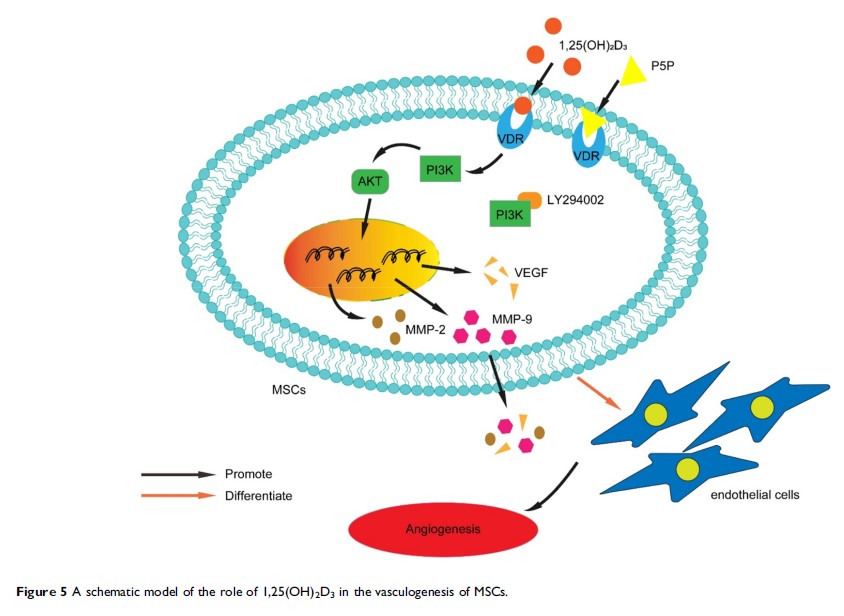
Background: Multipotent mesenchymal stromal cells (MSCs) have recently been reported to promote vasculogenesis by differentiating into endothelial cells and releasing numerous cytokines and paracrine factors. However, due to low cell activity, their potential for clinical application is not very satisfactory. This study aimed to explore the effects and mechanisms of 1,25-dihydroxyvitamin D (1,25(OH) 2D 3) on the vasculogenesis of MSCs.
Methods: MSCs were isolated from the femurs and tibias of rats and characterized by flow cytometry. After treatment with different concentrations of 1,25(OH) 2D 3 (0 μM, 0.1 μM and 1 μM), the proliferation of MSCs was analyzed by Cell Counting Kit-8 (CCK-8), and the migratory capability was measured by Transwell assays and cell scratch tests. Capillary-like structure formation was observed by using Matrigel. Western blotting was used to detect the expression of FLK-1 and vWF to investigate the differentiation of MSCs into endothelial cells. Western blotting and gelatin zymography were used to detect the expression and activities of VEGF, MMP-2 and MMP-9 secreted by MSCs under the influence of 1,25(OH) 2D 3. Finally, the VDR antagonist pyridoxal-5-phosphate (P5P) and the PI3K/AKT pathway inhibitor LY294002 were utilized to test the phosphorylation levels of key kinases in the PI3K/AKT pathway by Western blotting and the formation of capillary-like structures in Matrigel.
Results: The proliferation and migratory capability of MSCs and the ability of MSCs to form a tube-like structure in Matrigel were enhanced after treatment with 1,25(OH) 2D 3. Moreover, MSCs treated with 1,25(OH) 2D 3 showed high expression of vWF and Flk-1. There was a significant increase in the expression of VEGF, MMP-2 and MMP-9 secreted by MSCs treated with 1,25(OH) 2D 3, as well as in the activity of MMP-2 and MMP-9. The phosphorylation level of AKT increased with time after 1,25(OH) 2D 3 treatment, while LY294002 weakened AKT phosphorylation. In addition, the ability to form capillary-like structures was reduced when the VDR and PI3K/AKT pathways were blocked.
Conclusion: This study confirmed that 1,25(OH) 2D 3 treatment can strengthen the ability of MSCs to promote vasculogenesis in vitro, and the mechanism may be related to the activation of the PI3K/AKT pathway.
Keywords: multipotent mesenchymal stromal cells, 1,25-(OH) 2D 3, vasculogenesis, vitamin D receptor, PI3K/AKT pathway