115195
论文已发表
注册即可获取德孚的最新动态
IF 收录期刊
- 3.6 Breast Cancer (Dove Med Press)
- 4.3 Clin Epidemiol
- 2.6 Cancer Manag Res
- 3.2 Infect Drug Resist
- 4.1 Clin Interv Aging
- 6.1 Drug Des Dev Ther
- 4.1 Int J Chronic Obstr
- 8.7 Int J Nanomed
- 2.5 Int J Women's Health
- 3.2 Neuropsych Dis Treat
- 2.4 OncoTargets Ther
- 2.6 Patient Prefer Adher
- 2.6 Ther Clin Risk Manag
- 3.1 J Pain Res
- 3.5 Diabet Metab Synd Ob
- 4.5 Psychol Res Behav Ma
- 3.4 Nat Sci Sleep
- 2.4 Pharmgenomics Pers Med
- 2.6 Risk Manag Healthc Policy
- 4.6 J Inflamm Res
- 2.3 Int J Gen Med
- 3.9 J Hepatocell Carcinoma
- 3.3 J Asthma Allergy
- 2.5 Clin Cosmet Investig Dermatol
- 3.0 J Multidiscip Healthc

虚拟触摸成像定量的定性评估:一种简单而有用的乳腺病变诊断方法
Authors Zhu Y, Jia X, Zhou W, Zhan W, Zhou J
Received 10 December 2019
Accepted for publication 21 February 2020
Published 18 March 2020 Volume 2020:12 Pages 2037—2045
DOI https://doi.org/10.2147/CMAR.S241815
Checked for plagiarism Yes
Review by Single-blind
Peer reviewer comments 2
Editor who approved publication: Professor Nakshatri
Objective: To test the value of qualitative virtual touch imaging quantification (VTIQ) features in differentiating benign from malignant breast lesions.
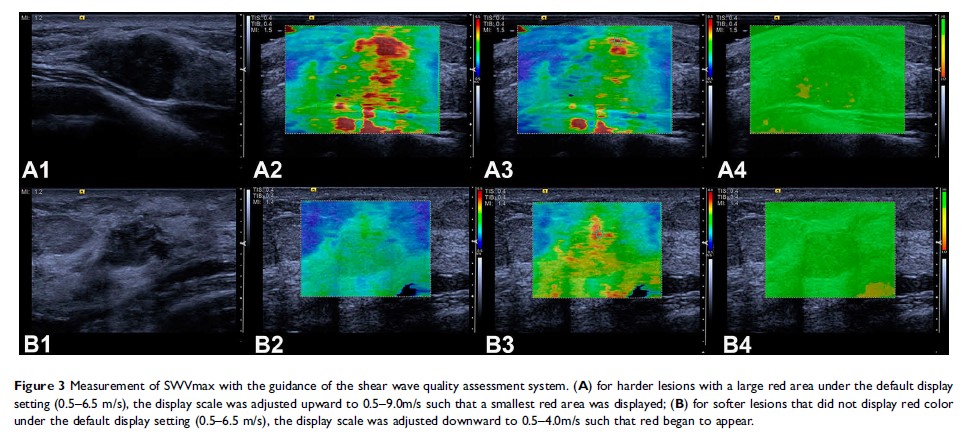
Methods: From November 2016 to August 2017, 230 lesions were subjected to conventional US and virtual touch imaging quantification before biopsy. The maximum shear wave velocity (SWVmax) was measured using a standardized method. Qualitative VTIQ features, including the “stiff rim” sign and color pattern classification, were assessed according to a binary classification. The sensitivity, specificity and area under the receiver operating curve (AUC) of Breast Imaging Reporting and Data System (BI-RADS), SWVmax, qualitative VTIQ features, and combined data were compared.
Results: Among the 230 breast lesions, 150 were benign and 80 were malignant. Compared to the benign lesions, the malignant ones had higher SWVmax values and were more likely to show the “stiff rim” sign and VTIQ pattern 2 (P < 0.001 for all). The AUC value was 0.885 for the qualitative VTIQ combination (the presence of the “stiff rim” sign and/or the display of VTIQ pattern 2), similar to that for SWVmax (P=0.472). BI-RADS combined with the qualitative VTIQ combination and with SWVmax yielded similar results, including significantly higher AUC values (P = 0.018 and 0.014, respectively), significantly higher specificities (P< 0.001 for both), and nonsignificantly decreased sensitivities (P = 0.249 for both) compared to BI-RADS alone.
Conclusion: The dual-category classification of qualitative VTIQ features according to the presence of the “stiff rim” sign and/or the classification of VTIQ pattern 2 is a simple and useful method that may be representative of quantitative VTIQ parameters in the evaluation of breast masses.
Keywords: breast, ultrasound, elastography