115195
论文已发表
注册即可获取德孚的最新动态
IF 收录期刊
- 3.6 Breast Cancer (Dove Med Press)
- 4.3 Clin Epidemiol
- 2.6 Cancer Manag Res
- 3.2 Infect Drug Resist
- 4.1 Clin Interv Aging
- 6.1 Drug Des Dev Ther
- 4.1 Int J Chronic Obstr
- 8.7 Int J Nanomed
- 2.5 Int J Women's Health
- 3.2 Neuropsych Dis Treat
- 2.4 OncoTargets Ther
- 2.6 Patient Prefer Adher
- 2.6 Ther Clin Risk Manag
- 3.1 J Pain Res
- 3.5 Diabet Metab Synd Ob
- 4.5 Psychol Res Behav Ma
- 3.4 Nat Sci Sleep
- 2.4 Pharmgenomics Pers Med
- 2.6 Risk Manag Healthc Policy
- 4.6 J Inflamm Res
- 2.3 Int J Gen Med
- 3.9 J Hepatocell Carcinoma
- 3.3 J Asthma Allergy
- 2.5 Clin Cosmet Investig Dermatol
- 3.0 J Multidiscip Healthc

重复剖宫产麻醉效果不足的风险要高于初次剖宫产:通过倾向评分匹配分析进行的回顾性研究
Authors Yang G, Bao X, Peng J, Li J, Yan G, Jing S, Li H, Duan G
Received 2 September 2019
Accepted for publication 7 March 2020
Published 18 March 2020 Volume 2020:13 Pages 555—563
DOI https://doi.org/10.2147/JPR.S229566
Checked for plagiarism Yes
Review by Single-blind
Peer reviewer comments 2
Editor who approved publication: Dr E Alfonso Romero-Sandoval
Purpose: This study aimed to compare the analgesic outcomes between primary and repeated cesarean delivery.
Patients and Methods: We performed a retrospective analysis based on the medical records of a teaching hospital in China from January 2018 to March 2019. We collected data on demographic characteristics, perioperative complications, anesthesia, and surgical factors for cesarean delivery patients. We also recorded the postoperative analgesic strategy, pain intensity (assessed by the number rating scale) during the first 48 hrs after surgery, hospital cost, and hospital stay. Postoperative inadequate analgesia was defined by a score of ≥ 4 in the number rating scale. Analgesic outcomes after cesarean delivery between primiparas and multiparas were compared using propensity score matching analysis. Moreover, subgroup logistic analysis for different age groups (≥ 35 and < 35 years) was performed to investigate the effect of the maternal category on postoperative inadequate analgesia.
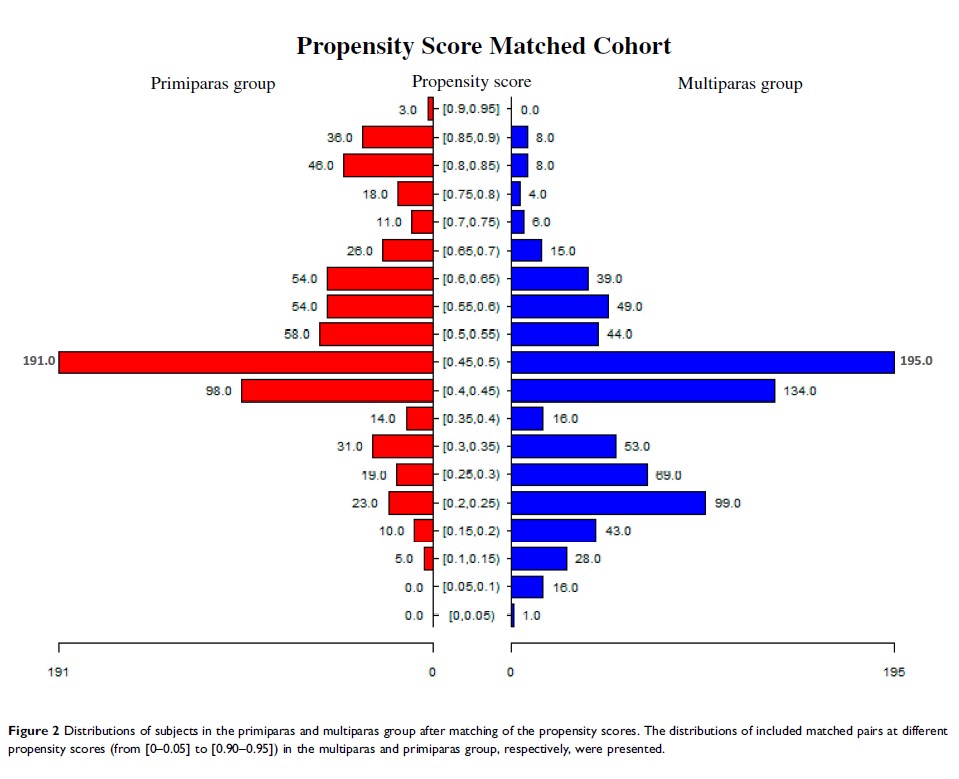
Results: A total of 1543 patients were included in the analysis and 571 pairs (1142 patients) were matched in the primiparas and multiparaparas group according to their propensity score. In both the non-matched and matched cohort, the incidence of inadequate analgesia in the primiparas group was lower than that in the multiparas group (16.7% vs. 24.0%, P < 0.001 and 16.1% vs. 23.5%, P = 0.002; respectively). The multiparas group was identified as being at risk of inadequate analgesia after cesarean delivery in both age groups (age ≥ 35 years, odds ratio: 2.18, 95% confidence interval: 1.20– 3.95; age < 35 years, odds ratio: 1.43, 95% confidence interval 1.08– 1.89).
Conclusion: Multiparas that undergo a repeat cesarean delivery had a significantly higher risk of inadequate postoperative pain treatment than primiparas. The maternal category should be considered when formulating the postoperative analgesia strategy after cesarean delivery.
Keywords: cesarean delivery, analgesia, primipara, multipara