115195
论文已发表
注册即可获取德孚的最新动态
IF 收录期刊
- 3.6 Breast Cancer (Dove Med Press)
- 4.3 Clin Epidemiol
- 2.6 Cancer Manag Res
- 3.2 Infect Drug Resist
- 4.1 Clin Interv Aging
- 6.1 Drug Des Dev Ther
- 4.1 Int J Chronic Obstr
- 8.7 Int J Nanomed
- 2.5 Int J Women's Health
- 3.2 Neuropsych Dis Treat
- 2.4 OncoTargets Ther
- 2.6 Patient Prefer Adher
- 2.6 Ther Clin Risk Manag
- 3.1 J Pain Res
- 3.5 Diabet Metab Synd Ob
- 4.5 Psychol Res Behav Ma
- 3.4 Nat Sci Sleep
- 2.4 Pharmgenomics Pers Med
- 2.6 Risk Manag Healthc Policy
- 4.6 J Inflamm Res
- 2.3 Int J Gen Med
- 3.9 J Hepatocell Carcinoma
- 3.3 J Asthma Allergy
- 2.5 Clin Cosmet Investig Dermatol
- 3.0 J Multidiscip Healthc

性别、低白蛋白和氧气水平是老年髋部骨折患者围手术期肺炎的危险因素
Authors Wang X, Dai L, Zhang Y, Lv Y
Received 10 December 2019
Accepted for publication 7 March 2020
Published 19 March 2020 Volume 2020:15 Pages 419—424
DOI https://doi.org/10.2147/CIA.S241592
Checked for plagiarism Yes
Review by Single-blind
Peer reviewer comments 2
Editor who approved publication: Dr Zhi-Ying Wu
Introduction: Pneumonia is a serious complication following hip fracture and is the primary risk factor for 30-day mortality after surgery. Modifying several laboratory factors may improve the outcomes of fragile hip fracture patients who are 80 years or older.
Purpose: To investigate several adjustable factors for perioperative pneumonia in order to improve patient prognosis and reduce mortality.
Patients and Methods: We retrospectively reviewed in-hospital hip fracture data from patients who were 80 years or over between January 1, 2014, and November 31, 2014, from Beijing Jishuitan Hospital. Patients were divided into two groups: perioperative pneumonia (POP) group and non-perioperative pneumonia (non-POP) group. Logistic regression models were used to identify independent risk factors. Statistical significance was set at 5% (p< 0.05).
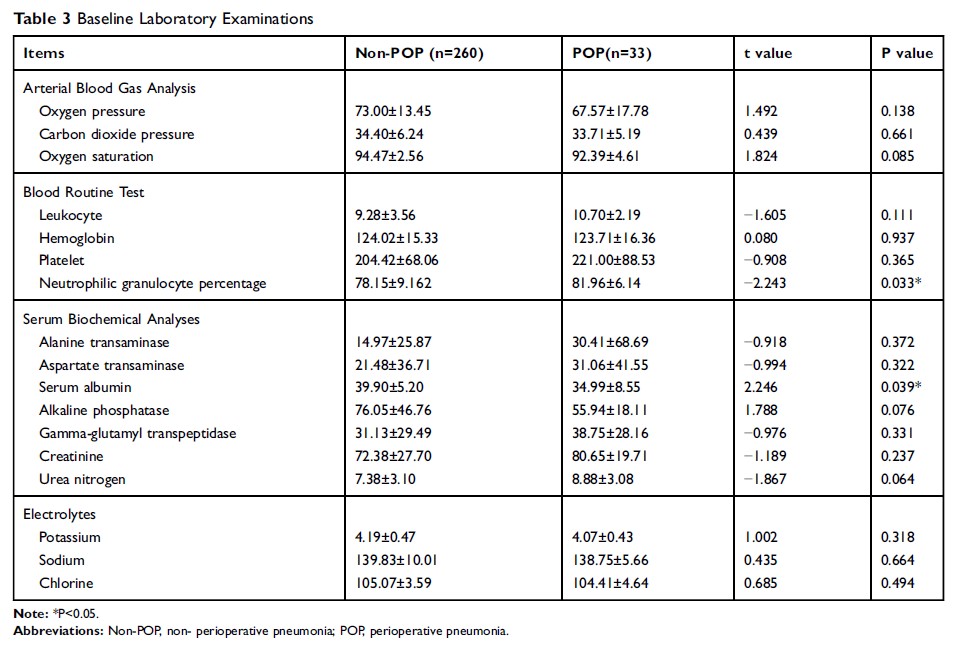
Results: The incidence of perioperative pneumonia (POP) in patients 80 years and older was 11.3% (33/293). Male patients had a higher incidence of POP (20/96 cases, 20.83%) compared to females (13/197, 6.6%)(P< 0.001). Higher neutrophilic granulocyte percentages (78.148%± 9.162% in POP vs 81.959%± 6.142% in Non-POP, P=0.033) and lower albumin levels (χ2=2.25, P=0.039) were observed in the POP group at baseline. After multivariate logistic regression, we observed that males (OR=3.402, P=0.048), lower albumin levels (OR=10.16, P=0.001) and PaO2 levels (OR=2.916, P=0.007) were independent risk factors for POP.
Conclusion: Low albumin and oxygen levels and the male gender were risk factors for perioperative pneumonia in geriatric hip fracture patients.
Keywords: hip fracture, pneumonia, elderly, perioperative, male, hypoalbuminemia, arterial blood gas analysis