117333
论文已发表
注册即可获取德孚的最新动态
IF 收录期刊
- 3.6 Breast Cancer (Dove Med Press)
- 4.3 Clin Epidemiol
- 2.6 Cancer Manag Res
- 3.2 Infect Drug Resist
- 4.1 Clin Interv Aging
- 6.1 Drug Des Dev Ther
- 4.1 Int J Chronic Obstr
- 8.7 Int J Nanomed
- 2.5 Int J Women's Health
- 3.2 Neuropsych Dis Treat
- 2.4 OncoTargets Ther
- 2.6 Patient Prefer Adher
- 2.6 Ther Clin Risk Manag
- 3.1 J Pain Res
- 3.5 Diabet Metab Synd Ob
- 4.5 Psychol Res Behav Ma
- 3.4 Nat Sci Sleep
- 2.4 Pharmgenomics Pers Med
- 2.6 Risk Manag Healthc Policy
- 4.6 J Inflamm Res
- 2.3 Int J Gen Med
- 3.9 J Hepatocell Carcinoma
- 3.3 J Asthma Allergy
- 2.5 Clin Cosmet Investig Dermatol
- 3.0 J Multidiscip Healthc

白蛋白与碱性磷酸酶的比率与乙型肝炎病毒阳性肝细胞癌(HCC)患者的良好预后相关
Authors Li Q, Lyu Z, Wang L, Li F, Yang Z, Ren W
Received 12 December 2019
Accepted for publication 26 February 2020
Published 20 March 2020 Volume 2020:13 Pages 2377—2384
DOI https://doi.org/10.2147/OTT.S242034
Checked for plagiarism Yes
Review by Single-blind
Peer reviewer comments 4
Editor who approved publication: Prof. Dr. Takuya Aoki
Purpose: The aim of this study was to investigate the prognostic significance of preoperative AAPR in hepatitis B virus-related hepatocellular carcinoma patients after curative hepatectomy.
Patients and Methods: A total of 221 patients with hepatitis B virus-related HCC patients who received curative liver resection were included. After propensity matching analysis, 188 patients were enrolled in the final analysis. COX regression analyses were used to analyze the prognosis value of AAPR and other prognostic factors. The overall survival (OS) and recurrence-free survival (RFS) curves were constructed and compared between different groups.
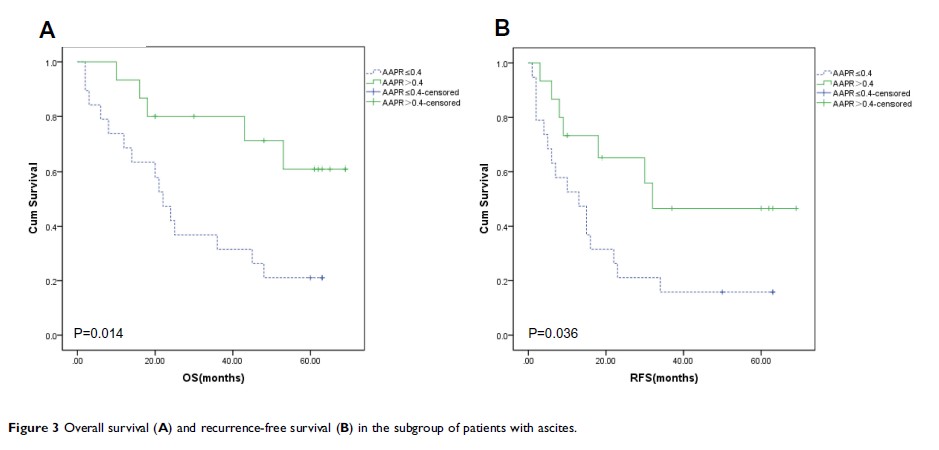
Results: The optimal cutoff of AAPR was defined as 0.40 with X-tile software. According to cutoff value, patients were divided into low-AAPR group (≤ 0.40) and high-AAPR group (> 0.40). The cumulative 1-, 3-, and 5-year OS rates were 97.1%, 78.2%, and 67.3% in patients with AAPR> 0.40 group, respectively, which were significantly higher than those in the AAPR≤ 0.40 group (80.2%, 54.4%, and 40.1%, respectively) (P < 0.001). In the multivariate COX regression analysis, AAPR, tumor number, ascites, and portal vein tumor thrombus (PVTT) were independent risk factors for OS and RFS.
Conclusion: AAPR shows promise as a reliable prognostic factor in patients with hepatitis B virus-related HCC after curative hepatectomy, which could be used as a routine inspection of HCC patients before surgery.
Keywords: albumin-to-alkaline phosphatase ratio, prognosis, hepatitis B virus, hepatocellular carcinoma