115195
论文已发表
注册即可获取德孚的最新动态
IF 收录期刊
- 3.6 Breast Cancer (Dove Med Press)
- 4.3 Clin Epidemiol
- 2.6 Cancer Manag Res
- 3.2 Infect Drug Resist
- 4.1 Clin Interv Aging
- 6.1 Drug Des Dev Ther
- 4.1 Int J Chronic Obstr
- 8.7 Int J Nanomed
- 2.5 Int J Women's Health
- 3.2 Neuropsych Dis Treat
- 2.4 OncoTargets Ther
- 2.6 Patient Prefer Adher
- 2.6 Ther Clin Risk Manag
- 3.1 J Pain Res
- 3.5 Diabet Metab Synd Ob
- 4.5 Psychol Res Behav Ma
- 3.4 Nat Sci Sleep
- 2.4 Pharmgenomics Pers Med
- 2.6 Risk Manag Healthc Policy
- 4.6 J Inflamm Res
- 2.3 Int J Gen Med
- 3.9 J Hepatocell Carcinoma
- 3.3 J Asthma Allergy
- 2.5 Clin Cosmet Investig Dermatol
- 3.0 J Multidiscip Healthc

HIF-1α、TWIST-1 和 ITGB-1 与肿瘤的僵硬度相关,是乳腺癌对新辅助化疗的病理反应的新型预测标志物
Authors Zhang J, Zhang S, Gao S, Ma Y, Tan X, Kang Y, Ren W
Received 17 January 2020
Accepted for publication 10 March 2020
Published 24 March 2020 Volume 2020:12 Pages 2209—2222
DOI https://doi.org/10.2147/CMAR.S246349
Checked for plagiarism Yes
Review by Single-blind
Peer reviewer comments 2
Editor who approved publication: Dr Ahmet Emre Eskazan
Purpose: To investigate the relationship between hypoxia-inducible factor 1-alpha (HIF-1α), Twist family BHLH transcription factor 1 (TWIST-1), and β 1 integrin (ITGB-1) expression and tumor stiffness, and evaluate performance of HIF-1α, TWIST-1, and ITGB-1 alone and in combination with Ki-67 for predicting pathological responses to neoadjuvant chemotherapy (NACT) in breast cancer (BC).
Patients and Methods: This was a prospective cohort study of 104 BC patients receiving NACT. Tumor stiffness and oxygen score (OS) were evaluated before NACT by shear-wave elastography and optical imaging; HIF-1α, TWIST-1, ITGB-1, and Ki-67 expression were quantitatively assessed by immunohistochemistry of paraffin-embedded tumor samples obtained by core needle biopsy. Indexes were compared among different residual cancer burden (RCB) groups, and associations of HIF-1α, TWIST-1, ITGB-1, and Ki-67 with tumor stiffness and OS were examined. The value of HIF-1α, TWIST-1, ITGB-1, and Ki-67, and a possible new combined index (predRCB) for predicting NACT responses was assessed by receiver operating characteristic (ROC) curves.
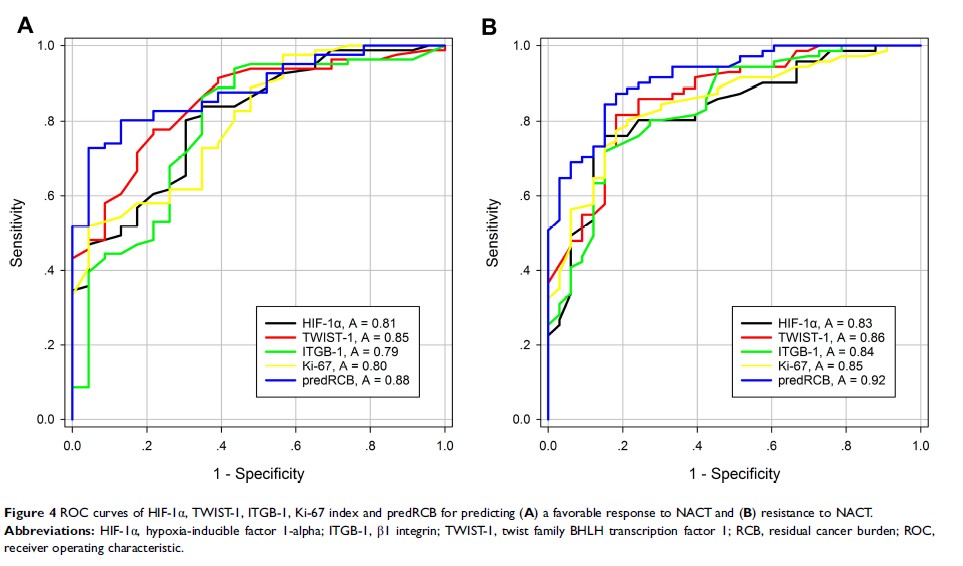
Results: HIF-1α, TWIST-1, and ITGB-1 expression were positively correlated with tumor stiffness and negatively with OS. Area under the ROC curves (AUCs) measuring the performance of HIF-1α, TWIST-1, ITGB-1, and Ki-67 for predicting responses to NACT were 0.81, 0.85, 0.79, and 0.80 for favorable responses, and 0.83, 0.86, 0.84, and 0.85 for resistant responses, respectively. PredRCB showed better prediction than the other individual indexes for favorable responses (AUC = 0.88) and resistant responses (AUC = 0.92).
Conclusion: HIF-1α, TWIST-1, ITGB-1, and Ki-67 performed well in predicting favorable responses and resistance to NACT, and predRCB improved the predictive power of the individual indexes. These results support individualized treatment of BC patients receiving NACT.
Keywords: HIF-1α, TWIST-1, ITGB-1, neoadjuvant chemotherapy, breast cancer, prediction