117333
论文已发表
注册即可获取德孚的最新动态
IF 收录期刊
- 3.6 Breast Cancer (Dove Med Press)
- 4.3 Clin Epidemiol
- 2.6 Cancer Manag Res
- 3.2 Infect Drug Resist
- 4.1 Clin Interv Aging
- 6.1 Drug Des Dev Ther
- 4.1 Int J Chronic Obstr
- 8.7 Int J Nanomed
- 2.5 Int J Women's Health
- 3.2 Neuropsych Dis Treat
- 2.4 OncoTargets Ther
- 2.6 Patient Prefer Adher
- 2.6 Ther Clin Risk Manag
- 3.1 J Pain Res
- 3.5 Diabet Metab Synd Ob
- 4.5 Psychol Res Behav Ma
- 3.4 Nat Sci Sleep
- 2.4 Pharmgenomics Pers Med
- 2.6 Risk Manag Healthc Policy
- 4.6 J Inflamm Res
- 2.3 Int J Gen Med
- 3.9 J Hepatocell Carcinoma
- 3.3 J Asthma Allergy
- 2.5 Clin Cosmet Investig Dermatol
- 3.0 J Multidiscip Healthc

食管鳞状细胞癌多种积极治疗与预后之间的关联
Authors Yang Y, Jia J, Sun Z, Liu C, Xiao Y, Yu J, Du F, Zhang X
Received 18 December 2019
Accepted for publication 15 March 2020
Published 24 March 2020 Volume 2020:12 Pages 2177—2184
DOI https://doi.org/10.2147/CMAR.S242780
Checked for plagiarism Yes
Review by Single-blind
Peer reviewer comments 2
Editor who approved publication: Dr Sanjeev Srivastava
Purpose: Esophageal squamous cell carcinoma (ESCC) is a critical threat to health and life. More than half of ESCC patients have recurrent or metastatic disease. Most late-stage patients undergo first-line treatment but experience further progression. Many of these patients have good performance status and are able to receive second-line therapy and even further treatments rather than best supportive care. Our analysis aimed to explore whether multiple lines of active treatment are beneficial in ESCC patients.
Methods: We conducted a retrospective cohort study. Univariate and multivariate survival analyses were used to identify whether the number of active treatment lines was related to prognosis. All analyses and the corresponding survival curves were based on the Cox proportional hazard regression model and the Kaplan–Meier method. Comparisons between groups were conducted using the t-test, chi-square test, and Fisher’s exact test, as applicable.
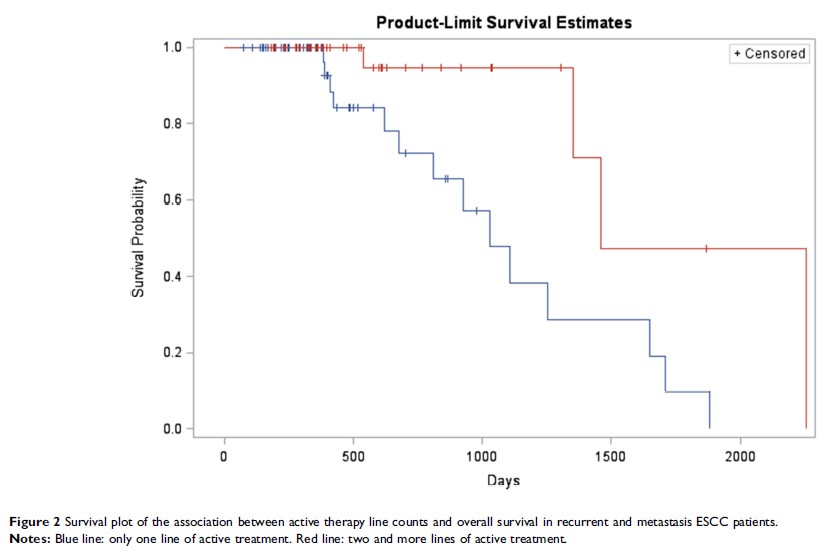
Results: Of a total of 138 patients with recurrent or metastatic disease, 66 (61.1%) received one line of active treatment, and 42 (38.9%) patients received two and more lines. Multiple lines of active therapy were statistically significantly associated with better prognosis (crude hazard ratio (HR) (95% confidence interval (CI))=0.21 (0.06– 0.73)), even after adjusting for relevant confounders (adjusted HR (95% CI)=0.19 (0.04– 0.86)). More grade 3– 4 hepatotoxicity patients were observed in the multiple-line treatment group (p=0.033). A small number of patients were cured by palliative management; these patients were more likely to have received both systematic and local treatment than other patients with repeated progression (9/15 versus 40/117, p=0.051).
Conclusion: Multiple lines of active treatment are related to prolonged survival in recurrent and metastatic ESCC patients, and adverse effects are acceptable. Comprehensive therapy modalities are recommended.
Keywords: multiple lines of active treatment, esophageal squamous cell carcinoma, prognosis