117333
论文已发表
注册即可获取德孚的最新动态
IF 收录期刊
- 3.6 Breast Cancer (Dove Med Press)
- 4.3 Clin Epidemiol
- 2.6 Cancer Manag Res
- 3.2 Infect Drug Resist
- 4.1 Clin Interv Aging
- 6.1 Drug Des Dev Ther
- 4.1 Int J Chronic Obstr
- 8.7 Int J Nanomed
- 2.5 Int J Women's Health
- 3.2 Neuropsych Dis Treat
- 2.4 OncoTargets Ther
- 2.6 Patient Prefer Adher
- 2.6 Ther Clin Risk Manag
- 3.1 J Pain Res
- 3.5 Diabet Metab Synd Ob
- 4.5 Psychol Res Behav Ma
- 3.4 Nat Sci Sleep
- 2.4 Pharmgenomics Pers Med
- 2.6 Risk Manag Healthc Policy
- 4.6 J Inflamm Res
- 2.3 Int J Gen Med
- 3.9 J Hepatocell Carcinoma
- 3.3 J Asthma Allergy
- 2.5 Clin Cosmet Investig Dermatol
- 3.0 J Multidiscip Healthc

A Renal Impairment Subgroup Analysis of the Safety and Efficacy of Naldemedine for the Treatment of Opioid-Induced Constipation in Patients with Chronic Non-Cancer Pain Receiving Opioid Therapy
Authors Webster LR, Hale ME, Yamada T, Wild JE
Received 8 November 2019
Accepted for publication 7 March 2020
Published 24 March 2020 Volume 2020:13 Pages 605—612
DOI https://doi.org/10.2147/JPR.S237833
Checked for plagiarism Yes
Review by Single-blind
Peer reviewer comments 3
Editor who approved publication: Dr E Alfonso Romero-Sandoval
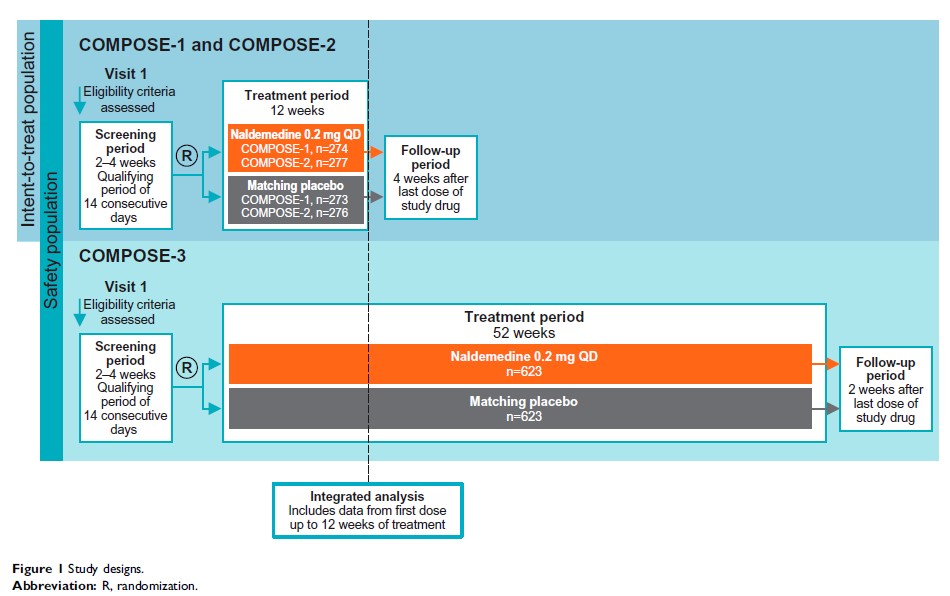
Purpose: Naldemedine, an oral, peripherally acting μ-opioid receptor antagonist approved for the treatment of opioid-induced constipation (OIC), is renally excreted. This subgroup analysis integrated data from 3 Phase 3 trials (COMPOSE-1, COMPOSE-2, COMPOSE-3) to evaluate the safety and efficacy of naldemedine in patients with renal impairment (RI).
Patients and Methods: Patients age 18– 80 years with chronic non-cancer pain (CNCP) and OIC received oral naldemedine 0.2 mg or placebo once daily. RI subgroups consisted of patients with normal function (baseline glomerular filtration rate ≥ 90 mL/min/1.73 m2), mild (≥ 60 to < 90 mL/min/1.73 m2), and moderate (≥ 30 to < 60 mL/min/1.73 m2) RI. Safety assessments based on ≤ 12 weeks of treatment from all 3 studies included incidence of treatment-emergent adverse events (TEAEs). Efficacy was based on the proportion of responders in COMPOSE-1 and COMPOSE-2 only, defined as ≥ 3 spontaneous bowel movements (SBMs)/week and a ≥ 1-SBM/week increase from baseline for ≥ 9 of 12 weeks and ≥ 3 of the last 4 weeks.
Results: In total, 2328 patients were included in this analysis. The incidence of TEAEs was similar in the naldemedine and placebo groups (overall, 47.1% vs 45.6%; normal, 44.6% vs 43.6%; mild RI, 49.0% vs 44.7%; moderate RI, 46.6% vs 55.9%). GI-related TEAEs occurred more frequently in the naldemedine group versus placebo (overall, 21.8% vs 13.8%; normal, 21.6% vs 12.5%; mild RI, 22.6% vs 14.7%; moderate RI, 18.0% vs 14.2%). A significantly greater proportion of patients in the naldemedine 0.2 mg group were responders versus the placebo group (overall, 50.1% vs 34.1%, P < 0.0001; normal, 52.0% vs 39.3%; mild RI, 48.3% vs 30.3%; moderate RI, 52.5% vs 31.7%).
Conclusion: This integrated analysis confirmed that OIC treatment with naldemedine 0.2 mg was generally well tolerated and effective in patients with CNCP and mild or moderate RI. Safety and efficacy results were consistent with the overall population.
Clinicaltrials.gov Registration: COMPOSE-1: NCT01965158; COMPOSE-2: NCT01993940; COMPOSE-3: NCT01965652.
Keywords: opioid-related disorders, opioid analgesics, naldemedine, renal insufficiency, constipation; chemically induced