117333
论文已发表
注册即可获取德孚的最新动态
IF 收录期刊
- 3.6 Breast Cancer (Dove Med Press)
- 4.3 Clin Epidemiol
- 2.6 Cancer Manag Res
- 3.2 Infect Drug Resist
- 4.1 Clin Interv Aging
- 6.1 Drug Des Dev Ther
- 4.1 Int J Chronic Obstr
- 8.7 Int J Nanomed
- 2.5 Int J Women's Health
- 3.2 Neuropsych Dis Treat
- 2.4 OncoTargets Ther
- 2.6 Patient Prefer Adher
- 2.6 Ther Clin Risk Manag
- 3.1 J Pain Res
- 3.5 Diabet Metab Synd Ob
- 4.5 Psychol Res Behav Ma
- 3.4 Nat Sci Sleep
- 2.4 Pharmgenomics Pers Med
- 2.6 Risk Manag Healthc Policy
- 4.6 J Inflamm Res
- 2.3 Int J Gen Med
- 3.9 J Hepatocell Carcinoma
- 3.3 J Asthma Allergy
- 2.5 Clin Cosmet Investig Dermatol
- 3.0 J Multidiscip Healthc

非小细胞肺癌中的 MET 原癌基因:MET 失调的机制和靶向 HGF/c-Met 轴的药物
Authors Liang H, Wang M
Received 16 September 2019
Accepted for publication 16 February 2020
Published 25 March 2020 Volume 2020:13 Pages 2491—2510
DOI https://doi.org/10.2147/OTT.S231257
Checked for plagiarism Yes
Review by Single-blind
Peer reviewer comments 2
Editor who approved publication: Dr Federico Perche
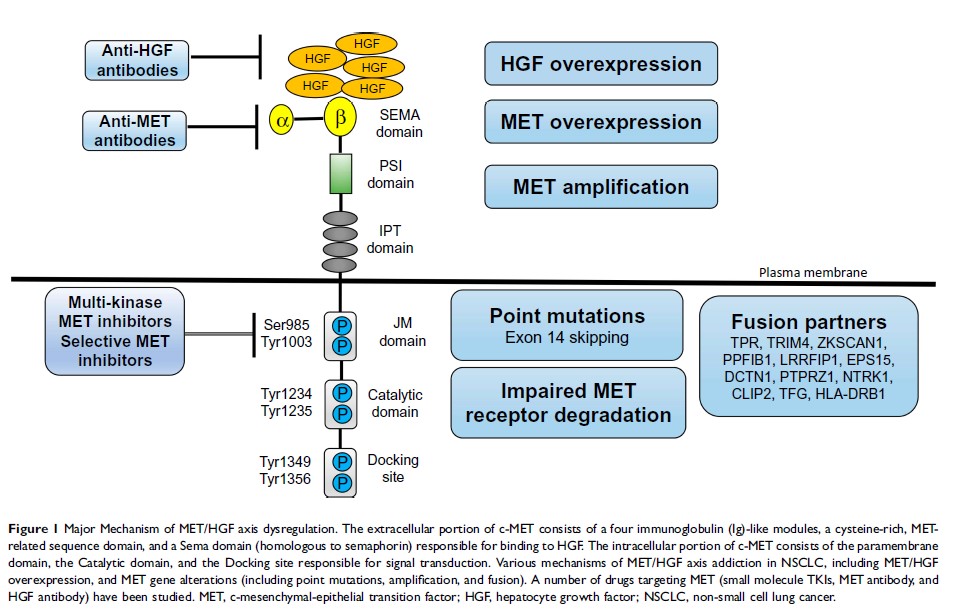
Abstract: Non-small cell lung cancer (NSCLC) is the leading cause of cancer-related death worldwide and has a poor prognosis. Current treatments for advanced NSCLC included traditional chemotherapy, radiotherapy, targeted therapy, and immunotherapy. The efficacy of targeted therapy relies on oncogene addiction. Mesenchymal-epithelial transition factor (MET) gene can encode unconventional receptor tyrosine kinases with pleiotropic functions, when signals are abnormally activated, it can initiate and maintain tumor transformation, promote cell proliferation, survival, tumor invasion and angiogenesis. Thus, it is a promising therapeutic target. Previous studies have shown that elevated levels of HGF and/or overexpression of c-Met are associated with poor prognosis in lung cancer. In preclinical and clinical trials, c-MET inhibitors have shown some antitumor activity in NSCLC. Although the efficacy results of MET inhibitors in Phase III clinical trials are disappointing, given the molecular heterogeneity of NSCLC, only subgroups of patients with MET gene alterations may benefit from c-MET inhibitors. The challenge for the future is to screen out the potential beneficiaries. To solve this problem, there is need for large data analysis for the detection methods and treatment effects, to establish standards that meet the MET activation status, and determine reliable thresholds to achieve effective patient stratification and clinical decision making. This article summarized the structure of the hepatocyte growth factor (HGF)/c-Met axis, the different mechanisms of MET addiction, as well as MET amplification as acquired resistance mechanism to epidermal growth factor receptor-tyrosine kinase inhibitors, the latest advances of MET inhibitors, and immuotherapy in the treatment of NSCLC with MET alterations.
Keywords: c-mesenchymal-epithelial transition, receptor tyrosine kinases, non-small cell lung cancer, treatment, oncogene addiction