117333
论文已发表
注册即可获取德孚的最新动态
IF 收录期刊
- 3.6 Breast Cancer (Dove Med Press)
- 4.3 Clin Epidemiol
- 2.6 Cancer Manag Res
- 3.2 Infect Drug Resist
- 4.1 Clin Interv Aging
- 6.1 Drug Des Dev Ther
- 4.1 Int J Chronic Obstr
- 8.7 Int J Nanomed
- 2.5 Int J Women's Health
- 3.2 Neuropsych Dis Treat
- 2.4 OncoTargets Ther
- 2.6 Patient Prefer Adher
- 2.6 Ther Clin Risk Manag
- 3.1 J Pain Res
- 3.5 Diabet Metab Synd Ob
- 4.5 Psychol Res Behav Ma
- 3.4 Nat Sci Sleep
- 2.4 Pharmgenomics Pers Med
- 2.6 Risk Manag Healthc Policy
- 4.6 J Inflamm Res
- 2.3 Int J Gen Med
- 3.9 J Hepatocell Carcinoma
- 3.3 J Asthma Allergy
- 2.5 Clin Cosmet Investig Dermatol
- 3.0 J Multidiscip Healthc

T1N0M0 食管癌患者通过内镜下黏膜切除术完全切除后复发和转移的风险:执行适当的观察和等待跟进策略的证据
Authors Zhu LH, Yao J, Wu T, Wang Y, Wang CW, Xue CQ, Wu LG, Fan XW, Wu CY
Received 8 September 2019
Accepted for publication 22 February 2020
Published 2 April 2020 Volume 2020:12 Pages 2427—2435
DOI https://doi.org/10.2147/CMAR.S227959
Checked for plagiarism Yes
Review by Single-blind
Peer reviewer comments 2
Editor who approved publication: Dr Yong Teng
Purpose: Endoscopic submucosal dissection (ESD) is a widely performed procedure for esophageal carcinoma when the depth of invasion reaches the epithelium and lamina propria. However, ESD for esophageal carcinoma with depth of invasion exceeding the muscularis mucosa is controversial. This study aimed to evaluate the long-term outcomes of ESD for T1N0M0 (tumor invading the mucosa and submucosa [T1], no regional lymph node metastasis [N0], no distant metastasis [M0]) esophageal cancer.
Patients and Methods: Esophageal cancer was evaluated via pathology and computed tomography (CT) in consecutive patients with negative margin and without additional therapy. A total of 84 patients were included. The mean follow-up time was 42 (range, 9– 99) months.
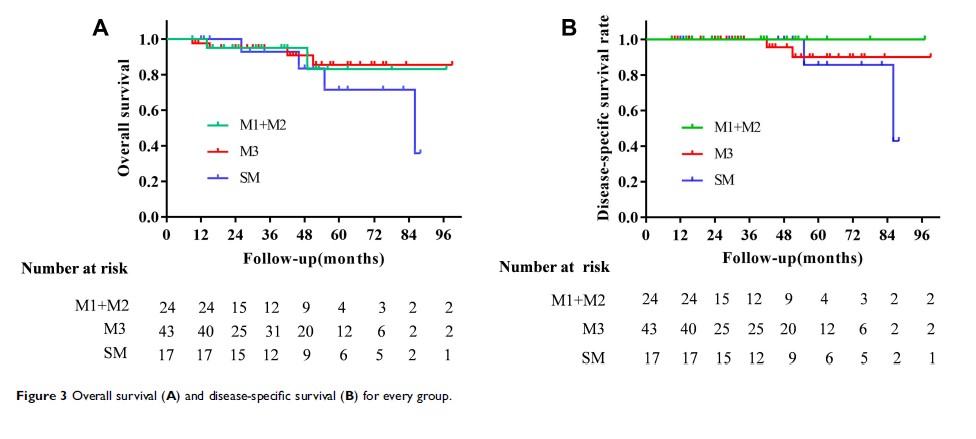
Results: No recurrence and metastasis were detected in the M1 and M2 group. The 5-year locoregional recurrence rate and distant metastasis rate were 4.2% and 5.6% for the M3 group and were 0% and 1.4% for the SM group, respectively. The 3- and 5-year overall survival were 94.4% (M1+M2 group, 95.0%; M3 group, 95.0%; SM group, 92.9%) and 80.9% (M1+M2 group, 95.0%; M3 group, 95.0%; SM group, 92.9%). Meanwhile, the 3- and 5-year disease-specific survival rates were 100% (M1+M2 group, 100%; M3 group, 100%; SM group, 100%) and 90.8% (M1+M2 group, 100%; M3 group, 90.0%; SM group, 85.7%). The major complications were postoperative strictures, most of which were grade 1– 2. In total, two (4.8%) and one (1.2%) patient developed grade 3 and 5 late esophageal strictures, respectively.
Conclusion: ESD complete resection yields low recurrence and metastasis rates in early esophageal cancer (T1N0M0). Thus, additional treatment is not necessary, and a watch and wait strategy may be reasonable.
Keywords: esophageal carcinoma, endoscopic therapy, endoscopic submucosal resection, recurrence and metastasis