117333
论文已发表
注册即可获取德孚的最新动态
IF 收录期刊
- 3.6 Breast Cancer (Dove Med Press)
- 4.3 Clin Epidemiol
- 2.6 Cancer Manag Res
- 3.2 Infect Drug Resist
- 4.1 Clin Interv Aging
- 6.1 Drug Des Dev Ther
- 4.1 Int J Chronic Obstr
- 8.7 Int J Nanomed
- 2.5 Int J Women's Health
- 3.2 Neuropsych Dis Treat
- 2.4 OncoTargets Ther
- 2.6 Patient Prefer Adher
- 2.6 Ther Clin Risk Manag
- 3.1 J Pain Res
- 3.5 Diabet Metab Synd Ob
- 4.5 Psychol Res Behav Ma
- 3.4 Nat Sci Sleep
- 2.4 Pharmgenomics Pers Med
- 2.6 Risk Manag Healthc Policy
- 4.6 J Inflamm Res
- 2.3 Int J Gen Med
- 3.9 J Hepatocell Carcinoma
- 3.3 J Asthma Allergy
- 2.5 Clin Cosmet Investig Dermatol
- 3.0 J Multidiscip Healthc

中国患者胸腺瘤相关重症肌无力(MG)的预后分析及其对 MG 治疗的意义:来自三级医院的经验
Authors Chen D, Peng Y, Li Z, Jin W, Zhou R, Li Y, Xu Q, Yang H
Received 23 December 2019
Accepted for publication 28 March 2020
Published 14 April 2020 Volume 2020:16 Pages 959—967
DOI https://doi.org/10.2147/NDT.S243519
Checked for plagiarism Yes
Review by Single-blind
Peer reviewer comments 2
Editor who approved publication: Professor Jun Chen
Background: Myasthenia gravis (MG) is an autoantibody-mediated neuromuscular disorder. Approximately 10– 20% of all MG patients experience thymoma (benign tumor arising from thymus tissue). Thymectomy has been the standard of care for thymomatous myasthenia gravis (TMG). However, the clinical outcome of TMG after thymectomy has not been sufficiently studied, especially the long-term prognosis. Therefore, the aim of this study was to analyze the clinical characteristics contributing to the prognostic factors of TMG.
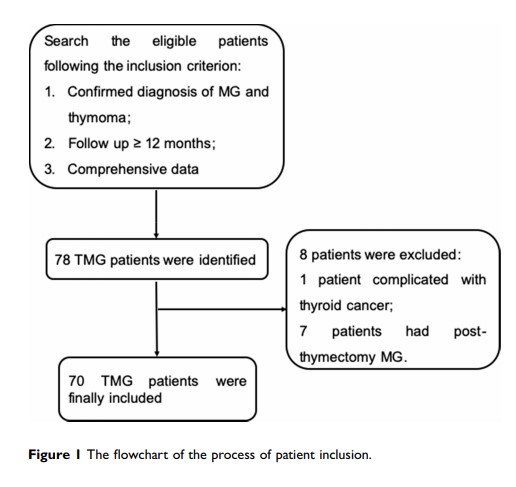
Methods: We reviewed 70 TMG patients in the Xiangya Hospital and classified them into the minimal manifestation (MM) group and No MM group, according to the long-term treatment outcome. MM-or-better status was defined as the goal treatment for TMG patients. We collected and analyzed the demographic data, the WHO classification of thymoma, MG-associated antibody levels, disease severity, treatment-related data as well as clinical outcome at six months. Variables selected by univariate analysis were used in the multivariate logistic regression model to identify the prognostic factors.
Results: The differences in clinical outcome at six months and worst QMGS were significant, while the differences in other factors were insignificant between groups. Clinical outcome at six months (OR=23.5 95% CI 2.4– 231.5, P=0.007) and dyspnea before thymectomy (OR=0.2, 95% CI 0.03– 0.75, P=0.021) were identified as the prognostic factors of long-term treatment.
Conclusion: Demographic and clinical features were similar in TMG patients treated at our hospital. The early achievement of MM-or-better status may indicate a good outcome in the long term. Dyspnea before thymectomy appears to associate with a poor prognosis.
Keywords: myasthenia gravis, thymoma, the WHO classification, clinical presentation, prognostic factors