117333
论文已发表
注册即可获取德孚的最新动态
IF 收录期刊
- 3.6 Breast Cancer (Dove Med Press)
- 4.3 Clin Epidemiol
- 2.6 Cancer Manag Res
- 3.2 Infect Drug Resist
- 4.1 Clin Interv Aging
- 6.1 Drug Des Dev Ther
- 4.1 Int J Chronic Obstr
- 8.7 Int J Nanomed
- 2.5 Int J Women's Health
- 3.2 Neuropsych Dis Treat
- 2.4 OncoTargets Ther
- 2.6 Patient Prefer Adher
- 2.6 Ther Clin Risk Manag
- 3.1 J Pain Res
- 3.5 Diabet Metab Synd Ob
- 4.5 Psychol Res Behav Ma
- 3.4 Nat Sci Sleep
- 2.4 Pharmgenomics Pers Med
- 2.6 Risk Manag Healthc Policy
- 4.6 J Inflamm Res
- 2.3 Int J Gen Med
- 3.9 J Hepatocell Carcinoma
- 3.3 J Asthma Allergy
- 2.5 Clin Cosmet Investig Dermatol
- 3.0 J Multidiscip Healthc

使用椎弓根螺钉固定的椎板分段切除术治疗胸椎黄韧带骨化:椎板截骨术和植骨技术的比较分析
Authors Zhang J, Lei T, Yang L, Lin YS, Wang ZH, Cao JM
Received 24 October 2019
Accepted for publication 4 March 2020
Published 17 April 2020 Volume 2020:16 Pages 311—319
DOI https://doi.org/10.2147/TCRM.S235868
Checked for plagiarism Yes
Review by Single-blind
Peer reviewer comments 2
Editor who approved publication: Professor Deyun Wang
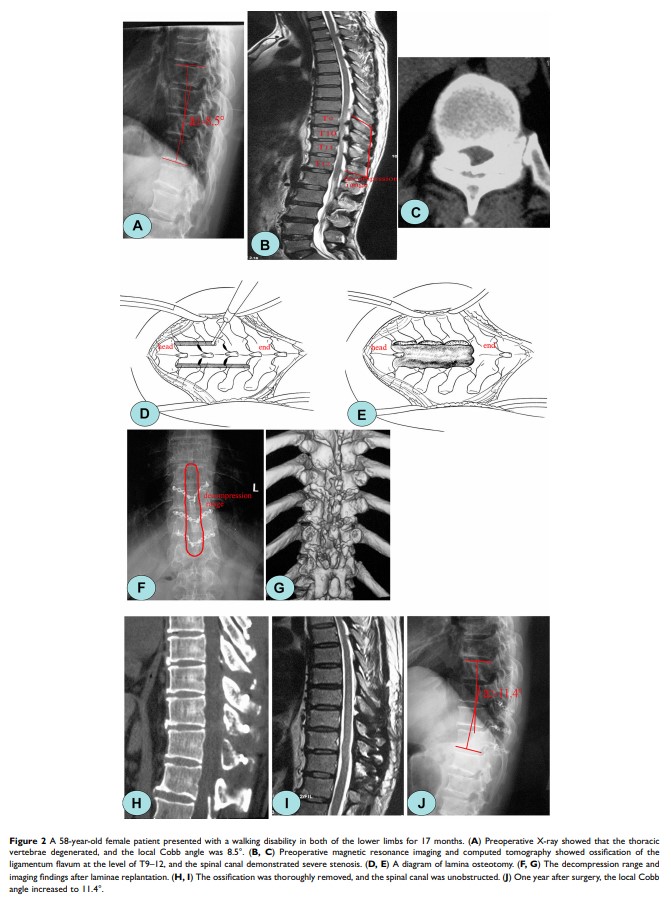
Background: There are many surgical procedures that can be used to relieve compression caused by thoracic ossification of the ligamentum flavum (TOLF). The present study aims to retrospectively observe the differences in subsection laminectomy with pedicle screw fixation (SLPF) and lamina osteotomy and replantation with miniplate fixation (LORF) in the treatment of continuous TOLF.
Patients and Methods: From March 2014 to October 2017, 61 patients with continuous TOLF underwent SLPF (group A) or LORF (group B). The surgical duration, intraoperative blood loss, change in thoracic kyphosis, and perioperative complications were analyzed. Neurological function was evaluated in accordance with the Japanese Orthopedic Association (JOA) score and the American Spinal Injury Association (ASIA) neurological grading.
Results: The surgical duration, intraoperative blood loss, and postoperative bed-rest duration in group A were significantly lower than those observed in group B (P < 0.05). Both groups demonstrated a significant improvement in JOA score and ASIA grade (P < 0.05). The neurological recovery rate was 69.8% ± 13.5% in group A and 68.5% ± 12.7% in group B (P > 0.05). There was also a significant improvement in ASIA grade at the final follow-up (P < 0.05). During follow-up, the Cobb angle was significantly increased in group B (P < 0.05), whereas no significant difference was observed in group A (P > 0.05). The occurrence rate of perioperative complications was 15.6% (5/32 patients) in group A and 37.9% (11/29 patients) in group B (P < 0.05).
Conclusion: Both SLPF and LORF significantly promote recovery of neurological function. SLPF has a shorter surgical duration, less intraoperative blood loss, and a lower complication rate. SLPF is more conducive to the correction of sagittal sequence and maintenance of thoracic stability.
Keywords: thoracic ossification of the ligamentum flavum, thoracic vertebra, posterior decompression, internal fixation, therapeutic effect analysis