117333
论文已发表
注册即可获取德孚的最新动态
IF 收录期刊
- 3.6 Breast Cancer (Dove Med Press)
- 4.3 Clin Epidemiol
- 2.6 Cancer Manag Res
- 3.2 Infect Drug Resist
- 4.1 Clin Interv Aging
- 6.1 Drug Des Dev Ther
- 4.1 Int J Chronic Obstr
- 8.7 Int J Nanomed
- 2.5 Int J Women's Health
- 3.2 Neuropsych Dis Treat
- 2.4 OncoTargets Ther
- 2.6 Patient Prefer Adher
- 2.6 Ther Clin Risk Manag
- 3.1 J Pain Res
- 3.5 Diabet Metab Synd Ob
- 4.5 Psychol Res Behav Ma
- 3.4 Nat Sci Sleep
- 2.4 Pharmgenomics Pers Med
- 2.6 Risk Manag Healthc Policy
- 4.6 J Inflamm Res
- 2.3 Int J Gen Med
- 3.9 J Hepatocell Carcinoma
- 3.3 J Asthma Allergy
- 2.5 Clin Cosmet Investig Dermatol
- 3.0 J Multidiscip Healthc

在中国接受替诺福韦治疗的肾功能正常的 HIV-1 感染患者 GFR 预估值之纵向进展
Authors Liu F, Xu A, Zhao H, Yang Z, Chen C, Ranieri B, Bao J, Zheng G, Wang M, Wang Y, Xun Y
Received 31 December 2019
Accepted for publication 27 March 2020
Published 17 April 2020 Volume 2020:16 Pages 299—310
DOI https://doi.org/10.2147/TCRM.S243913
Checked for plagiarism Yes
Review by Single-blind
Peer reviewer comments 2
Editor who approved publication: Professor Deyun Wang
Purpose: Estimated glomerular filtration rate (eGFR) decline in HIV-1-infected patients exposure to tenofovir disoproxil fumarate (TDF) has been widely assessed using linear models, but nonlinear assumption is not well validated. We constructed a retrospective cohort study to assess whether eGFR decline follows nonlinearity during antiviral therapy.
Patients and Methods: We examined 823 (299 of TDF users and 524 of non-TDF users) treatment-naïve HIV-1-infected participants (age ≥ 17 years, initial eGFR ≥ 90 mL/min/1.73m2). Estimated GFR trajectories were compared by one-linear and piecewise-linear mixed effects models, before and after propensity score matching, respectively. Whether the incidence of renal dysfunction (reduced renal function [RRF], eGFR < 90 mL/min/1.73 m2 and rapid kidney function decline [RKFD], eGFR > − 3 mL/min/1.73 m2/year) follows nonlinearity was assessed by logistic regression.
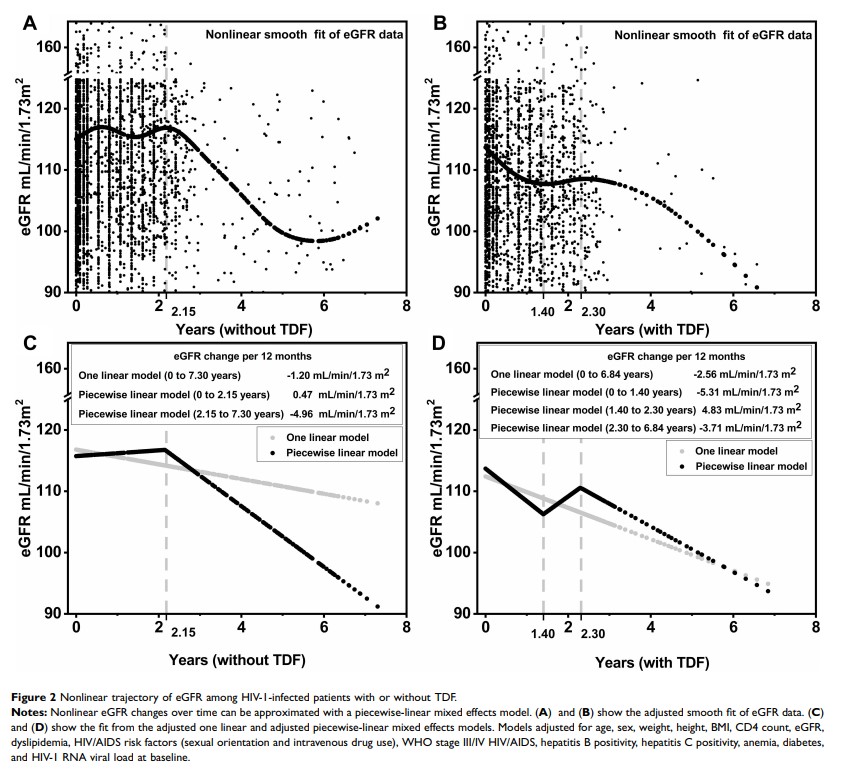
Results: The median follow-up time of this study was 10 (interquartile range, 2– 20) months, during which 178 (21.6%) experienced RRF, and 451 (54.8%) experienced RKFD. The slopes (mL/min/1.73 m2/year) of eGFR were − 5.31 (95% CI: − 6.57, − 4.06) before 1.40 years, 4.83 (95% CI: 1.38, 8.28) from years 1.40 to 2.30 and − 3.71 (95% CI: − 5.97, − 1.45) after 2.30 years among TDF users. Within years 1.40– 2.30, each year of TDF exposure was associated with a 78% decreased risk of RKFD (95% CI: − 91%, − 49%). In comparison, eGFR increased slightly at the initiation of antiviral therapy, declined after 2.15 years (− 4.96; 95% CI: − 5.76, − 4.17) among non-TDF users. Such a progression nonlinear trajectory was missed on the assumption of one-linearity, whether in TDF or non-TDF users.
Conclusion: Over the piecewise mixed-effects analyses with the advantage of revealing the true nature of the exposure outcome relationships, an interesting reverse S-shaped relationship was observed. A routine screen based on nonlinearity could be more helpful for patient management.
Keywords: nonlinear trajectory, renal function, human immunodeficiency virus-1