117333
论文已发表
注册即可获取德孚的最新动态
IF 收录期刊
- 3.6 Breast Cancer (Dove Med Press)
- 4.3 Clin Epidemiol
- 2.6 Cancer Manag Res
- 3.2 Infect Drug Resist
- 4.1 Clin Interv Aging
- 6.1 Drug Des Dev Ther
- 4.1 Int J Chronic Obstr
- 8.7 Int J Nanomed
- 2.5 Int J Women's Health
- 3.2 Neuropsych Dis Treat
- 2.4 OncoTargets Ther
- 2.6 Patient Prefer Adher
- 2.6 Ther Clin Risk Manag
- 3.1 J Pain Res
- 3.5 Diabet Metab Synd Ob
- 4.5 Psychol Res Behav Ma
- 3.4 Nat Sci Sleep
- 2.4 Pharmgenomics Pers Med
- 2.6 Risk Manag Healthc Policy
- 4.6 J Inflamm Res
- 2.3 Int J Gen Med
- 3.9 J Hepatocell Carcinoma
- 3.3 J Asthma Allergy
- 2.5 Clin Cosmet Investig Dermatol
- 3.0 J Multidiscip Healthc

颗粒状基因家族可以作为结肠癌的新型生物标志物
Authors Yuan M, Wang J, Fang F
Received 17 December 2019
Accepted for publication 22 February 2020
Published 17 April 2020 Volume 2020:13 Pages 3237—3245
DOI https://doi.org/10.2147/OTT.S242763
Checked for plagiarism Yes
Review by Single-blind
Peer reviewer comments 2
Editor who approved publication: Dr XuYu Yang
Objective: The Grainyhead-like (GRHL) genes family were reported to participate in the development of a number of diseases. This study was designed to investigate the role of GRHL genes family in colon cancer (CC).
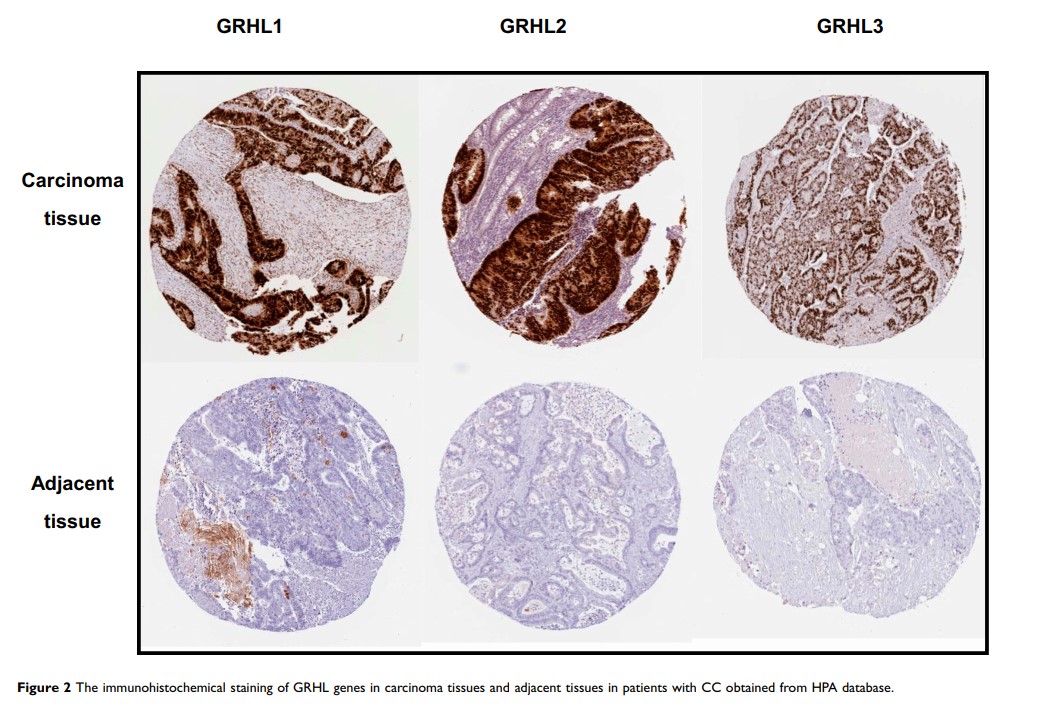
Methods: In this study, the transcriptional levels of GRHL genes family in patients with CC from GEPIA were explored. Meanwhile, the immunohistochemical data of the GRHL genes family were also obtained in the HPA database. Additionally, we re-identified the mRNA of these genes via real-time PCR. Furthermore, the association between the levels of GRHL genes and stage plot as well as survival condition including overall survival and disease-free survival of patients with CC was analyzed. Finally, by transfecting with specific-siRNA, clone formation assay was performed to observe the role of GRHL genes family in the proliferation of SW480 human colon cancer cells.
Results: We found that the mRNA and protein levels of GRHL1 , GRHL2 and GRHL3 were significantly higher in CC tissues than in normal colon tissues. Additionally, GRHL1 , GRHL2 and GRHL3 were significantly associated with the stages of CC. The Kaplan–Meier plotter showed that the low levels of GRHL1 , GRHL2 and GRHL3 conferred a better overall survival of patients with CC while the high levels of GRHL1 and GRHL3 were associated with poor disease-free survival. Knockdown of GRHL1 , GRHL2 and GRHL3 siHgnificantly inhibited the ability of colony formation of human colon cancer cells.
Conclusion: Our study demonstrated that GRHL genes are involved in the prognosis and survival in patients with CC, the inhibition of which may suppress the proliferation of colon cancer cells.
Keywords: colon cancer, Grainyhead-like genes family, prognosis, biomarkers, bioinformatics