117333
论文已发表
注册即可获取德孚的最新动态
IF 收录期刊
- 3.6 Breast Cancer (Dove Med Press)
- 4.3 Clin Epidemiol
- 2.6 Cancer Manag Res
- 3.2 Infect Drug Resist
- 4.1 Clin Interv Aging
- 6.1 Drug Des Dev Ther
- 4.1 Int J Chronic Obstr
- 8.7 Int J Nanomed
- 2.5 Int J Women's Health
- 3.2 Neuropsych Dis Treat
- 2.4 OncoTargets Ther
- 2.6 Patient Prefer Adher
- 2.6 Ther Clin Risk Manag
- 3.1 J Pain Res
- 3.5 Diabet Metab Synd Ob
- 4.5 Psychol Res Behav Ma
- 3.4 Nat Sci Sleep
- 2.4 Pharmgenomics Pers Med
- 2.6 Risk Manag Healthc Policy
- 4.6 J Inflamm Res
- 2.3 Int J Gen Med
- 3.9 J Hepatocell Carcinoma
- 3.3 J Asthma Allergy
- 2.5 Clin Cosmet Investig Dermatol
- 3.0 J Multidiscip Healthc

颈椎间盘置换术后自发融合:病例报告和文献回顾
Authors Ge CY, Wang J, Zhang BF, Hui H, Shan LQ, Zhao QP, Hao DJ
Received 17 December 2019
Accepted for publication 3 April 2020
Published 21 April 2020 Volume 2020:13 Pages 771—776
DOI https://doi.org/10.2147/JPR.S242646
Checked for plagiarism Yes
Review by Single-blind
Peer reviewer comments 3
Editor who approved publication: Dr E Alfonso Romero-Sandoval
Objective: To report a rare case of spontaneous fusion (SF) following cervical disc arthroplasty (CDA), to review the related literature, and to propose a new measure to prevent it.
Methods: The course of a patient with SF is described here. The potential causes, risk factors, and preventive measure of SF after CDA published in previous studies have also been reviewed and discussed.
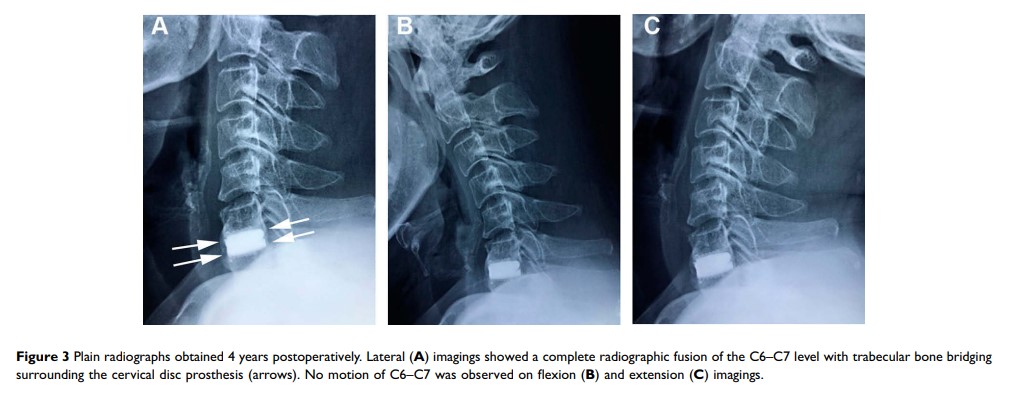
Results: A 63-year-old man presented with a 6-month history of progressive neck pain and developed left C-7 radiculopathy 4 years ago. Magnetic resonance imaging revealed disc herniation at the C6–C7 levels resulting in compression of the left C-7 nerve root. The patient underwent CDA at the C6–C7 levels, during which a PRESTIGE cervical disc device was implanted. He failed to follow-up regularly as recommended postoperatively because he was completely free from the pain in his neck and left upper limb. Four years later, he was readmitted with a 2-month history of occasional neck stiffness. Plain radiographs indicated complete radiographic fusion of the C6–C7 levels with trabecular bone bridging surrounding the cervical disc prosthesis, and dynamic imaging showed no motion. He was seen at regular follow-up visits for up to 60 months without special treatment, as his symptoms of neck stiffness were minor and his symptom has not worsened since then.
Conclusion: SF after CDA is a rare condition that can be attributed to patient- or prosthesis-related causes, and its risk factors are diverse. SF after CDA did not affect the patient’s clinical outcome, and no special treatment was required for it. Practitioners should be aware of this rare complication and advise patients of the risks before performing CDA.
Keywords: adjacent segment disease, cervical disc arthroplasty, spontaneous fusion, heterotopic ossification