117333
论文已发表
注册即可获取德孚的最新动态
IF 收录期刊
- 3.6 Breast Cancer (Dove Med Press)
- 4.3 Clin Epidemiol
- 2.6 Cancer Manag Res
- 3.2 Infect Drug Resist
- 4.1 Clin Interv Aging
- 6.1 Drug Des Dev Ther
- 4.1 Int J Chronic Obstr
- 8.7 Int J Nanomed
- 2.5 Int J Women's Health
- 3.2 Neuropsych Dis Treat
- 2.4 OncoTargets Ther
- 2.6 Patient Prefer Adher
- 2.6 Ther Clin Risk Manag
- 3.1 J Pain Res
- 3.5 Diabet Metab Synd Ob
- 4.5 Psychol Res Behav Ma
- 3.4 Nat Sci Sleep
- 2.4 Pharmgenomics Pers Med
- 2.6 Risk Manag Healthc Policy
- 4.6 J Inflamm Res
- 2.3 Int J Gen Med
- 3.9 J Hepatocell Carcinoma
- 3.3 J Asthma Allergy
- 2.5 Clin Cosmet Investig Dermatol
- 3.0 J Multidiscip Healthc

miR-1224-5p/ELF3 轴通过 PI3K/AKT/Notch 信号通路调节胰腺癌的恶性行为
Authors Kong L, Liu P, Zheng M, Wang Z, Gao Y, Liang K, Wang H, Tan X
Received 10 February 2020
Accepted for publication 31 March 2020
Published 23 April 2020 Volume 2020:13 Pages 3449—3466
DOI https://doi.org/10.2147/OTT.S248507
Checked for plagiarism Yes
Review by Single-blind
Peer reviewer comments 2
Editor who approved publication: Dr Arseniy Yuzhalin
Purpose: Aberrant expression of microRNAs contributes to the progression of pancreatic cancer by targeting downstream genes. A novel regulatory axis, miR-1224-5p/ELF3, was identified by bioinformatic analysis and experimental verification. Studies of the underlying molecular mechanisms behind this axis lead to a better understanding of the development of pancreatic cancer.
Materials and Methods: The differential expression of miR-1224-5p and ELF3 was verified based on Gene Expression Omnibus (GEO) datasets and clinical samples. The relationship between miR-1224-5p and ELF3 was demonstrated by luciferase assay and Western blot. The related signaling pathways of the miR-1224-5p/ELF3 axis in pancreatic cancer were investigated by gene set enrichment analysis (GSEA) and verified by Western blot. An analysis between ELF3 expression and immune infiltration was performed. Cellular and animal experiments were utilized to explore the effects of miR-1224-5p and ELF3 in pancreatic cancer.
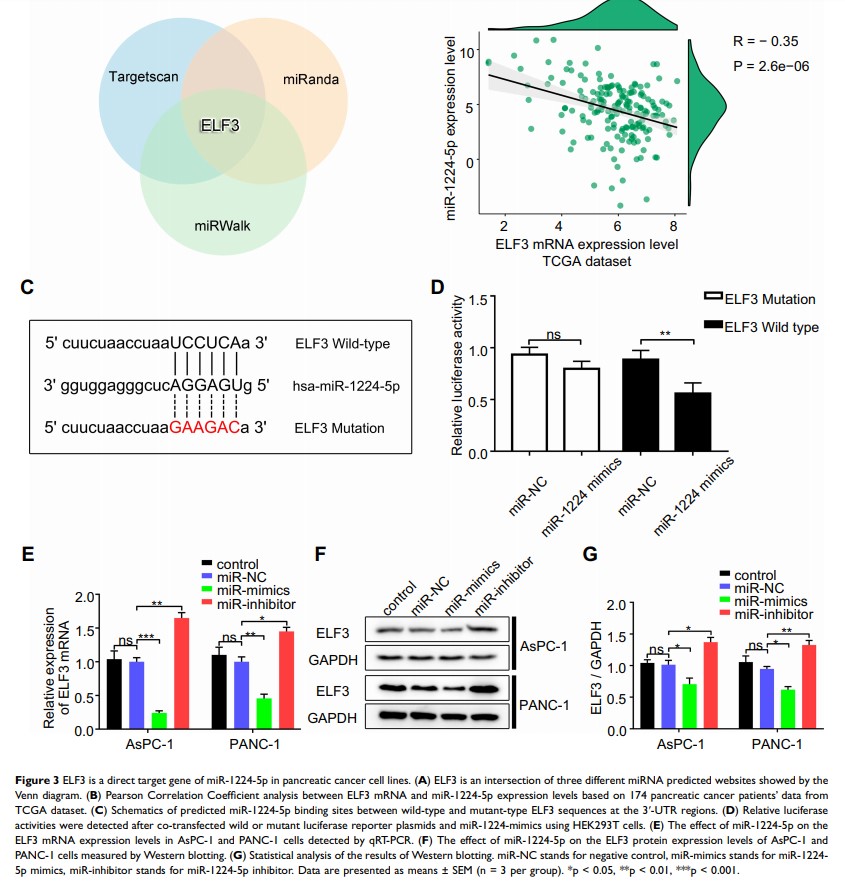
Results: Suppressed expression of miR-1224-5p in pancreatic tumor tissues and cancer cells was identified first. Furthermore, miR-1224-5p is correlated with clinicopathological features, and decreased expression of miR-1224-5p indicates poor prognosis. miR-1224-5p serves as a tumor suppressor and inhibits malignant behaviors of pancreatic cancer based on in vivo and in vitro assays. The putative target gene ELF3 was predicted by bioinformatic analysis and confirmed by dual-luciferase reporter assay. Overexpression of ELF3 can improve the malignant behaviors of pancreatic cancer and demonstrates poor prognosis and advanced clinical stage. The inhibitory role of miR-1224-5p in pancreatic cancer is manifested by its direct targeting of ELF3. A negative correlation between ELF3 expression and immune cell infiltration was identified, suggesting an immunosuppressive state resulting from ELF3 overexpression. The PI3K/AKT/Notch signaling pathways and epithelial-to-mesenchymal transition (EMT) are important underlying mechanisms.
Conclusion: The miR-1224-5p/ELF3 axis may serve as a new diagnostic, therapeutic, and prognostic biomarker in pancreatic cancer. The related PI3K/AKT/Notch/EMT signaling pathways greatly promote the elucidation of the progression of pancreatic cancer.
Keywords: miR-1224-5p, ELF3, immune infiltration, proliferation, migration, invasion