117333
论文已发表
注册即可获取德孚的最新动态
IF 收录期刊
- 3.6 Breast Cancer (Dove Med Press)
- 4.3 Clin Epidemiol
- 2.6 Cancer Manag Res
- 3.2 Infect Drug Resist
- 4.1 Clin Interv Aging
- 6.1 Drug Des Dev Ther
- 4.1 Int J Chronic Obstr
- 8.7 Int J Nanomed
- 2.5 Int J Women's Health
- 3.2 Neuropsych Dis Treat
- 2.4 OncoTargets Ther
- 2.6 Patient Prefer Adher
- 2.6 Ther Clin Risk Manag
- 3.1 J Pain Res
- 3.5 Diabet Metab Synd Ob
- 4.5 Psychol Res Behav Ma
- 3.4 Nat Sci Sleep
- 2.4 Pharmgenomics Pers Med
- 2.6 Risk Manag Healthc Policy
- 4.6 J Inflamm Res
- 2.3 Int J Gen Med
- 3.9 J Hepatocell Carcinoma
- 3.3 J Asthma Allergy
- 2.5 Clin Cosmet Investig Dermatol
- 3.0 J Multidiscip Healthc

通过数据非依赖采集而进行的定量蛋白质组学探索 HIV 感染患者中结核的潜在血浆生物标记物
Authors Shen Y, Xun J, Song W, Wang Z, Wang J, Liu L, Zhang R, Qi T, Tang Y, Chen J, Sun J, Lu H
Received 9 January 2020
Accepted for publication 7 April 2020
Published 24 April 2020 Volume 2020:13 Pages 1185—1196
DOI https://doi.org/10.2147/IDR.S245460
Checked for plagiarism Yes
Review by Single-blind
Peer reviewer comments 2
Editor who approved publication: Dr Joachim Wink
Purpose: Tuberculosis (TB) is the leading cause of mortality in individuals infected with human immunodeficiency virus (HIV), yet the methods for detecting Mycobacterium tuberculosis at an early stage remain insensitive or ineffective. This study aimed to discover plasma biomarkers for distinguishing HIV-TB coinfected individuals from HIV individuals without TB (HIV-nonTB).
Patients and Methods: A total of 200 Chinese HIV-positive patients were recruited, 100 each for HIV-nonTB group and HIV-TB group. Plasma proteomic profiles were analyzed for 50 patients each in both groups, using data-independent acquisition (DIA)-mass spectrometry-based proteomics. Differently expressed proteins were revealed with ridge regression analysis. Enzyme-linked immunosorbent assay (ELISA) analyses were performed for further validation in other 100 patients.
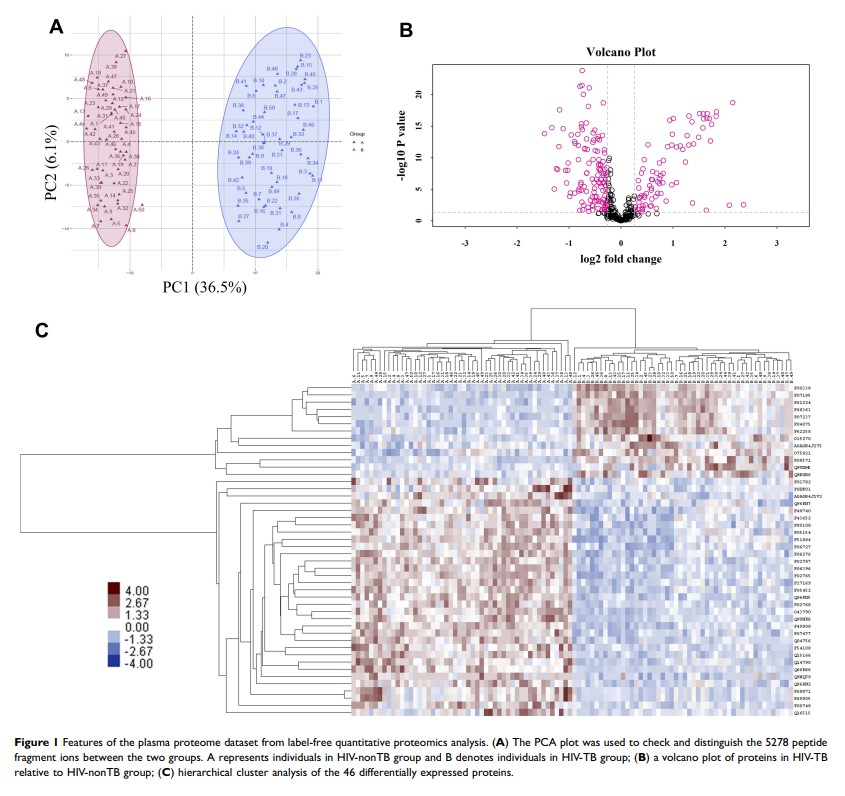
Results: DIA-mass spectrometry revealed 13 upregulated and 33 downregulated proteins in the HIV-TB group. AMACR (α-methylacyl-CoA racemase), LDHB (L-lactate dehydrogenase B chain), and RAP1B (Ras-related protein Rap-1b) were selected for building a diagnostic model, for which the receiver operation characteristic curve had under areas of 0.99 and 0.89 testing with proteomics data (sensitivity = 92%, specificity = 100%) and ELISA data (sensitivity = 76%, specificity = 92%), respectively.
Conclusion: The combination of AMACR, LDHB, and RAP1B proteins may serve as a potential marker of TB in HIV-infected patients.
Keywords: diagnosis, coinfection, AIDS-related opportunistic infections, Mycobacterium tuberculosis, ROC curve, proteome