117333
论文已发表
注册即可获取德孚的最新动态
IF 收录期刊
- 3.6 Breast Cancer (Dove Med Press)
- 4.3 Clin Epidemiol
- 2.6 Cancer Manag Res
- 3.2 Infect Drug Resist
- 4.1 Clin Interv Aging
- 6.1 Drug Des Dev Ther
- 4.1 Int J Chronic Obstr
- 8.7 Int J Nanomed
- 2.5 Int J Women's Health
- 3.2 Neuropsych Dis Treat
- 2.4 OncoTargets Ther
- 2.6 Patient Prefer Adher
- 2.6 Ther Clin Risk Manag
- 3.1 J Pain Res
- 3.5 Diabet Metab Synd Ob
- 4.5 Psychol Res Behav Ma
- 3.4 Nat Sci Sleep
- 2.4 Pharmgenomics Pers Med
- 2.6 Risk Manag Healthc Policy
- 4.6 J Inflamm Res
- 2.3 Int J Gen Med
- 3.9 J Hepatocell Carcinoma
- 3.3 J Asthma Allergy
- 2.5 Clin Cosmet Investig Dermatol
- 3.0 J Multidiscip Healthc

长非编码 RNA H19 通过 miR-140-5p/FGF9 轴促进小细胞肺癌的发生
Authors Li X, Lv F, Li F, Du M, Liang Y, Ju S, Liu Z, Wang B, Gao Y
Received 12 January 2020
Accepted for publication 10 April 2020
Published 28 April 2020 Volume 2020:13 Pages 3525—3534
DOI https://doi.org/10.2147/OTT.S245710
Checked for plagiarism Yes
Review by Single-blind
Peer reviewer comments 2
Editor who approved publication: Dr Arseniy Yuzhalin
Purpose: Long noncoding RNAs (lncRNAs) are emerging as gene regulators to drive many important cancer phenotypes through interaction with microRNAs. There have been numerous data about upregulation of H19 and its strong oncogenic function in progression of cancers. However, the function and detailed mechanisms of H19 on small cell lung cancer (SCLC) are still unclear.
Methods: In this study, we investigated H19 expression in SCLC and para-carcinoma tissues. We also explored the function and detailed mechanisms of H19 on SCLC cells via RT-PCR, transwell assay, Western blot, dual-luciferase report assay and RNA pull-down experiments.
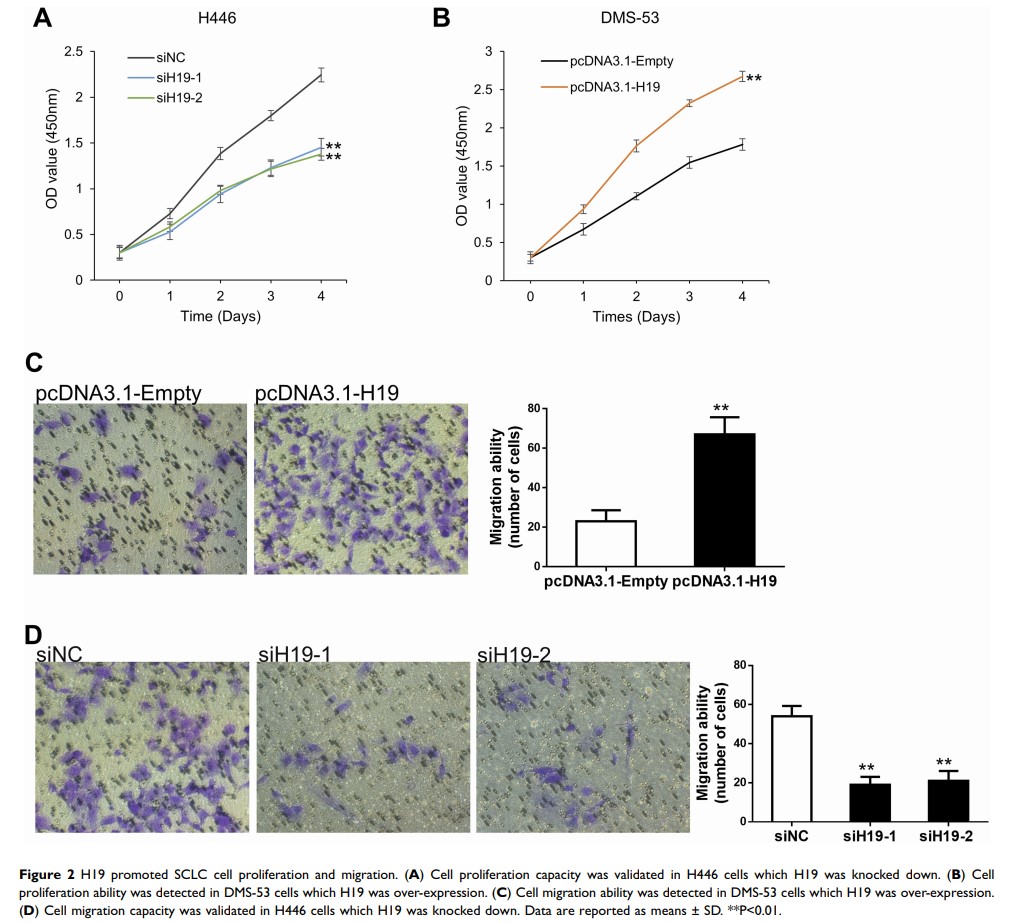
Results: In this study, we observed that H19 was upregulated in SCLC compared with para-carcinoma tissues or NSCLC tissues. We also uncovered that H19 could promote proliferation and migration of SCLC cells. Functional investigation illustrated that H19 acted as a sponge for miR-140-5p to regulate its expression in SCLC. Interestingly, we further found that H19 upregulated FGF9 expression to promote SCLC progression via sponging miR-140-5p. H19 and FGF9 were also revealed to have similar expression patterns in clinical SCLC samples.
Conclusion: These data demonstrated that H19 might be a promising prognostic and therapeutic target for SCLC.
Keywords: H19, small cell lung cancer, SCLC, miR-140-5p, FGF9