117333
论文已发表
注册即可获取德孚的最新动态
IF 收录期刊
- 3.6 Breast Cancer (Dove Med Press)
- 4.3 Clin Epidemiol
- 2.6 Cancer Manag Res
- 3.2 Infect Drug Resist
- 4.1 Clin Interv Aging
- 6.1 Drug Des Dev Ther
- 4.1 Int J Chronic Obstr
- 8.7 Int J Nanomed
- 2.5 Int J Women's Health
- 3.2 Neuropsych Dis Treat
- 2.4 OncoTargets Ther
- 2.6 Patient Prefer Adher
- 2.6 Ther Clin Risk Manag
- 3.1 J Pain Res
- 3.5 Diabet Metab Synd Ob
- 4.5 Psychol Res Behav Ma
- 3.4 Nat Sci Sleep
- 2.4 Pharmgenomics Pers Med
- 2.6 Risk Manag Healthc Policy
- 4.6 J Inflamm Res
- 2.3 Int J Gen Med
- 3.9 J Hepatocell Carcinoma
- 3.3 J Asthma Allergy
- 2.5 Clin Cosmet Investig Dermatol
- 3.0 J Multidiscip Healthc

肝动脉灌注联合全身化疗治疗胃癌广泛性肝转移患者
Authors Qiang W, Shi H, Wu J, Ji M, Wu C
Received 12 January 2020
Accepted for publication 31 March 2020
Published 29 April 2020 Volume 2020:12 Pages 2911—2916
DOI https://doi.org/10.2147/CMAR.S245697
Checked for plagiarism Yes
Review by Single-blind
Peer reviewer comments 2
Editor who approved publication: Dr Seema Singh
Purpose: Liver metastases in patients with gastric cancer often indicate poor prognosis. Once liver metastases are extensive, it is difficult to achieve disease control by using systemic chemotherapy alone. The purpose of this study was to evaluate the effect and safety of hepatic arterial infusion (HAI) combined with systemic chemotherapy on extensive liver metastases from gastric cancer.
Patients and Methods: Between 2012 and 2019, 21 patients with extensive liver metastases from gastric cancer (LMGC) were enrolled in our study. Liver metastases were identified as unresectable and a major factor affecting prognosis mainly based on size and number of intrahepatic lesions. All patients received systemic chemotherapy with S-1 and HAI oxaliplatin plus floxuridine (FUDR).
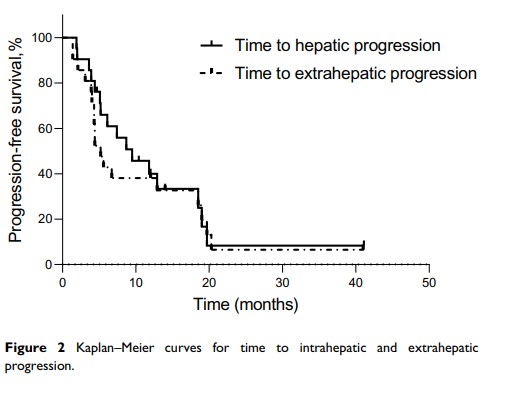
Results: Liver metastases in 16 patients (76.2%) were evaluated as H3. The overall response rate was 76.2% (9.5% complete response). Intrahepatic and extrahepatic median progression-free survival times were 9.5 and 5.2 months, respectively. Median survival time (MST) was 12.3 months. All patients did not have the toxicity of grade 4. Grade 3 toxic effects included bone marrow suppression (14.3%) and diarrhea (9.5%). The other treatment-related toxicities were mild and reversible.
Conclusion: HAI combined with systemic chemotherapy for extensive LMGC seems to be safe and effective, which achieves a high-local response and may contribute to long survival time for patients.
Keywords: gastric cancer, liver metastases, hepatic arterial infusion, systemic chemotherapy