115195
论文已发表
注册即可获取德孚的最新动态
IF 收录期刊
- 3.6 Breast Cancer (Dove Med Press)
- 4.3 Clin Epidemiol
- 2.6 Cancer Manag Res
- 3.2 Infect Drug Resist
- 4.1 Clin Interv Aging
- 6.1 Drug Des Dev Ther
- 4.1 Int J Chronic Obstr
- 8.7 Int J Nanomed
- 2.5 Int J Women's Health
- 3.2 Neuropsych Dis Treat
- 2.4 OncoTargets Ther
- 2.6 Patient Prefer Adher
- 2.6 Ther Clin Risk Manag
- 3.1 J Pain Res
- 3.5 Diabet Metab Synd Ob
- 4.5 Psychol Res Behav Ma
- 3.4 Nat Sci Sleep
- 2.4 Pharmgenomics Pers Med
- 2.6 Risk Manag Healthc Policy
- 4.6 J Inflamm Res
- 2.3 Int J Gen Med
- 3.9 J Hepatocell Carcinoma
- 3.3 J Asthma Allergy
- 2.5 Clin Cosmet Investig Dermatol
- 3.0 J Multidiscip Healthc

具备聚集诱导发光和 MRI 对比增强特性的治疗性纳米颗粒,可作为影像引导的肿瘤光动力治疗的双模态成像平台
Authors Yang H, He Y, Wang Y, Yang R, Wang N, Zhang LM, Gao M, Jiang X
Received 2 January 2020
Accepted for publication 9 April 2020
Published 30 April 2020 Volume 2020:15 Pages 3023—3038
DOI https://doi.org/10.2147/IJN.S244541
Checked for plagiarism Yes
Review by Single-blind
Peer reviewer comments 2
Editor who approved publication: Dr Mian Wang
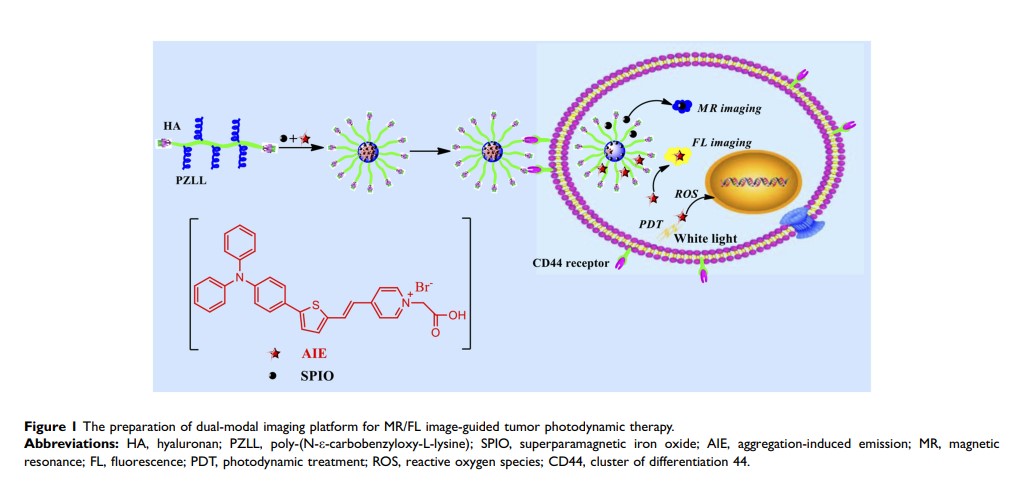
Introduction: Advanced tumor-targeted theranostic nanoparticles play a key role in tumor diagnosis and treatment research. In this study, we developed a multifunctional theranostic platform based on an amphiphilic hyaluronan/poly-(N -ϵ-carbobenzyloxy-L-lysine) derivative (HA-g -PZLL), superparamagnetic iron oxide (SPIO) and aggregation-induced emission (AIE) nanoparticles for tumor-targeted magnetic resonance (MR) and fluorescence (FL) dual-modal image-guided photodynamic therapy (PDT).
Materials and Methods: The amphiphilic hyaluronan acid (HA) derivative HA-g -PZLL was synthesized by grafting hydrophobic poly-(N -ϵ-carbobenzyloxy-L-lysine) (PZLL) blocks onto hyaluronic acid by a click conjugation reaction. The obtained HA-g -PZLLs self-assembled into nanoparticles in the presence of AIE molecules and SPIO nanoparticles to produce tumor-targeted theranostic nanoparticles (SPIO/AIE@HA-g -PZLLs) with MR/FL dual-modal imaging ability. Cellular uptake of the theranostic nanoparticles was traced by confocal laser scanning microscopy (CLSM), flow cytometry and Prussian blue staining. The intracellular reactive oxygen species (ROS) generation characteristics of the theranostic nanoparticles were evaluated with CLSM and flow cytometry. The effect of PDT was evaluated by cytotoxicity assay. The dual-mode imaging ability of the nanoparticles was evaluated by a real-time near-infrared fluorescence imaging system and magnetic resonance imaging scanning.
Results: The resulting theranostic nanoparticles not only emit red fluorescence for high-quality intracellular tracing but also effectively produce singlet oxygen for photodynamic tumor therapy. In vitro cytotoxicity experiments showed that these theranostic nanoparticles can be efficiently taken up and are mainly present in the cytoplasm of HepG2 cells. After internalization, these theranostic nanoparticles showed serious cytotoxicity to the growth of HepG2 cells after white light irradiation.
Discussion: This work provides a simple method for the preparation of theranostic nanoparticles with AIE characteristics and MR contrast enhancement, and serves as a dual-modal imaging platform for image-guided tumor PDT.
Keywords: aggregation-induced emission, MR imaging, dual-modal imaging, photodynamic therapy