115195
论文已发表
注册即可获取德孚的最新动态
IF 收录期刊
- 3.6 Breast Cancer (Dove Med Press)
- 4.3 Clin Epidemiol
- 2.6 Cancer Manag Res
- 3.2 Infect Drug Resist
- 4.1 Clin Interv Aging
- 6.1 Drug Des Dev Ther
- 4.1 Int J Chronic Obstr
- 8.7 Int J Nanomed
- 2.5 Int J Women's Health
- 3.2 Neuropsych Dis Treat
- 2.4 OncoTargets Ther
- 2.6 Patient Prefer Adher
- 2.6 Ther Clin Risk Manag
- 3.1 J Pain Res
- 3.5 Diabet Metab Synd Ob
- 4.5 Psychol Res Behav Ma
- 3.4 Nat Sci Sleep
- 2.4 Pharmgenomics Pers Med
- 2.6 Risk Manag Healthc Policy
- 4.6 J Inflamm Res
- 2.3 Int J Gen Med
- 3.9 J Hepatocell Carcinoma
- 3.3 J Asthma Allergy
- 2.5 Clin Cosmet Investig Dermatol
- 3.0 J Multidiscip Healthc

血浆 cfDNA 作为评估胃癌化疗疗效的潜在生物标志物
Authors Zhong Y, Fan Q, Zhou Z, Wang Y, He K, Lu J
Received 22 December 2019
Accepted for publication 21 April 2020
Published 5 May 2020 Volume 2020:12 Pages 3099—3106
DOI https://doi.org/10.2147/CMAR.S243320
Checked for plagiarism Yes
Review by Single-blind
Peer reviewer comments 4
Editor who approved publication: Dr Antonella D'Anneo
Objective: To investigate the clinical value of plasma cell-free DNA (cfDNA) as a potential biomarker for advanced gastric cancer (GC).
Patients and Methods: One hundred and six cases of advanced gastric cancer patients receiving chemotherapy were selected as study objects. Another 40 healthy volunteers were included as control groups. Plasma cfDNA concentration was detected by (SuperbDNATM) hybridization. Changes in cfDNA concentration during chemotherapy in patients with gastric cancer whose efficacy was assessed as partial response (PR), stable disease (SD) and disease progression (PD) were analyzed respectively. The relationship between the level of cfDNA and the efficacy of chemotherapy and clinical characteristics was also explored. In addition, cfDNA and other tumor markers were subjected to specificity and sensitivity analyses using ROC.
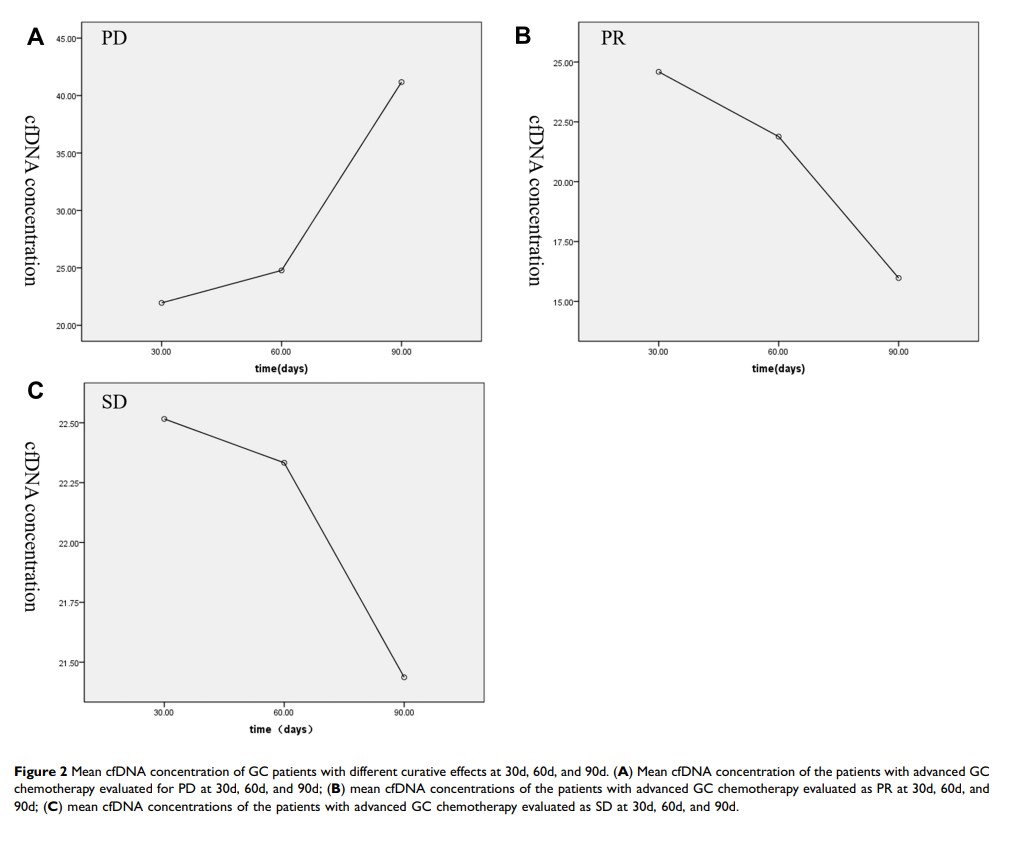
Results: cfDNA concentration in advanced GC patients was significantly higher than that in healthy controls (P< 0.05). The concentration of plasma cfDNA in patients with PD showed an increasing trend over time. The concentration of plasma cfDNA in patients with therapeutic effect of PR decreased over time. In patients with therapeutic effect of SD, the plasma DNA concentration showed a stable trend over time. There was no significant correlation between cfDNA concentration and factors including gender, age, pathological type, CA724, CA125,CA199, AFP and CEA. ROC results showed that the area under the curve of cfDNA was larger than other tumor markers.
Conclusion: Plasma cfDNA concentration was significantly increased in patients with gastric cancer, and its diagnostic efficacy was superior to that of traditional tumor markers. It can be used as a tumor biomarker to monitor the efficacy of chemotherapy for gastric cancer.
Keywords: advanced gastric cancer, cfDNA, tumor marker