115195
论文已发表
注册即可获取德孚的最新动态
IF 收录期刊
- 3.6 Breast Cancer (Dove Med Press)
- 4.3 Clin Epidemiol
- 2.6 Cancer Manag Res
- 3.2 Infect Drug Resist
- 4.1 Clin Interv Aging
- 6.1 Drug Des Dev Ther
- 4.1 Int J Chronic Obstr
- 8.7 Int J Nanomed
- 2.5 Int J Women's Health
- 3.2 Neuropsych Dis Treat
- 2.4 OncoTargets Ther
- 2.6 Patient Prefer Adher
- 2.6 Ther Clin Risk Manag
- 3.1 J Pain Res
- 3.5 Diabet Metab Synd Ob
- 4.5 Psychol Res Behav Ma
- 3.4 Nat Sci Sleep
- 2.4 Pharmgenomics Pers Med
- 2.6 Risk Manag Healthc Policy
- 4.6 J Inflamm Res
- 2.3 Int J Gen Med
- 3.9 J Hepatocell Carcinoma
- 3.3 J Asthma Allergy
- 2.5 Clin Cosmet Investig Dermatol
- 3.0 J Multidiscip Healthc

2013 年至 2017 年中国东南地区急性腹泻患者分离而得的副溶血性弧菌的病原特征和变异
Authors Chen X, Zhu Q, Liu Y, Wang R, Xie H, Chen J, Cheng Y, Zhang H, Cao L, Chen Y
Received 10 October 2019
Accepted for publication 14 March 2020
Published 5 May 2020 Volume 2020:13 Pages 1307—1318
DOI https://doi.org/10.2147/IDR.S234186
Checked for plagiarism Yes
Review by Single-blind
Peer reviewer comments 2
Editor who approved publication: Dr Sahil Khanna
Objective: Vibrio parahaemolyticus is a major diarrhoea-inducing pathogen in coastal areas. In this study, we analysed the pathogenic characteristics of and variation in V. parahaemolyticus isolated from acute diarrhoeal patients in seven hospitals in different areas of southeastern China from 2013 to 2017.
Methods: The fecal specimens of patients with acute diarrhoea were collected. The routine microbiological test procedure combining with MALDI Biotyper microbial identification system was carried out to identify the V. parahaemolyticus . Serum agglutination tests, PCR for the detection of virulence-related genes and the Kirby-Bauer method to test for antimicrobial sensitivity were performed.
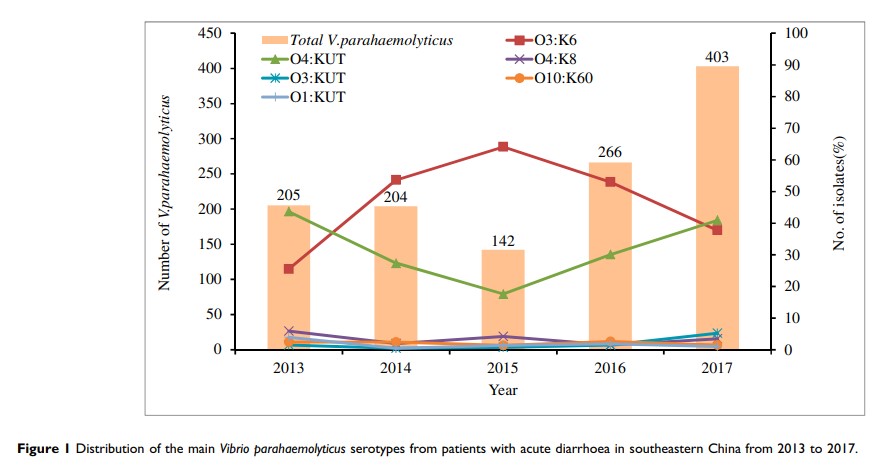
Results: From 2013 to 2017 in southeastern China, a total of 1220 V. parahaemolyticus strains were isolated from 16,504 stool specimens collected from acute diarrhoeal patients, and the annual isolation rate fluctuated between 6.1% and 8.7%. In total, 96.7% of the V. parahaemolyticus isolates were isolated in summer and autumn, mainly in people aged 18– 44. Fifty-nine serotypes were identified, and the agglutination rate of the O antigen was 98.5%. From 2014 to 2016, the dominant serotype was O3:K6, while in 2013 and 2017, it was O4:KUT. The serotypes of O3:K6, O4:KUT, O4:K8, O3:KUT, O10:K60, O1:KUT and O1:K36 appeared every year from 2013 to 2017. O4:K6 and OUT:K6 began to appear after 2014 and 2015, respectively. A total of 49.5% of the strains belonged to the pandemic group, which consisted of 26 serotypes. Most isolates were sensitive to common antibiotics, excluding ampicillin.
Conclusion: V. parahaemolyticus is still present at a high level in southeastern China. Although the pandemic O3:K6 serotype is predominant, new serotypes continue to emerge, especially the O4:KUT serotype, which exceeded O3:K6 in prevalence in some years. Long-term surveillance is necessary to prevent the outbreak or transmission of this pathogen.
Keywords: Acute diarrhoea, Vibrio parahaemolyticus , serotypes, virulence genes, antimicrobial resistance