115195
论文已发表
注册即可获取德孚的最新动态
IF 收录期刊
- 3.6 Breast Cancer (Dove Med Press)
- 4.3 Clin Epidemiol
- 2.6 Cancer Manag Res
- 3.2 Infect Drug Resist
- 4.1 Clin Interv Aging
- 6.1 Drug Des Dev Ther
- 4.1 Int J Chronic Obstr
- 8.7 Int J Nanomed
- 2.5 Int J Women's Health
- 3.2 Neuropsych Dis Treat
- 2.4 OncoTargets Ther
- 2.6 Patient Prefer Adher
- 2.6 Ther Clin Risk Manag
- 3.1 J Pain Res
- 3.5 Diabet Metab Synd Ob
- 4.5 Psychol Res Behav Ma
- 3.4 Nat Sci Sleep
- 2.4 Pharmgenomics Pers Med
- 2.6 Risk Manag Healthc Policy
- 4.6 J Inflamm Res
- 2.3 Int J Gen Med
- 3.9 J Hepatocell Carcinoma
- 3.3 J Asthma Allergy
- 2.5 Clin Cosmet Investig Dermatol
- 3.0 J Multidiscip Healthc

饮食诱导的肥胖小鼠通过粪便增加能量支出和能量损失,有助于 Roux-en-Y 胃旁路术的长期结果
Authors Chen K, Xiao B, Zhou Z, Peng W, Liu W
Received 8 March 2020
Accepted for publication 19 April 2020
Published 6 May 2020 Volume 2020:13 Pages 1545—1553
DOI https://doi.org/10.2147/DMSO.S252971
Checked for plagiarism Yes
Review by Single-blind
Peer reviewer comments 2
Editor who approved publication: Dr Antonio Brunetti
Background: Roux-en-Y gastric bypass (RYGB) has been proved to be more effective than other bariatric procedures in the long term on body-weight loss and remission of diabetes. However, the mechanism remains poorly understood. Long-term changes in energy metabolism after RYGB have rarely been reported.
Objective: To investigate the long-term effects of RYGB on energy metabolism on a diet-induced obesity (DIO) mouse model.
Methods: DIO mice fed a high-fat diet were assigned to two groups: RYGB (n=8) and sham (n=7), followed by high-fat diet feeding until 12 weeks after surgery. Body weight and food intake were recorded weekly. Measurement of body composition and energy metabolism by metabolic chamber were conducted at weeks 4, 8, and 12 after surgery. Fecal energy measurement, intraperitoneal glucose-tolerance tests, and insulin-tolerance tests were conducted at postoperative week 12.
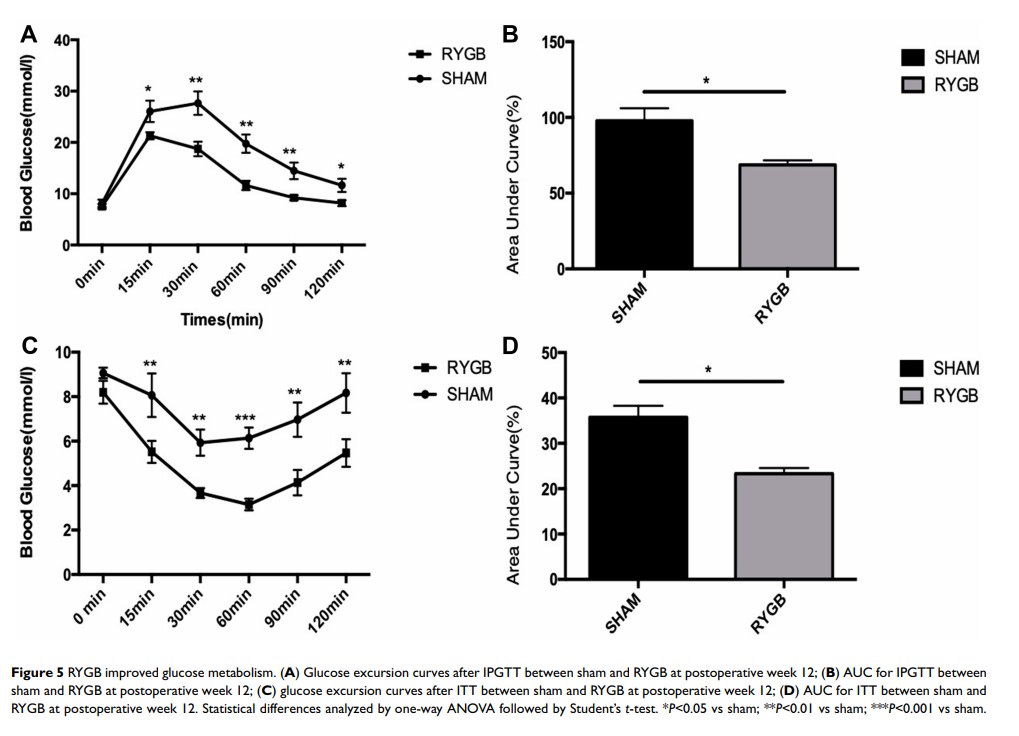
Results: Food intake was reduced in the RYGB group within the first 3 weeks after surgery and increased to the same as the sham group from postoperative week 4. At 12 weeks after surgery, body weight had reduced by 36%± 3.2% in the RYGB group compared to a 16%± 2% body-weight gain in the sham group, while fat mass had reduced significantly in the RYGB group compared to the sham group (9.2%± 1.5% versus 30.1%± 0.7%). Energy expenditure was significantly higher at postoperative week 8 in the RYGB group than the sham group. In comparison with the sham group, the respiratory exchange ratio was unchanged, decreased, and increased in the RYGB group at postoperative weeks 4, 8, and 12, respectively. Fecal energy measurement showed that feces from mice in the RYGB group contained higher energy levels than the sham group. Glucose metabolism had significantly improved in the RYGB group, in contrast to the sham group, demonstrated by intraperitoneal glucose tolerance tests (AUC 1,502± 104 versus 2,277± 198, respectively) and insulin tolerance tests (AUC 524± 50 versus 838± 63, respectively).
Conclusion: Increased energy expenditure and energy loss through feces contribute to long-term body-weight control after RYGB. Enhanced glucose utilization might play a role in long-term improvement in glucose metabolism.
Keywords: Roux-en-Y gastric bypass, mouse model, glucose metabolism, energy expenditure, respiratory exchange ratio