115195
论文已发表
注册即可获取德孚的最新动态
IF 收录期刊
- 3.6 Breast Cancer (Dove Med Press)
- 4.3 Clin Epidemiol
- 2.6 Cancer Manag Res
- 3.2 Infect Drug Resist
- 4.1 Clin Interv Aging
- 6.1 Drug Des Dev Ther
- 4.1 Int J Chronic Obstr
- 8.7 Int J Nanomed
- 2.5 Int J Women's Health
- 3.2 Neuropsych Dis Treat
- 2.4 OncoTargets Ther
- 2.6 Patient Prefer Adher
- 2.6 Ther Clin Risk Manag
- 3.1 J Pain Res
- 3.5 Diabet Metab Synd Ob
- 4.5 Psychol Res Behav Ma
- 3.4 Nat Sci Sleep
- 2.4 Pharmgenomics Pers Med
- 2.6 Risk Manag Healthc Policy
- 4.6 J Inflamm Res
- 2.3 Int J Gen Med
- 3.9 J Hepatocell Carcinoma
- 3.3 J Asthma Allergy
- 2.5 Clin Cosmet Investig Dermatol
- 3.0 J Multidiscip Healthc

GPR30 通过激活 AKT 和 ERK 信号通路促进血管平滑肌细胞的表型转换
Authors Zha B, Qiu P, Zhang C, Li X, Chen Z
Received 30 December 2019
Accepted for publication 14 April 2020
Published 6 May 2020 Volume 2020:13 Pages 3801—3808
DOI https://doi.org/10.2147/OTT.S244128
Checked for plagiarism Yes
Review by Single-blind
Peer reviewer comments 2
Editor who approved publication: Dr Sanjay Singh
Background: Lower extremity varicose veins (LEVVs) are a common venous disorder of venous dilation and tortuosity. The functional integrity of vascular smooth muscle cells (VSMCs), the majority of the cells in venous tissues, and their phenotypic differences play important roles in the occurrence and development of LEVV. However, the underlying mechanism remains unclear.
Methods: The expression of estrogen receptors ERα and ERβ and G-protein-coupled receptor 30 (GPR30) in LEVV tissues and the role of GPR30 in VSMC phenotypic switching were examined by Western blotting and quantitative real-time PCR. Finally, the related mechanisms underlying LEVVs were explored by Western blotting.
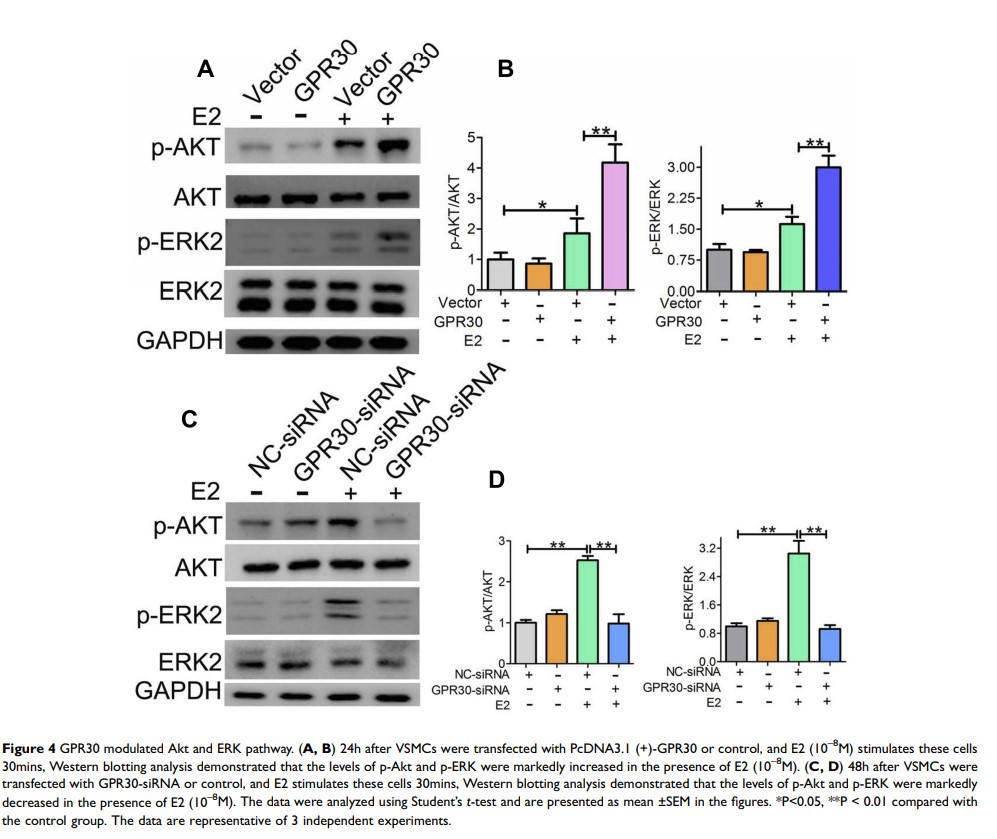
Results: The serum estradiol content was increased in LEVV patients compared with normal control patients, but the mRNA levels of ERα and ERβ were not significantly different. GPR30 was overexpressed in LEVVs, and high expression of GPR30 promoted the maintenance of a synthetic phenotype in which OPN, MMP-1 and MMP-9 were highly expressed and α-SMA was poorly expressed in VSMCs. Finally, the mechanism by which GPR30 promotes the phenotypic switching of VSMCs is dependent on the ERK1/2 and AKT pathways.
Conclusion: GPR30 may contribute to the pathogenesis of LEVVs by promoting the maintenance of a synthetic phenotype in VSMCs by activating the ERK1/2 and AKT pathways, and GPR30 might be a novel therapeutic target for clinical LEVV treatment.
Keywords: GPR30, vascular smooth muscle cell, varicose veins, phenotypic switch, AKT and ERK pathways