115195
论文已发表
注册即可获取德孚的最新动态
IF 收录期刊
- 3.6 Breast Cancer (Dove Med Press)
- 4.3 Clin Epidemiol
- 2.6 Cancer Manag Res
- 3.2 Infect Drug Resist
- 4.1 Clin Interv Aging
- 6.1 Drug Des Dev Ther
- 4.1 Int J Chronic Obstr
- 8.7 Int J Nanomed
- 2.5 Int J Women's Health
- 3.2 Neuropsych Dis Treat
- 2.4 OncoTargets Ther
- 2.6 Patient Prefer Adher
- 2.6 Ther Clin Risk Manag
- 3.1 J Pain Res
- 3.5 Diabet Metab Synd Ob
- 4.5 Psychol Res Behav Ma
- 3.4 Nat Sci Sleep
- 2.4 Pharmgenomics Pers Med
- 2.6 Risk Manag Healthc Policy
- 4.6 J Inflamm Res
- 2.3 Int J Gen Med
- 3.9 J Hepatocell Carcinoma
- 3.3 J Asthma Allergy
- 2.5 Clin Cosmet Investig Dermatol
- 3.0 J Multidiscip Healthc

醇质体凝胶对四种神经保护成分的局部递送:协同药物组合治疗奥沙利铂引起的周围神经病变
Authors Lin HM, Lin LF, Sun MY, Liu J, Wu Q
Received 7 October 2019
Accepted for publication 24 February 2020
Published 7 May 2020 Volume 2020:15 Pages 3251—3266
DOI https://doi.org/10.2147/IJN.S233747
Checked for plagiarism Yes
Review by Single-blind
Peer reviewer comments 2
Editor who approved publication: Dr Mian Wang
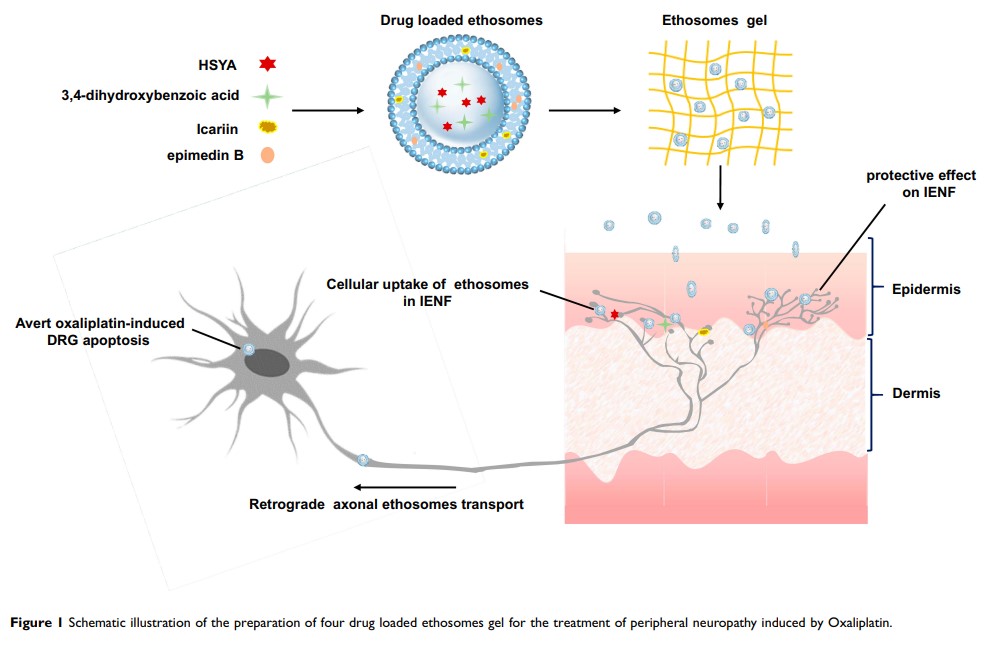
Background: Peripheral neuropathy is a common and painful side effect that occurs in patients with cancer induced by Oxaliplatin (OXL). The neurotoxicity correlates with the damage of dorsal root ganglion (DRG) neurons and Schwann cells (SCs). Hydroxysafflor yellow A (HSYA), icariin, epimedin B and 3, 4-dihydroxybenzoic acid (DA) are the main neuroprotective ingredients identified in Wen-Luo-Tong (WLT), a traditional Chinese medicinal topical compound. The purpose of this study was to prepare and evaluate the efficacy of an ethosomes gel formulation loaded with a combination of HSYA, icariin, epimedin B and DA. However, the low LogP value, poor solubility and macromolecule are several challenges for topical delivery of these drugs.
Methods: Ethosomes were prepared by the single-step injection technique. Particle size, entrapment efficiency and in vitro drug deposition studies were determined to select the optimum ethosomes. The optimized ethosomes were further incorporated into carbopol to obtain a gel. The rheological properties, morphology, in vitro drug release, in vitro gel application and skin distribution of the ethosomes gels were studied. A rat model of oxaliplatin-induced neuropathy was established to assess the therapeutic efficacy of the ethosomes gel.
Results: Seventy percent (v/v) ethanol, cinnamaldehyde and Phospholipon 90G were employed to develop ethosomes a carrier system. This system had a high entrapment efficiency, carried large amounts of HSYA, epimedin B, DA and icarrin, and penetrated deep into the epidermis and dermis. The optimized ethosomes had the maximum deposition of icariin, HSYA, epimedin B and relative higher amount of DA in epidermis (2.00± 0.13 μg/cm2, 5.72± 0.75 μg/cm2, 1.97± 0.27 μg/cm2 and 9.25± 1.21 μg/cm2, respectively). 0.5% carbopol 980 was selected to develop the ethosomes gel with desirable viscoelasticity and spreadability, which was suitable for topical application. The mechanical allodynia and hyperalgesia induced by OXL in rats were significantly reduced after the new ethosomes gel was applied to rats compared to model group.
Conclusion: Based on our findings, the ethosomes gel delivery system provided a new formulation for the topical delivery of HSYA, icariin, epimedin B and DA to counteract OXL-induced peripheral neuropathy.
Keywords: hydroxysafflor yellow A, icariin, epimedin B, 3, 4-dihydroxybenzoic acid, DA, oxaliplatin-induced neuropathy, ethosomes gel