115195
论文已发表
注册即可获取德孚的最新动态
IF 收录期刊
- 3.6 Breast Cancer (Dove Med Press)
- 4.3 Clin Epidemiol
- 2.6 Cancer Manag Res
- 3.2 Infect Drug Resist
- 4.1 Clin Interv Aging
- 6.1 Drug Des Dev Ther
- 4.1 Int J Chronic Obstr
- 8.7 Int J Nanomed
- 2.5 Int J Women's Health
- 3.2 Neuropsych Dis Treat
- 2.4 OncoTargets Ther
- 2.6 Patient Prefer Adher
- 2.6 Ther Clin Risk Manag
- 3.1 J Pain Res
- 3.5 Diabet Metab Synd Ob
- 4.5 Psychol Res Behav Ma
- 3.4 Nat Sci Sleep
- 2.4 Pharmgenomics Pers Med
- 2.6 Risk Manag Healthc Policy
- 4.6 J Inflamm Res
- 2.3 Int J Gen Med
- 3.9 J Hepatocell Carcinoma
- 3.3 J Asthma Allergy
- 2.5 Clin Cosmet Investig Dermatol
- 3.0 J Multidiscip Healthc

DNAM1 和 2B4 共刺激结构域可增强抗 GPC3 的嵌合抗原受体修饰的自然杀伤细胞对肝癌细胞的体外细胞毒性作用
Authors Huang Y, Zeng J, Liu T, Xu Q, Song X, Zeng J
Received 12 March 2020
Accepted for publication 4 April 2020
Published 8 May 2020 Volume 2020:12 Pages 3247—3255
DOI https://doi.org/10.2147/CMAR.S253565
Checked for plagiarism Yes
Review by Single-blind
Peer reviewer comments 3
Editor who approved publication: Dr Eileen O'Reilly
Purpose: Hepatocellular cancer (HCC) is the sixth most prevalent cancer and the third leading cause of cancer-related death worldwide. Cellular immunotherapy against glypican 3 (GPC3) has recently been used in the treatment of HCC, following the success of chimeric antigen receptor (CAR)-T therapy in treatment of B cell malignancy. However, CAR-T cells are not “off-the-shelf” and always cause cytokine release syndrome, which can be eliminated by using natural killer (NK) cells as effector cells. Since a costimulatory signal is necessary for the activation, persistence, or cytotoxicity of CAR-T cells, we speculated that the costimulatory signal is also required for CAR-NK cells in HCC treatment.
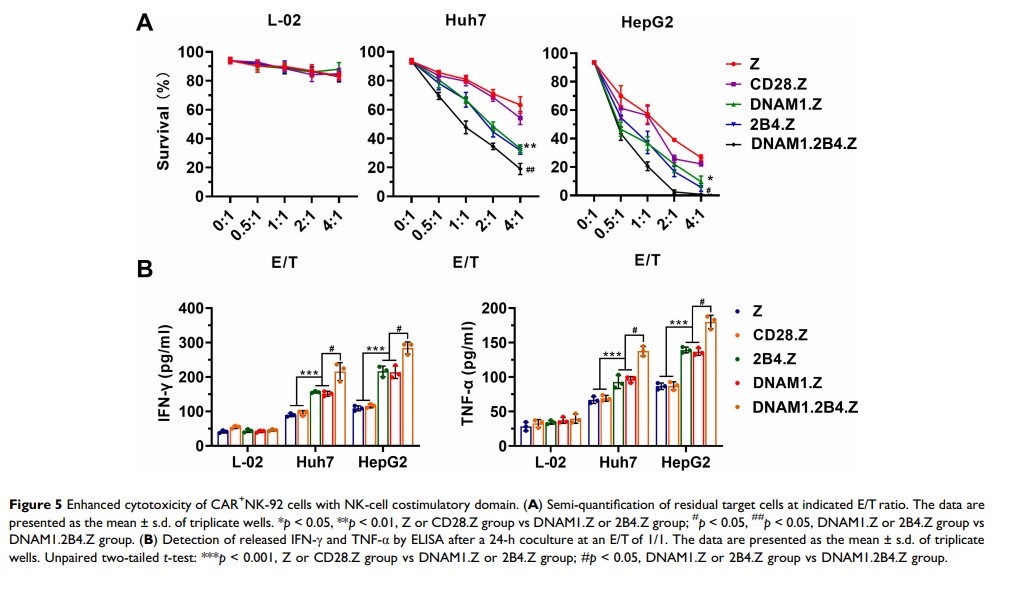
Methods: Five anti-GPC3 CAR plasmids containing different costimulatory domains were constructed. They included Z (only the CD3ζ domain, no costimulatory domain), CD28.Z (T-cell costimulatory domain CD28), DNAM1/2B4.Z (NK-cell-associated costimulatory domain DNAM1 or 2B4), and DNAM1.2B4.Z (both NK-cell-associated costimulatory domains). Respective CAR-NK-92 cells were generated. The MTT viability assay was performed to evaluate the effect of the different costimulatory domains on CAR-NK-cell proliferation. The effect on persistence was analyzed using an apoptosis assay and flow cytometry. Special cytotoxicity against normal hepatocellular cells and GPC3+ malignant cells was investigated in vitro. The concentration of cytokines (TNF-α and IFN-γ) released by CAR-NK-92 cells was also measured by ELISA.
Results: NK-cell-associated costimulatory signal was necessary for CAR-NK-92 cells. CAR-NK-92 cells with DNAM1 and/or 2B4 expanded more quickly and persisted with a lower apoptotic ratio, compared to the presence of CD28 or no costimulatory signal. All CAR-NK-92 cells showed special cellular cytotoxicity in vitro. CAR-NK-92 cells with NK-cell-associated costimulatory domains exhibited higher cytotoxic ability compared with those without any costimulatory domain or with T-cell costimulatory domain. CAR-NK-92 cells with both DNAM1 and 2B4 displayed the highest cytotoxicity. The cytokine release assay results were consistent with those of the cytotoxicity assay.
Conclusion: We provided the first evidence supporting a strategy using DNAM1 and 2B4 costimulatory domains to generate anti-GPC3 CAR-NK-92 cells, which exhibits enhanced cytotoxicity against hepatocellular cancer cells in vitro.
Keywords: HCC, CAR-NK, DNAM1, 2B4, proliferation, apoptosis, cytotoxicity